
Solo Brands’ Financial Strain Persists: Liquidity Strength vs. Unproven Business Model
Solo Brands, Inc. continues to operate with a reported liquidity position, but persistent net losses and a lack of operational visibility raise fundamental questions about the company’s underlying business model and long-term viability.
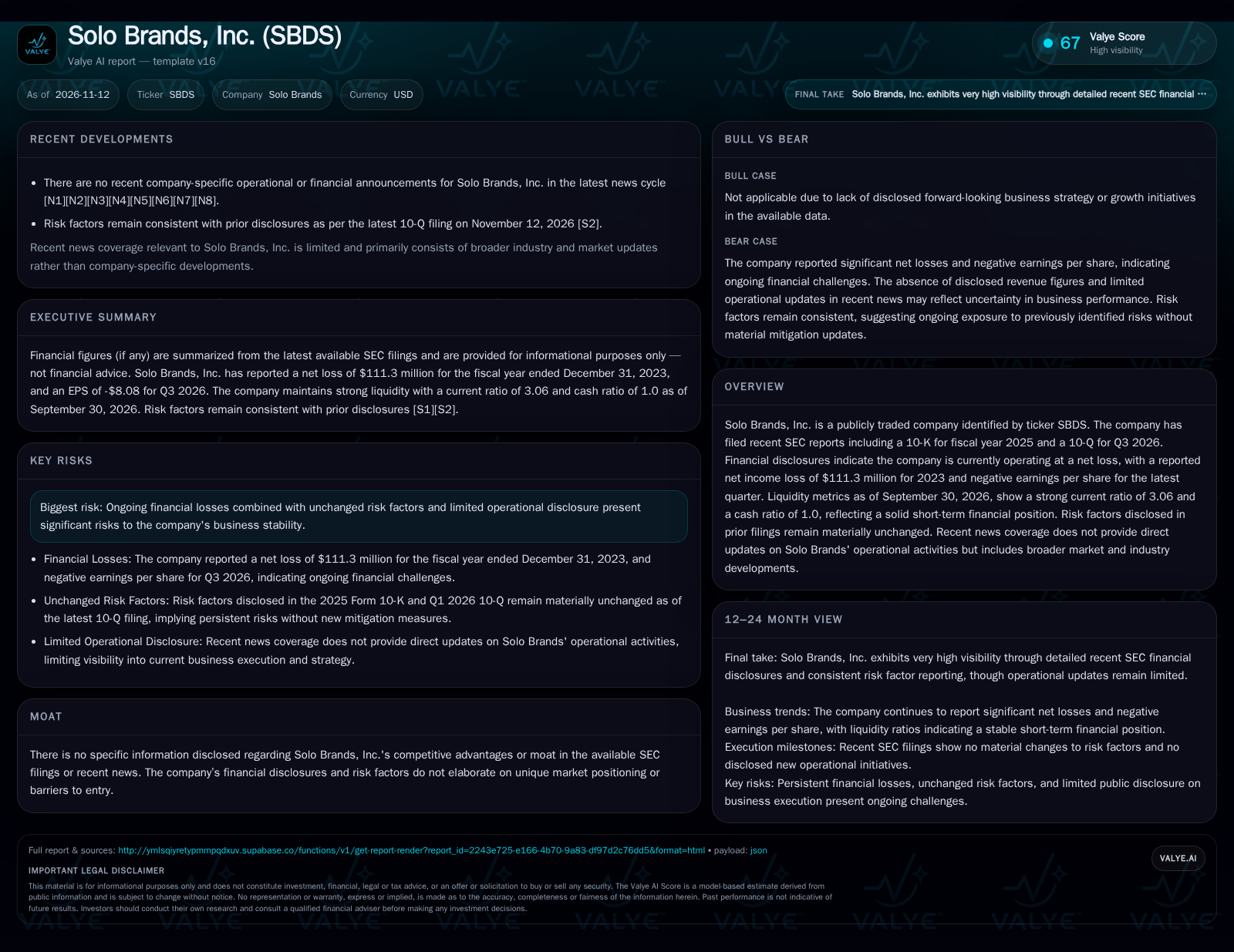
Solo Brands, Inc. (SBDS) reports ongoing financial losses, with a net loss of $111.3 million in 2023 and negative EPS of -$8.08 for Q3 2026. The company’s current ratio of 3.06 and cash ratio of 1.0 as of September 30, 2026, indicate short-term liquidity is not an immediate concern. However, unchanged risk disclosures and a lack of new operational detail leave investors with little insight into how or if Solo Brands can reverse its trajectory. The central question: does a reported balance sheet position merely buy time, or is there a path to sustainable profitability? [S1] [S2]
Solo Brands, Inc. finds itself at a crossroads: the company’s latest filings reveal a business with a reported liquidity position cushion but ongoing, material operating losses and no fresh guidance on how management intends to reverse its fortunes. For investors, the central issue is whether time and cash reserves can be converted into a credible turnaround—or whether they simply delay an inevitable reckoning.
Persistent Losses and Liquidity Snapshot Define the Current State
Solo Brands, Inc. reported a net loss of $111.3 million for the year ended December 31, 2023, and posted a negative basic and diluted earnings per share (EPS) of -$8.08 for the third quarter of 2026 [S1] [S2]. Despite these losses, the company’s balance sheet as of September 30, 2026, shows $40.2 million in cash and cash equivalents, current assets of $122.9 million, and current liabilities of $40.1 million. This results in a current ratio of 3.06 and a cash ratio of 1.0, reflecting reported liquidity position [S2]. However, the most recent filings disclose no material changes to risk factors and provide no new operational or strategic updates. The lack of direct news coverage about company initiatives or performance further clouds visibility, leaving the investment narrative dominated by persistent losses and balance-sheet strength rather than clear business progress.
Economic Model: reported cash balance vs. Unproven Path to Profitability
Solo Brands’ current financial disclosures do not provide detail on revenue composition, gross margins, or segment performance, making it difficult to assess the economics of its core business. The company’s persistent net losses suggest that, as presently structured, operating expenses and/or cost of goods sold are not being offset by sufficient top-line performance. This raises questions about whether the business is burdened by high fixed costs (such as manufacturing, marketing, or SG&A) or suffering from weak pricing power and low volumes.
The company reported cash and liquidity metrics for the period; these figures do not by themselves establish operating runway, investment capacity, financial flexibility, or financing capacity. However, absent a turnaround in underlying unit economics or a shift to a more scalable or higher-margin business model, cash burn will eventually erode this cushion. Without evidence of operating leverage or a structural shift in the cost/revenue mix, Solo Brands’ current economics appear unsustainable over the long run.
The lack of new operational disclosures leaves open the question of whether Solo Brands is pursuing cost rationalization, margin expansion, or new product introductions to drive a reversal. If the company’s model is reliant on physical goods, as the name and sectoral history might suggest, capital intensity and working capital needs could further strain profitability, especially in a competitive or commoditized market.
Opaque Market Presence Raises Competitive Uncertainty
With no recent operational updates or market-share disclosures, Solo Brands’ current competitive position is unclear. Durable business knowledge suggests that consumer goods companies—if Solo Brands is indeed operating in this space—face significant competition from both established players and private-label or direct-to-consumer upstarts. Absent evidence of differentiated products, brand loyalty, or a compelling value proposition, such companies often struggle to sustain pricing power or defend against substitution.
The absence of moat commentary or unique strategic assets in the latest filings suggests that Solo Brands may not enjoy significant barriers to entry or network effects. If the business is reliant on brand recognition or community engagement, the lack of current marketing or engagement metrics is notable. In a market environment where consumer preferences evolve rapidly and distribution channels are increasingly digital, an undifferentiated offering could quickly erode, especially if cost structure remains high.
Turnaround Potential: What Would Signal a Reversal in Fortunes?
The most favorable scenario for Solo Brands would involve a credible turnaround in core business performance, driven by either successful new product launches, a shift to higher-margin offerings, or significant cost reductions. For this to materialize, future disclosures would need to show a narrowing of net losses, stabilization or growth in revenue, and improving gross and operating margins.
Confirmation of such a scenario would likely come through management commentary on strategic initiatives, evidence of new customer acquisition or retention, and concrete data on margin expansion. Disclosure of operational KPIs—such as unit economics, customer lifetime value, or channel growth—would help validate claims of a recovery. Conversely, continued absence of such detail or persistent deep losses would falsify the turnaround thesis.
Stalled Progress: Cash Buys Time, but Not Traction
In the most plausible scenario based on current disclosures, Solo Brands continues to operate at a loss while relying on its liquidity cushion to meet short-term obligations. Without new operational initiatives or visible progress in cost containment and revenue generation, the business likely remains in a holding pattern—neither collapsing nor demonstrating a path to profitability.
Evidence supporting this view would include continued reporting of losses with little change in risk disclosures or strategic commentary. A stable, but slowly declining, cash position would further confirm that the company is spending to maintain operations but not investing in transformative growth. The lack of new product announcements, partnerships, or market expansion efforts would reinforce the sense of stasis.
Cash Burn Accelerates Without Business Model Reform
The adverse scenario is one in which Solo Brands’ cash reserves are rapidly depleted due to unaddressed operating losses and no improvement in core business fundamentals. If fixed costs remain high and revenue fails to rebound, the company could face a liquidity crunch within several quarters, forcing dilutive capital raises, asset sales, or even restructuring.
This scenario would be confirmed by accelerating cash outflows, a declining current ratio, and mounting net losses without offsetting operational progress. Any indications of supplier or customer attrition, shrinking gross margins, or negative working capital trends would further reinforce the risk. In this case, the liquidity cushion does not provide a bridge to sustainability, but merely delays more severe financial distress.
What Could Change the Story for Solo Brands
Disclosure of revenue trends, gross margin, and segment performance—if provided—would clarify whether the business has stabilizing or worsening fundamentals.
Updates on new product launches, channel partnerships, or strategic pivots would help determine if management is actively seeking to reverse losses.
Any commentary on cost-cutting initiatives, restructuring efforts, or SG&A reductions would be critical in assessing the potential for improved operating leverage.
Evidence of customer growth, retention, or repeat purchase rates—if disclosed—would shed light on brand strength and future revenue visibility.
Disclosure of capital allocation priorities, such as R&D, marketing, or M&A, would help evaluate management’s conviction in investing for growth versus preserving cash.
Changes in risk factor language or the addition of new risk disclosures in future SEC filings could indicate shifting business conditions or emerging challenges.
A useful metric would be management’s guidance or commentary on the expected timing of breakeven or return to profitability, if disclosed.
Disclaimer: This is research-only, informational analysis and not investment advice. It may include AI-generated interpretation and general industry context. Always verify important details using primary sources.

Comments