
Comscore Streamlines Focus After Movies Divestiture Amid Liquidity and Market Pressures
Second-quarter results highlight operational shifts, ongoing losses, and the critical need for liquidity management in a highly regulated media measurement landscape.
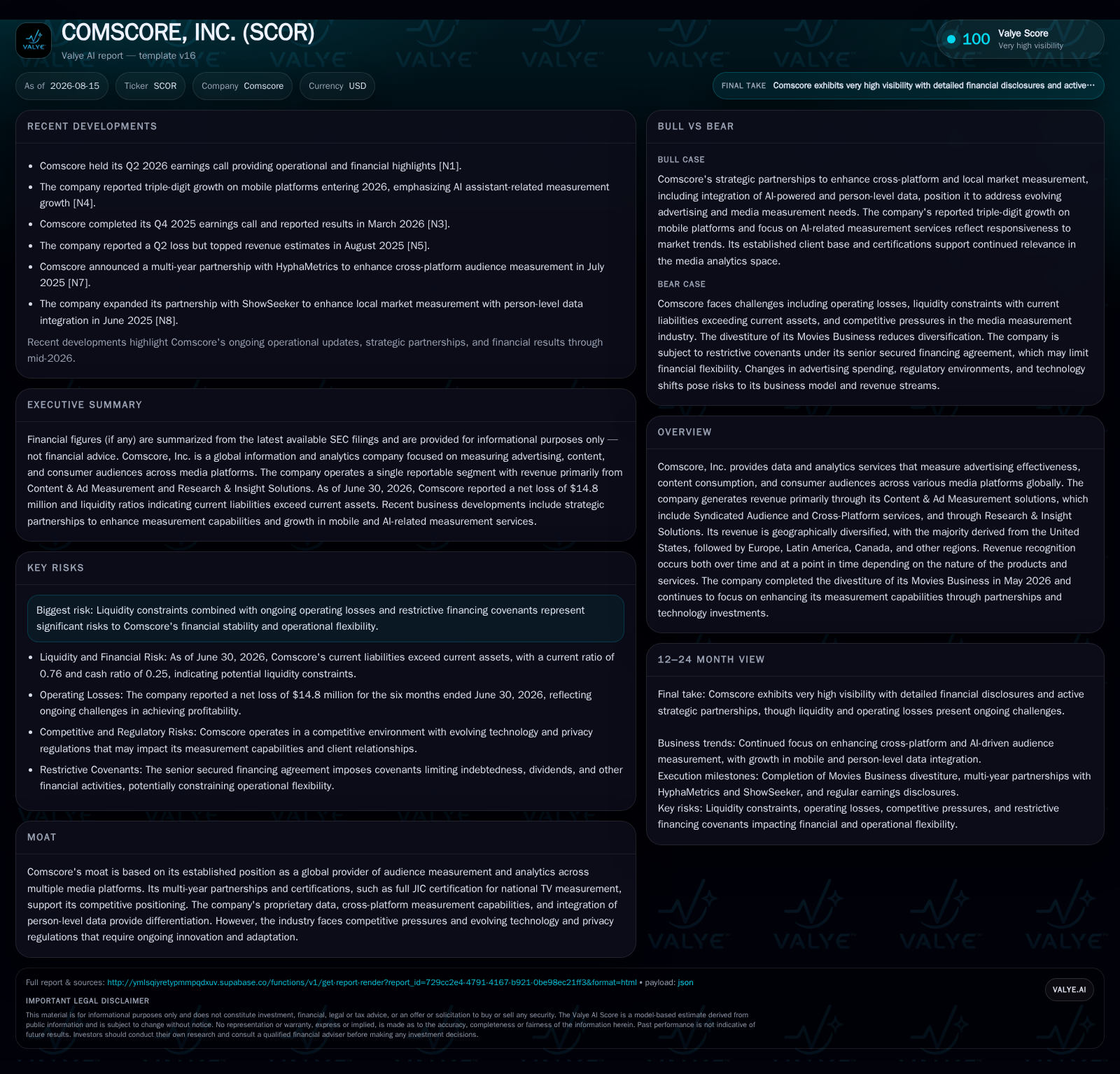
Comscore’s latest quarterly filing reveals a strategic pivot following the May 2026 divestiture of its Movies Business, underscoring an intensified focus on core Content & Ad Measurement and Research & Insight solutions. The company remains challenged by declining revenues and persistent operating losses, partly due to market headwinds and evolving privacy regulations affecting data collection methodologies. Liquidity constraints and restrictive debt covenants compound operational risks, necessitating continued cost discipline and technology investment to maintain competitive cross-platform analytics capabilities. Comscore’s unique multi-year partnerships and JIC certifications provide some moat protection in an industry adapting rapidly to digital shift and privacy compliance.
Recent Operating Update Highlights
An important near-term development was the amendment to the Stockholders Agreement that reduced the special dividend threshold associated with Series B Preferred Stock by about $32.8 million plus prior dividends paid — lowering it effectively to around $47.0 million [S2]. This adjustment signals tighter restrictions on capital returns due to preferred stockholders' rights, reinforcing liquidity retention needs.
The company’s liquidity position appears strained with a current ratio under 1 at 0.76 (current assets approximately $87.8 million against current liabilities of $115.2 million) as of June 30, 2026 [F1], while net debt stands near $19.3 million after subtracting cash equivalents ($25.7 million) from total debt of $45.0 million as of March-end [F1][S2]. These figures illustrate limited financial flexibility during ongoing losses.
Business Model Specificity
Comscore operates principally as a global audience measurement and analytics provider bridging media content owners—such as broadcasters and publishers—and advertisers seeking precise insights into consumer behavior across multiple platforms including TV, digital streaming, mobile apps, and emerging media formats. Its revenue is chiefly derived from licensing syndicated audience data under multi-year contracts alongside customized research solutions tailored for clients’ strategic marketing decisions [S1]. This diverse revenue mix is monetized primarily through subscription-based licenses granting continuous access to real-time or periodic measurement datasets plus project-based consulting fees.
Critical to Comscore’s model is its proprietary database integrating person-level data sources enabling granular cross-platform analytics addressing client demands for comprehensive advertising effectiveness metrics and media attribution insights. The firm emphasizes certifications such as JIC (Joint Industry Committee) full accreditation for national TV measurement which underpins industry trust in its methodologies—a notable moat given advertisers’ reliance on certified viewership metrics.
Revenue recognition follows both over time (for ongoing platform subscriptions) and point-in-time methods depending on service type; hence billings cadence relies heavily on contractual terms impacting cash flow profiles [S1][S2]. Operational KPIs closely watched include client retention rates—indicating subscription stability—and breadth of syndicated subscriptions spanning geographies.
Industry Structure and Competitive Positioning
The media measurement space is characterized by entrenched competitors like Nielsen and Kantar offering analogous cross-media audience measurement solutions globally; digital analytics providers such as DoubleVerify add pressure particularly on verification of programmatic ad spends. Differentiating factors include scale of data coverage across platforms/geographies, accuracy validated by certifications (e.g., JIC), robustness of proprietary integrations (person-level linked data), technology platform reliability, compliance with evolving privacy regimes (GDPR/CCPA-era constraints), and strength of long-term customer relationships.
Comscore's proprietary data pools combined with its certified TV ratings remain competitive advantages but require constant technological reinvestment to keep pace with real-time digital tracking demands heightened by AI-powered marketing strategies. The recent divestiture signals focus effort on core competencies rather than diversified unit management.
Growth Drivers
Underlying market trends support structural demand growth in sophisticated audience measurement:
- Digital ad budgets are steadily reallocating from traditional media driving increased need for granular cross-screen consumer insights.
- Programmatic advertising expansion fuels appetite for real-time verification tools that combine media attribution with audience demographics.
- Advances in artificial intelligence/machine learning offer enhanced analytics capabilities enabling predictive consumer behavior modeling.
- Expanding partnerships with technology platforms broaden raw data source access enhancing accuracy/scalability.
- Regulatory-driven emphasis on privacy compliance spurs demand for compliant measurement solutions capable of anonymization without quality loss.
- Emerging markets present untapped potential for extended geographic coverage beyond traditional US/Europe-centric domains.
- Marketers’ increasing adoption of data-driven strategies enhances recurring revenue visibility through multi-year licensing agreements.
These growth vectors are contingent upon Comscore maintaining competitive platform uptime/scalability, agile product innovation addressing regulatory shifts, maintaining certification statuses, expanding client acquisition rate while preserving retention stability—all critical KPIs internally implied but not enumerated explicitly in recent filings.
Risks and Growth Constraints
Significant risks temper the growth narrative:
- Privacy regulations continuously evolve potentially restricting third-party cookie replacements or limiting person-level data aggregation impacting measurement completeness/accuracy.
- Technological disruption remains high requiring ongoing capital allocation into software engineering R&D before payback horizons are visible.
- Client concentration risks exist due to dependence on major advertisers/media conglomerates whose budget cuts driven by macroeconomic slowdowns could depress demand dramatically.
- Macro environment uncertainty affects overall advertising expenditure generally considered cyclical yet trending increasingly digital centricly contentious with platform shifts.
- The company faces liquidity pressures exacerbated by sizeable operating losses coupled with restrictive financing covenants limiting deleveraging flexibility or dividend distributions [S2][F1].
- Accuracy challenges in multi-platform measurement introduce margin of error risk possibly impacting client trust if not effectively managed via certifications/integrations.
- Dependency on certain strategic partnerships exposes vulnerability should terms change or new entrants secure exclusive deals siphoning key customers away.
- Litigation or increased regulatory scrutiny related to privacy or competition could emerge given sector sensitivity.
- Market fragmentation driven by low-entry-cost cloud-based analytic startups may erode share over time absent scaling advantages.
Management commentary during earnings calls offers useful qualitative context on all above fronts including macro environment impacts witnessed among customer verticals such as retail vs entertainment sectors often detailed in analyst discussions post-quarter earnings release [N1].
Financial Profile Discussion
Operating expenses summed selling & marketing ($14.8 million), research & development ($7.2 million), plus general & administrative ($15.0 million), marking modest declines but still outpacing revenue movement leading to persistent operating losses during the period [F1][S2]. Cash and equivalents totaled approximately $25.7 million as of June 30, 2026, while total debt was about $45.0 million as of March 31, 2026, resulting in net debt near $19.3 million [F1][S2]. The current ratio stood at 0.76x as of June 30, 2026, reflecting current liabilities exceeding current assets and indicating working capital deficits requiring careful short-term cash management [F1].
The company’s debt is dominated by senior secured term loans maturing initially in late 2028 [S2]. Recent amendments to the Stockholders Agreement and preferred stock terms have lowered the special dividend threshold to approximately $47.0 million, restricting dividend distributions and equity return capacity for the foreseeable future
Overall gross margin contraction combined with smaller scale post-sale highlights critical need for operational efficiency gains supported by technology investments aimed at sustaining long-term subscriber retention momentum as core profitability drivers moving forward within the capital-intensive SaaS-like revenue model typical in media measurement field where recurring contract stability dictates valuation premium expectations.
This analysis synthesizes publicly filed quarterly financial disclosures supplemented by industry context relevant to Comscore’s operational environment within Media Measurement and Analytics sector as of August 2026. It highlights key dynamics shaping the company’s prospects without offering investment research views or forecasts.
Disclaimer: This is research-only, informational analysis and not investment advice. It may include AI-generated interpretation and general industry context. Always verify important details using primary sources.

Comments