
Helix Acquisition Corp. III's Sponsor Strategy and Redemption Dynamics in Healthcare SPACs
Helix Acquisition Corp. III maintains robust liquidity and an experienced healthcare-focused sponsor team as it pursues its initial business combination amid shareholder redemption risks.
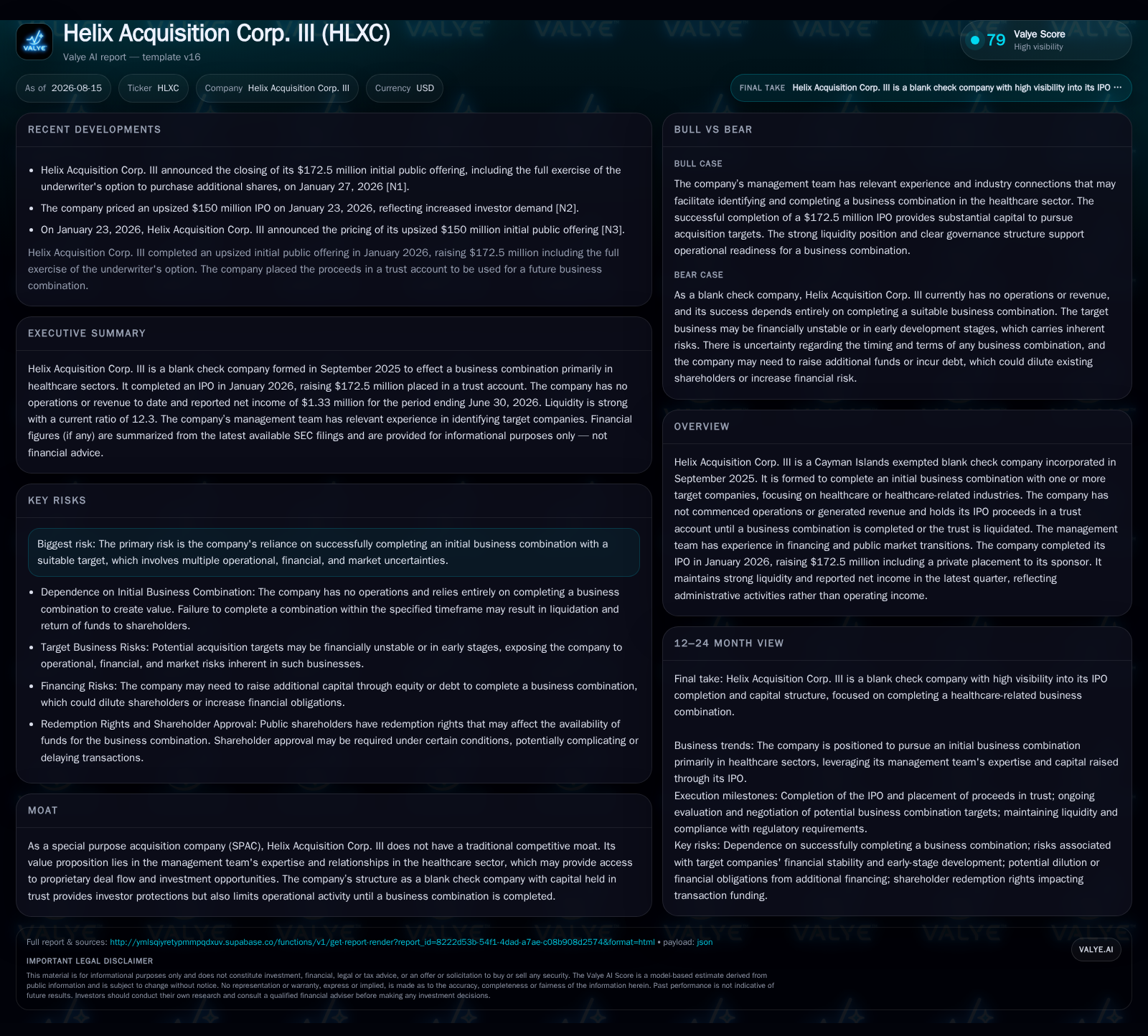
Helix Acquisition Corp. III, a blank check company launched in January 2026 with $172.5 million gross proceeds, remains in an early search phase holding capital primarily in trust. Its latest quarterly filing confirms minimal operating expenses and stable liquidity, positioning it to pursue de-SPAC transactions in the competitive healthcare sector. Key near-term challenges include navigating shareholder redemption rights that may reduce acquisition capital and balancing sponsor equity incentives against dilution risks. The company’s sponsor experience and sector focus provide potential edge in deal sourcing within a crowded SPAC market.
Quarterly Update Validates Liquidity Stability Amid Early Operating Phase
Helix Acquisition Corp. III’s latest quarterly report filed August 14, 2026 confirms it operates strictly as a blank check company without operational revenues or commercial activities beyond administrative functions typical for SPACs prior to combination [S2]. The reported net loss is modest and solely reflects administrative expenses such as legal and accounting fees necessary for compliance and maintenance [F1]. This disciplined cost structure supports capital preservation during the ongoing search phase.
The balance sheet reveals approximately $2.36 million in current assets against $192,000 in current liabilities as of June 30, 2026, resulting in a robust current ratio of about 12.3 — indicative of very low short-term obligations relative to liquid resources [F1]. Capital is predominantly held in trust accounts funded by the IPO proceeds, ensuring investor protection by restricting premature use until an initial business combination is completed or liquidation occurs [S1]. This financial conservatism is standard among SPACs given their typical operational runway constraints of 18 to 24 months.
SPAC Business Model Fundamentals: Capital Waiting for Healthcare Deals
Helix’s business model centers on raising capital through an IPO designed exclusively to fund a future merger or acquisition within the healthcare sector. The company completed its IPO in January 2026 generating gross proceeds of approximately $172.25 million by selling Class A ordinary shares at $10 per share including the full exercise of the underwriters’ over-allotment option [S1]. Concurrently, the sponsor invested nearly $5 million via a private placement at the same share price, aligning sponsor commitment with public investors.
Founder shares held by the sponsor constitute roughly one quarter of total issued shares post-IPO after adjustments removing forfeiture risk related to over-allotment options [S1]. These founder shares are illiquid until after de-SPAC completion but participate fully in any shareholder votes on proposed combinations. This structure aligns management’s financial interests with successful deal execution while creating dilution considerations for new investors.
Funds held in trust provide a safeguard ensuring capital is preserved pending deal consummation or returned upon failure to complete a qualifying transaction within regulatory deadlines [S1]. Consequently, Helix generates no revenue or operating cash flow until after completing an initial business combination.
Sponsor Structure and Founder Shares: Alignment or Dilution Risk?
The sponsor’s founder shares representing about 25% of total equity align incentives by granting management potential improvement only realized upon successful de-SPAC closure [S1]. However, these shares effectively represent equity issued at nominal cost which dilutes public shareholders’ ownership percentages upon completion.
The simultaneous private placement further increases sponsor exposure while subjecting those shares to transfer restrictions until after combination closing [S1]. Such dual-layered equity stakes reinforce alignment but require credible deal pipelines and governance discipline to justify dilution effects versus public investor returns.
This dynamic highlights a common tension among SPACs where significant founder holdings must be balanced against shareholder dilution concerns and redemption-related funding variability.
Competitive Landscape: Sourcing Healthcare Targets in a Crowded SPAC Field
Targeting attractive healthcare companies faces intense competition from other SPACs specializing in similar sectors as well as well-funded private equity groups and strategic acquirers seeking synergistic investments [S1]. Many competitors have greater financial resources or longer operating histories enhancing their bidding power.
Helix’s competitive advantage lies largely in its sponsor’s sector expertise and industry relationships led by Chairperson and CEO Bihua Chen who manages the sponsoring entity Helix Holdings III LLC [S1]. Access to proprietary deal flow through established networks could differentiate Helix amid competing bidders for scarce high-quality targets.
Absent specific disclosures on pipeline activity or competing bids this remains an overarching challenge rather than immediate value inflection but underscores the importance of experienced leadership in this space.
Growth Opportunity Drivers: Sponsor Expertise and Market Demand for Healthcare Platforms
Investor appetite for SPAC vehicles continues driven by demand from innovative private healthcare firms seeking faster and more flexible public market access than traditional IPOs afford. Helix benefits from this macro trend amplified by secular growth in digital health technologies and biotech breakthroughs.
The sponsor’s deep sector knowledge positions it well to identify emerging companies requiring growth capital and liquidity solutions tailored to evolving market niches. Availability of PIPE financing post-announcement provides additional capital sources supplementing IPO proceeds which helps address funding gaps caused by shareholder redemptions common among healthcare-targeting SPACs.
Successful precedent de-SPAC transactions within healthcare validate this approach although individual deal economics will ultimately dictate investment returns.
Key Risks in Deal Execution: Redemption Rights, Time Constraints, and Market Sentiment
A critical execution risk arises from public shareholders’ redemption rights allowing them to redeem shares before transaction closing thereby reducing acquisition capital available from trust funds [S1]. High redemption rates constrain valuation flexibility forcing sponsors either to increase personal capital contributions or scale down deal size.
HLXC also faces regulatory time limits typically requiring completion of an initial business combination within 18–24 months or face liquidation [S1]. Delays due to valuation disagreements or extended due diligence heighten risk especially amid volatile market sentiment around healthcare SPAC deals influenced by regulatory scrutiny or macroeconomic headwinds.
Governance risk exists as founders have committed votes that may approve combinations regardless of majority public shareholder dissent — an arrangement attracting regulatory attention focused on fairness protections [S1].
What to Watch: Milestones Signaling Move Toward Initial Business Combination
Investors should monitor announcements identifying candidate target companies along with preliminary transaction terms disclosed publicly. Scheduling of shareholder votes represents key decision points alongside efforts to secure PIPE financing which often bridges shortfalls caused by redemptions.
Additional indicators include updates on deferred underwriting commissions payable upon deal closure impacting net merger proceeds available for reinvestment.
These milestones mark transition from capital preservation into active deal execution where risk-reward profiles become clearer.
Financial Profile Discussion: Cash Trust Strength Sustains Search Phase
From a financial perspective, Helix maintains solid liquidity supporting continued search activities [F1]. As of June 30, 2026 current assets stand near $2.36 million against liabilities under $200 thousand yielding a high current ratio around 12.3 reflecting minimal operational burdens
Net losses remain modest (-$51K) driven entirely by routine administrative expenditures consistent with expectations for pre-combination blank check companies lacking revenue streams but incurring compliance costs [F1]
No debt or contingent liabilities have been reported enhancing confidence that financial flexibility remains intact during this nascent stage prior to executing complex de-SPAC transactions.
Preserving trust account integrity is paramount as these funds underpin investor protections ensuring eventual merger counterparties receive sufficient cash consideration without premature depletion caused by redemptions.
This analysis synthesizes insights from Helix Acquisition Corp. III’s SEC filings through August 2026 combined with broader industry context on healthcare-focused special purpose acquisition companies (SPACs). It avoids speculation on undisclosed targets while elucidating structural economics influencing intrinsic value creation prospects.
Disclaimer: This is research-only, informational analysis and not investment advice. It may include AI-generated interpretation and general industry context. Always verify important details using primary sources.

Comments