
HealthLynked Corp’s Shift to a Tech-Driven Healthcare Ecosystem Amid Financial Strains
HealthLynked prioritizes its digital healthcare platform and virtual medical supply distribution while managing mounting liquidity challenges.
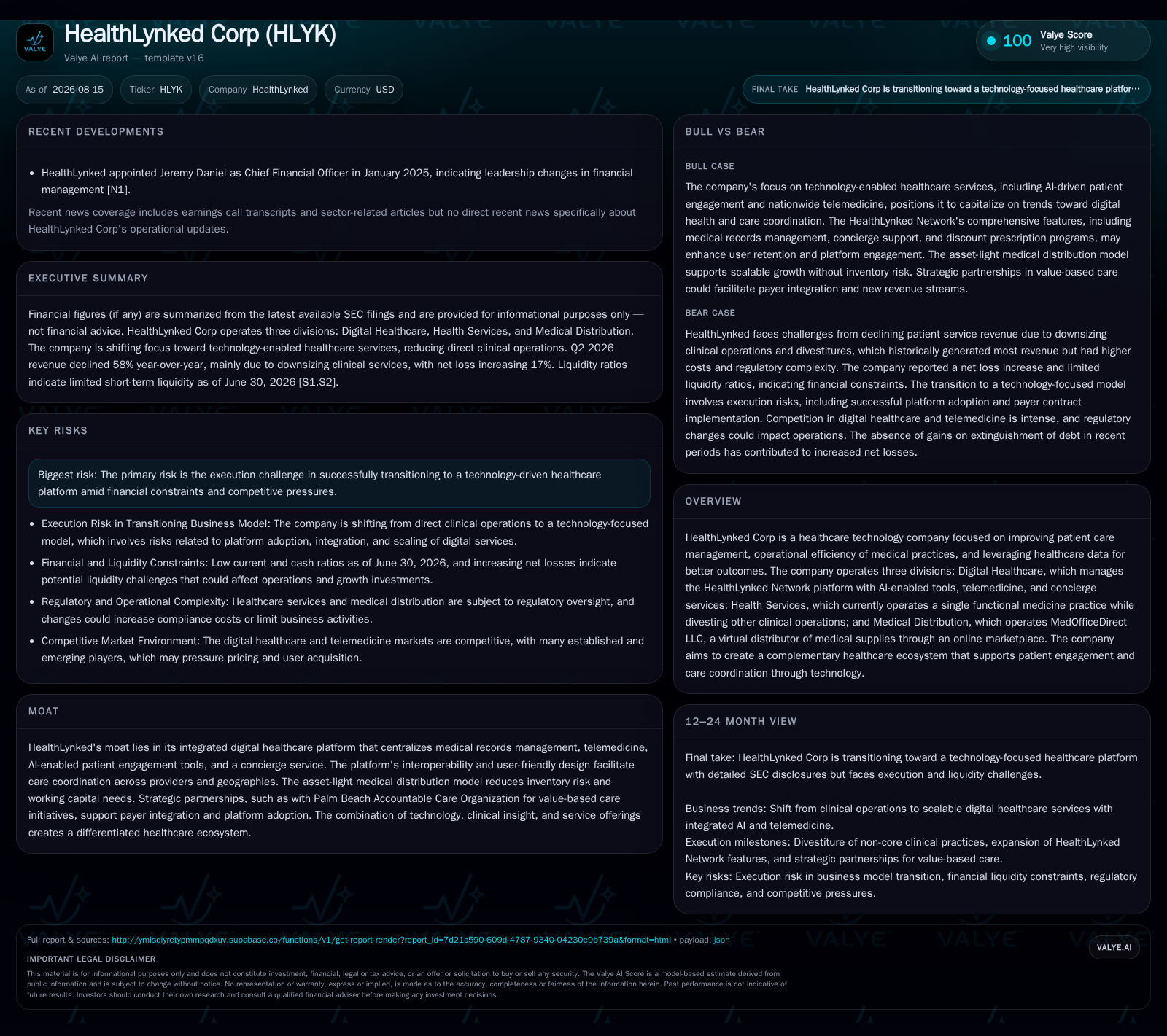
In its latest quarterly report, HealthLynked Corp accelerated its strategic pivot from legacy clinical operations toward an integrated digital healthcare ecosystem comprising telemedicine, AI-enabled patient engagement, and virtual medical supply distribution [S2]. This shift intends to capitalize on growing demand for scalable healthcare technology solutions but is tempered by acute liquidity constraints reflected in a working capital deficit and minimal cash reserves [F1]. The company’s triadic business model balances recurring subscription revenues and telehealth service fees with asset-light distribution margins, though financial sustainability remains a key execution risk. Monitoring platform adoption metrics and partnership traction will be critical to validating the strategic realignment amid tightening financial headwinds.
Q2 Operating Shifts Highlight Accelerated Platform Focus during Cost Rationalization
HealthLynked’s August 2026 quarterly filing reveals meaningful organizational changes that spotlight the company's intent to sharpen its focus on scalable technology offerings during tight financial resources. The recent departure of COO Duncan McGillivray, with his role eliminated by July 24, 2026 as part of management's effort to optimize executive leadership aligned with operational priorities and budget constraints, underscores a leaner management approach focused on cost control [S3]. Concurrently, HealthLynked completed the divestiture of its BTG clinical practice in October 2025 to reduce regulatory complexity and overhead burdens associated with direct clinical operations [S2]. This move aligns with the company's broader strategy articulated in the recent annual report to transition away from labor-intensive health services toward expanding its Digital Healthcare platform to improve operating leverage and profitability [S1]. These shifts collectively position HealthLynked toward emphasizing software-enabled medical record management, telemedicine services, and AI-driven patient engagement functionalities as pillars for future growth.
Deconstructing HealthLynked’s Business Triad: From Clinic Floors to Virtual Marketplaces
HealthLynked operates through three core divisions presenting contrasting economic profiles. The Digital Healthcare division centers on the HealthLynked Network—a cloud-based platform offering consolidated electronic health records (EHR) management coupled with telemedicine appointment scheduling, concierge services, and AI-powered decision support tools that enhance care coordination across providers and patients [S1]. Revenue emanates primarily from subscription fees paid by providers or patients (via premium Concierge memberships), alongside transactional service fees tied to telehealth consultations. This subscription-plus-transaction revenue model bears close resemblance in monetization mechanics to peers like Teladoc Health but with an integrated digital infrastructure including AI engagement features.
In contrast, the Health Services division now comprises only a single functional medicine practice (under the NCFM brand) after divesting other clinical operations. Historically responsible for the majority of company revenue, this segment exhibits higher operating costs and regulatory burden that compress margins—reasons cited by management for deemphasizing this unit as a growth driver while retaining it mainly for clinical insight feeding back into platform development [S1], [S2]. The shift reduces capex intensity but leaves a constrained-margin operational footprint.
The Medical Distribution division operates MedOfficeDirect LLC (MOD), a virtual marketplace distributing medical supplies nationwide without inventory risks through partnerships with suppliers like NDC National Distribution [S1]. This asset-light model generates margins driven by sales volume minus fulfillment costs while minimizing working capital requirements—a model loosely comparable to McKesson’s supply chain platforms but at smaller scale. Though not currently core to growth projections, MOD complements the Digital Healthcare platform by enhancing user engagement via integrated supply offerings.
Healthcare Tech Competitive Terrain: Platform Adoption versus Legacy Clinical Drag
Within the rapidly evolving healthcare technology landscape characterized by increasing telemedicine adoption and demand for integrated care coordination platforms, HealthLynked confronts entrenched competition from larger entities such as Teladoc (telehealth services) and Cerner (EHR systems). Teladoc sets high bars for scaling telemedicine utilization volumes while confronting ongoing industry adoption frictions; Cerner exemplifies complex integration challenges fundamental to interoperability across provider networks. Against this backdrop, HealthLynked's integrated approach combining EHR management with AI-enabled patient engagement tools aims to differentiate through streamlined workflows and personalized care navigation support.
However, legacy clinical operations impose margin pressures absent in pure-play software models. Notably, U.S. healthcare regulations complicate data interoperability and elevate compliance costs—a challenge for any emergent platform provider but intensified here due to residual clinical service exposure. Further competitive pressure arises from established payer-provider relationships that can impede new digital entrants' network expansion unless supported by compelling value-based care initiatives.
Despite these hurdles, strategic partnerships—such as those with insurance carriers targeting per-member-per-month licensing—offer pathways toward scaling user bases enterprise-wide beyond direct-to-consumer efforts. This strategy reflects acknowledgment of payer integration as vital for network effect realization in healthcare IT ecosystems [S21].
Growth Vectors: Telemedicine Volume, AI Engagement, and Supply Chain Efficiency
HealthLynked's prospects hinge significantly on increasing active users within its Digital Healthcare platform coupled with escalating telemedicine consultation volumes—key KPIs that underpin subscription renewal rates and transactional fee accruals. Enhanced patient engagement facilitated by proprietary AI tools is designed to drive higher retention and adherence metrics analogous to chronic disease management solutions pioneered by firms like Livongo Health. These digital capabilities enable personalized care navigation without replacing licensed clinicians’ roles but amplify efficiency by supporting preventative care adherence.
Simultaneously, MedOfficeDirect contributes incremental non-labor intensive revenue streams through its virtual marketplace sales with gross margins favoring lower working capital intensity—a valuable diversification within a capital-constrained environment [S1],. Sustaining improvements in gross margin on supply sales while maintaining timely delivery standards will influence overall margin expansion.
Realizing scalable operating leverage depends on achieving meaningful volume inflection points across these vectors while continuing cost rationalization within Clinical Operations—the latter having already shrunk via targeted divestitures to a disciplined cost base reflecting better operating ratios than historical patterns suggest.
Fiscal Watchpoints: Balancing Investment Need Against Cash Squeeze Risks
Financial disclosures portray acute liquidity constraints amplifying execution risks for HealthLynked’s pivot strategy. With cash & equivalents totaling a scant $12,844 as of June 30, 2026 juxtaposed against current liabilities exceeding $8.8 million resulting in a stark current ratio of approximately 0.17, the company faces severe working capital shortfalls that jeopardize normal operating cycles absent immediate capital infusions [F1], [S2]. The accumulated deficit climbed above $53 million signaling prolonged operating losses sustained over multiple periods.
Cash burn persists at rates unsustainable without fresh funding; operating activities consumed approximately $572K over the first half of 2026 despite reported expense reductions relative to prior years [S14]. Management acknowledges prevailing going concern doubts citing dependency on raising incremental equity or convertible debt financing at terms unfavorable enough potentially dilutive or onerous in servicing costs [S1], [S2], [S26].
This financial profile parallels common challenges observed among smaller healthcare SaaS companies transitioning from service-heavy models towards technology-first platforms where upfront investments precede profitable scale attainment but require vigilant balancing of cash runway against milestone achievement.
Milestones Ahead: Platform Uptake Metrics, Partnership Expansion, and Cost Control
Key upcoming markers that will illuminate HealthLynked’s trajectory include sequential active user growth statistics on the HealthLynked Network—a direct indicator of consumer acceptance—as well as monthly telemedicine consultation counts signaling monetization ramp progress. Additionally, announcements concerning new or expanded enterprise agreements with insurance entities or employer groups would evidence successful payer channel penetration crucial for long-term sustainable growth outside high-cost direct acquisitions.
Continued execution in curtailing overhead expenses within Clinical Services remains important given this segment's legacy drag on margins despite being scaled down structurally. Operating expenses must continue trending down without sacrificing product development or sales capacity pivotal for platform expansion efforts.
Further integration milestones involving interoperability enhancements or onboarding improvements encouraging provider participation could enhance competitive positioning vis-à-vis established healthcare IT incumbents potentially accelerating network effects across stakeholders.
Financial Profile Discussion: Liquidity Challenges Amplify Execution Risks
Summarizing HealthLynked’s financial condition reveals an urgent liquidity crunch constraining operational flexibility. The juxtaposition of minimal cash reserves ($12.8K) against outsized current liabilities (~$8.9M) yields a razor-thin buffer inadmissible under conventional benchmarks for healthy SaaS enterprises which typically maintain multiple months’ coverage through liquid assets alone [F1]. Sustained negative cash flow from operating activities exceeding half a million dollars year-to-date exacerbates vulnerability especially given reliance on external financing sources subject to market receptivity uncertainties [S14], [S26].
Persistent accumulated deficits around $53 million indicate extended periods of unprofitability predicated largely on investments in technology platform development offset currently by contracting legacy clinical revenues [F1]. Accordingly, near-term financial viability is contingent upon executing fundraising initiatives successfully combined with accelerating scalable revenue streams from subscriptions and telehealth services [S1], [S2]. Failure to secure requisite funding or sluggish commercial traction could precipitate severe downsizing or restructuring options reducing strategic optionality considerably.
This analysis synthesizes publicly filed disclosures with sector-native insights relevant to understanding HealthLynked Corp's evolving business mix amid pronounced fiscal stress. It does not constitute investment advice.
Disclaimer: This is research-only, informational analysis and not investment advice. It may include AI-generated interpretation and general industry context. Always verify important details using primary sources.

Comments