
Fortress Biotech’s Strategic Subsidiary Model Drives Rare Disease Advances Amid Financing Constraints
Fortress Biotech leverages a diversified subsidiary portfolio to progress niche biopharma assets, balancing regulatory milestones and capital challenges.
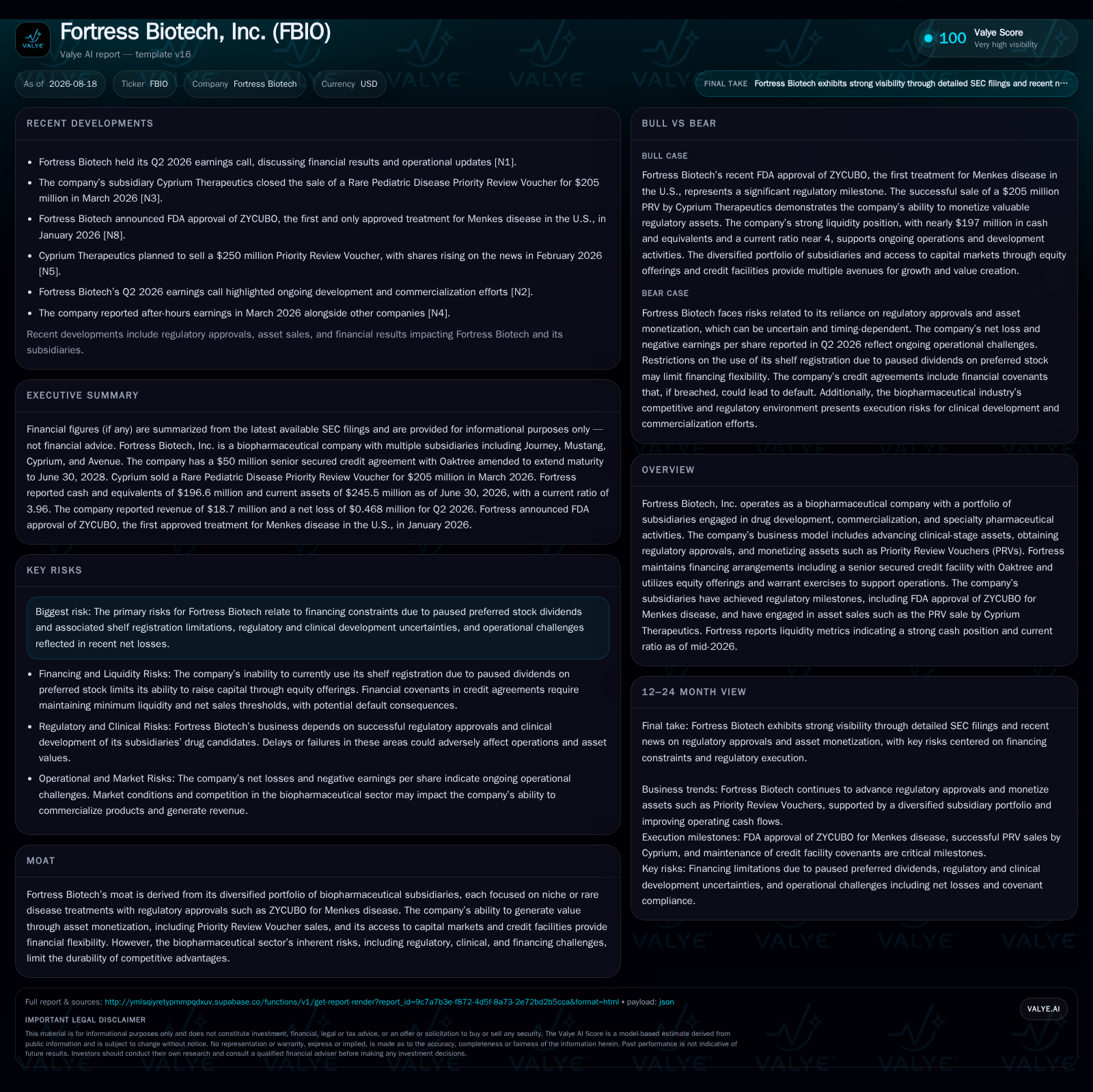
Fortress Biotech, Inc. operates through multiple subsidiaries specializing in rare disease drug development and commercialization, exemplified by FDA approval of ZYCUBO for Menkes disease. Recent quarterly filings reveal solid liquidity with $197 million in cash against $40 million of debt as of mid-2026, supported by asset monetization like the Priority Review Voucher sale by Cyprium Therapeutics. However, dividend suspensions on preferred stock have temporarily limited Fortress’s ability to use shelf registration for equity raises, impacting financing flexibility. The company’s growth hinges on continued regulatory progress across its portfolio and successful commercialization of approved therapies.
Recent Operating Update
Fortress Biotech’s latest quarterly filing for Q2 2026 outlines a continued focus on advancing its diversified portfolio of biopharmaceutical subsidiaries specialized predominantly in rare diseases and specialty pharmaceuticals [S2]. A significant recent milestone is the FDA approval of ZYCUBO for the ultra-rare Menkes disease indication under one of its subsidiaries [S1]. This approval underscores Fortress’s ability to shepherd difficult-to-develop assets through regulatory hurdles. Additionally, the monetization strategy through asset sales remains active; notably, Cyprium Therapeutics completed the sale of its Priority Review Voucher (PRV), yielding gross proceeds of $205 million [S13]. This transaction contributed directly to enhanced liquidity for Fortress.
However, financial filings also highlight structural constraints: the Board suspended dividends on Series A Preferred Stock starting July 2024 due to paused payments [S2]. This action immediately limited Fortress’s capacity to deploy at-the-market equity offerings under Form S-3 registration rules until dividend arrears are cleared at the next annual report filing. Thus, while Fortress retains a substantial $42.1 million under its 2024 Shelf registration, actual execution is curtailed until dividend compliance resumes [S2].
Business Model Analysis
Fortress Biotech operates primarily as a biopharmaceutical holding company underpinning multiple subsidiaries engaged across the value chain from early clinical development to product commercialization. Its revenue model combines conventional drug development milestones and royalties with active asset monetization strategies such as PRV sales—a valuable FDA regulatory incentive that can generate sizable non-dilutive capital infusions. The company typically funds operations through issuing equity or debt at parent or subsidiary levels while sharing costs and risks across entities.
Monetization mechanics depend heavily on achieving regulatory benchmarks that unlock milestone payments or provide marketing rights for commercial launches. Importantly, Fortress's subsidiaries may also engage in public equity raises—for instance, Journey has recently filed multiple S-3 shelf registrations enabling up to $150 million issuance capacity each year, along with active ATM programs [S2]. Nevertheless, these financing capabilities are contingent upon parent-level dividend policies that currently suspend access to simplified Form S-3 offerings.
Margins and cash conversion vary widely depending on product life cycle stage: early clinical-stage assets incur high R&D expense ratios without revenue; approved products like ZYCUBO or Journey's dermatology line contribute positive operating contributions but remain small relative to consolidated expenses. Cash burn management is thus critical, with Fortress leveraging warrant exercises and strategic partnerships alongside traditional financings.
Industry Structure and Competitive Position
The biopharmaceutical sector focuses intensely on novel indications with long development timelines and high attrition rates. Fortress differentiates itself as a biotech holding entity that spreads development risk across approximately a dozen specialty subsidiaries targeting rare or underserved indications—a strategy reflected in companies such as Roivant Sciences but distinguished by Fortress’s emphasis on monetizing regulatory incentives like PRVs.
Peers such as Amicus Therapeutics and Ultragenyx share the rare disease focus but tend to carry more advanced commercialization platforms internally rather than via subsidiary models. Specialty pharma firms frequently employ asset sales including PRVs for funding; Fortress’s Cyprium sale aligns with this prevalent capital strategy within niche biopharma.
Growth Drivers
Fortress's primary growth driver is the progression of clinical trial programs within its subsidiaries toward eventual regulatory approvals and commercial launches—the classic biopharma value creation pathway. Key catalysts include additional FDA approvals beyond ZYCUBO, expansion into other rare diseases supported by exclusive licenses (e.g., Avenue's ATX-04 license targeting lysosomal storage diseases) [S20], plus revenue ramp-up from existing marketed assets like Journey's dermatology portfolio.
Asset monetization remains an important secondary driver; the recent PRV sale injected capital, enabling better runway extension. Furthermore, strategic equity offerings at the subsidiary level (Journey initiated new ATM programs effective in 2025) signal ongoing capital accessibility supporting pipeline advancement [S2]
Milestone payments on licensed technologies—both achieved and anticipated—contribute incremental revenue components that may become meaningful if clinical successes materialize. Partnerships or licensing deals enabling third-party commercialization may also accelerate revenue growth outside direct sales efforts.
Risks and Growth Constraints
Key risks revolve around financing limitations posed by suspended preferred dividends which preclude using Form S-3 shelf offerings until resolved [S2]. This restriction could delay opportunistic equity raises essential for funding high-burn development projects spread across multiple subsidiaries. Competition in orphan drug spaces is intensifying globally—as regulatory incentives attract peer entrants—raising market risks around eventual pricing power or reimbursement.
Operational complexity managing diverse subsidiaries adds integration risks including cost control challenges or inconsistent governance practices across entities under the holding company umbrella. Managerial bandwidth may be stretched overseeing disparate therapeutic platforms requiring distinct expertise.
Finally, dilution risk arises from warrant exercises tied to credit agreements which can pressure share counts over time unless offset by sustained operational improvements supporting stock valuations [S11].
Addressing these points will clarify whether Fortress can sustain its multi-subsidiary model through typical sector cycles while continuing value creation via innovation and smart capital deployment.
Financial Profile Discussion
As of June 30, 2026, Fortress Biotech reported $196.6 million in cash and equivalents against total debt approximating $40 million [F1]. This generates an ample current ratio near 3.96x given current assets exceeded $245 million versus current liabilities around $62 million—a reflection of strong short-term liquidity buffers supportive of ongoing operations [F1].
While equity issuance ability at parent level currently pauses due to suspended dividend payouts affecting shelf registration eligibility [S2], subsidiary-level fundraising continues actively—most notably Journey's ATM offerings raising tens of millions annually—helping maintain aggregate financial health when combined with asset monetizations and warrant exercises embedded in loan agreements [S2][S17].
Conservatively managed cash reserves relative to debt position reflect prudent risk management common among biopharma holding companies balancing heavy R&D spending profiles against milestone-dependent revenues. However, sustaining this profile depends heavily on timely resolution of dividend-related restrictions affecting capital market access alongside steady pipeline advancement consistent with historically disclosed budgets.
Disclaimer: This analysis is based solely on publicly available information as cited. It does not constitute investment advice or research views but aims to provide an informed perspective grounded in observed operating facts.
Disclaimer: This is research-only, informational analysis and not investment advice. It may include AI-generated interpretation and general industry context. Always verify important details using primary sources.

Comments