
Air Water Ventures Ltd: Post-Business Combination Structural Overview and Disclosure Limitations
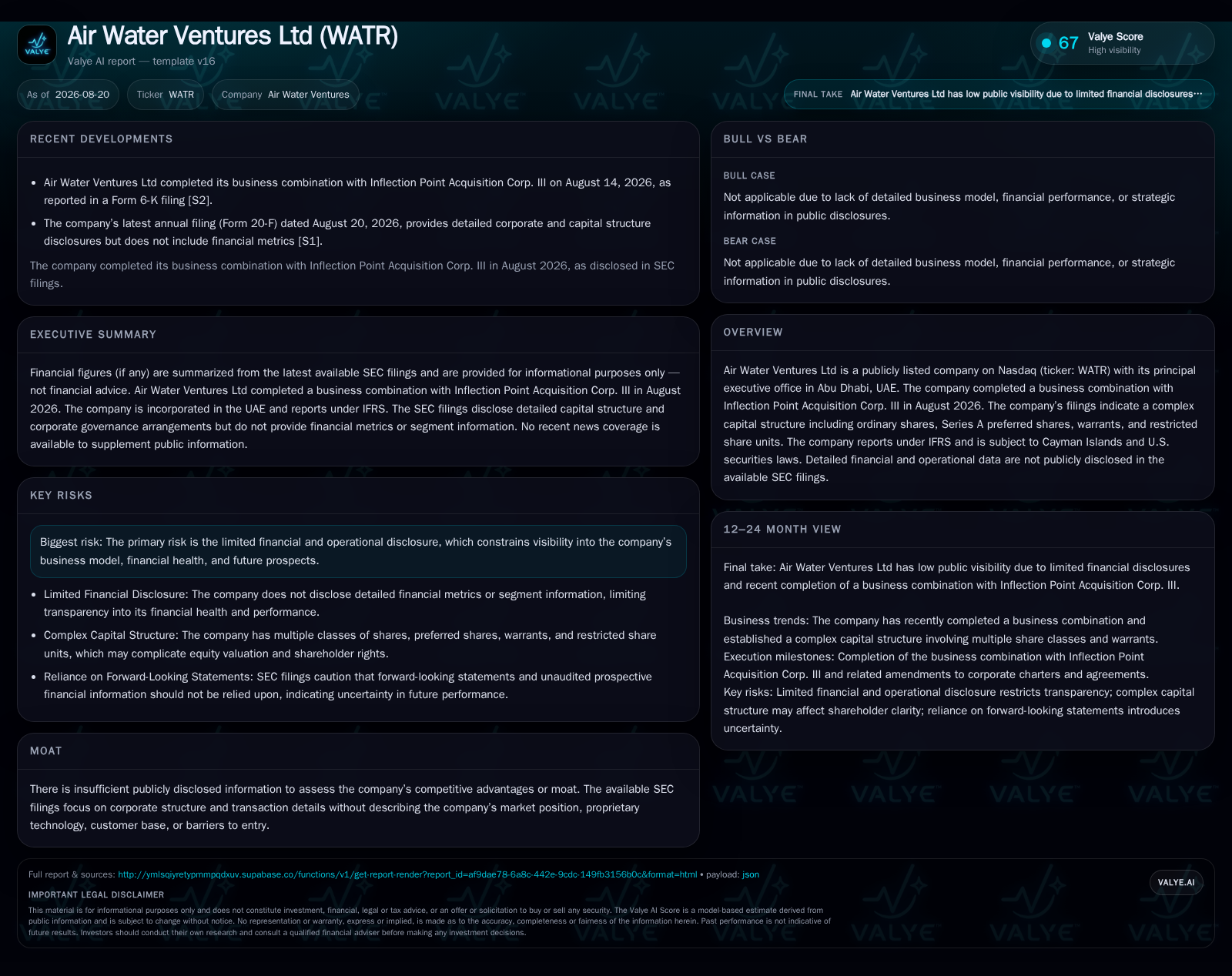
Air Water Ventures Ltd completed its business combination with Inflection Point Acquisition Corp. III in August 2026, establishing its public listing and capital structure amid limited operational disclosures.
Air Water Ventures Ltd finalized its merger with Inflection Point Acquisition Corp. III on August 14, 2026, marking its transition to a Nasdaq-listed entity. The company’s post-combination capital structure includes ordinary shares, multiple series of preferred shares, warrants, and restricted share units. However, current public filings provide minimal financial and operational details, restricting investor ability to evaluate its business model, financial health, and competitive positioning. Future disclosure improvements would enhance transparency, while continued opacity could sustain investor uncertainty.
Business Combination Completion and Capital Structure
Air Water Ventures Ltd completed its business combination with Inflection Point Acquisition Corp. III on August 14, 2026, officially becoming a Nasdaq-listed public company [S3]. This transaction represents a significant structural milestone, transitioning the company from a private entity to a publicly traded one. The August 20, 2026 20-F filing outlines a complex capital structure established post-merger, which includes ordinary shares, Series A-1 and A-2 preferred shares, warrants exercisable at a specified price, and restricted share units (RSUs) alongside performance-based restricted share units (PSUs) [S1]. These multiple equity instruments reflect typical post-SPAC capital arrangements designed to balance investor interests, sponsor incentives, and future equity dilution potential.
The capital structure details are extensive. Ordinary shares have a nominal par value, while the Series A preferred shares are divided into Series A-1 and Series A-2, each with specific rights and redemption features. Warrants issued allow holders to purchase ordinary shares at a fixed price of $7,624.33 per share, indicating a high strike price that may affect their exercisability depending on future market conditions. Additionally, RSUs and PSUs provide equity incentives tied to performance milestones, which could lead to further share issuance upon achievement of triggering events. This layered capital structure is common in SPAC transactions, reflecting negotiated terms among sponsors, PIPE investors, and management, but it also introduces complexity in understanding potential dilution and shareholder value dynamics [S1].
Disclosure Limitations and Impact on Investor Assessment
Despite this corporate milestone, Air Water Ventures Ltd’s public disclosures provide very limited insight into its operational or financial condition. This lack of operational and financial detail significantly restricts investors’ ability to assess the company’s economic fundamentals or growth prospects. Furthermore, there is no description of the company’s business model, customer base, product offerings, or competitive positioning.
This opacity is not uncommon for companies newly public via SPAC mergers, where initial filings often emphasize capital structure and transaction details over operational transparency. However, the absence of quantitative financial metrics and qualitative business descriptions creates a high degree of uncertainty regarding the company’s financial health and competitive stance. Without these disclosures, valuation and investment analysis rely heavily on future reporting and management communications. This pattern aligns with typical post-SPAC behavior, where companies initially provide limited information and expand disclosures as operations stabilize and reporting requirements mature [S1][S3]. Confirmation of this scenario would come from future quarterly or annual reports containing revenue, profit, segment data, and management commentary on business strategy and market positioning. Such developments would reduce investor uncertainty and enable more informed valuation and investment decisions.
Conversely, the company may continue to provide minimal disclosure, which could reflect either an early-stage development phase or operational challenges. This scenario would perpetuate high investor uncertainty and risk, as the absence of financial and operational data impedes meaningful evaluation. Confirmation would be the continued lack of material operational disclosures and absence of revenue or profit generation over multiple reporting periods. This could result in negative investor sentiment and share price volatility due to the persistent opacity.
Business Economics and Watchpoints
From a business economics perspective, the complex capital structure established post-combination introduces several considerations. The presence of multiple classes of preferred shares and warrants creates potential dilution risks that could affect ordinary shareholders’ equity value. The high exercise price of warrants suggests that their impact depends on future share price performance. Additionally, the RSUs and PSUs link equity compensation to performance milestones, which may align management incentives with shareholder interests but also add uncertainty regarding future share issuance.
The absence of disclosed financial metrics such as cash flow, working capital, or capital expenditures limits the ability to evaluate the company’s financial flexibility and capital allocation strategy. Without operational data, it is unclear how the company generates revenue, manages costs, or competes in its market. This lack of transparency complicates any assessment of the company’s economic viability or growth potential.
Key watchpoints for investors and analysts include the filing of future quarterly and annual reports that provide operational and financial metrics, management disclosures on business strategy and market positioning, and any changes in the capital structure or equity instruments. Monitoring these developments will be critical to reducing uncertainty and enabling a clearer understanding of Air Water Ventures Ltd’s business economics and investment potential.
In summary, while the completion of the business combination marks an important corporate event establishing Air Water Ventures Ltd as a Nasdaq-listed entity, the current lack of operational and financial disclosure limits investor insight. The company’s future disclosure trajectory will be pivotal in enabling a clearer understanding of its business economics and investment potential.
Disclaimer: This is research-only, informational analysis and not investment advice. It may include AI-generated interpretation and general industry context. Always verify important details using primary sources.

Comments