
DocGo’s Vertical Integration and Labor Pressures Define Its Growth and Margin Outlook
DocGo Inc. expands medical transport capabilities through merger while managing labor cost headwinds in a capital-intensive healthcare niche.
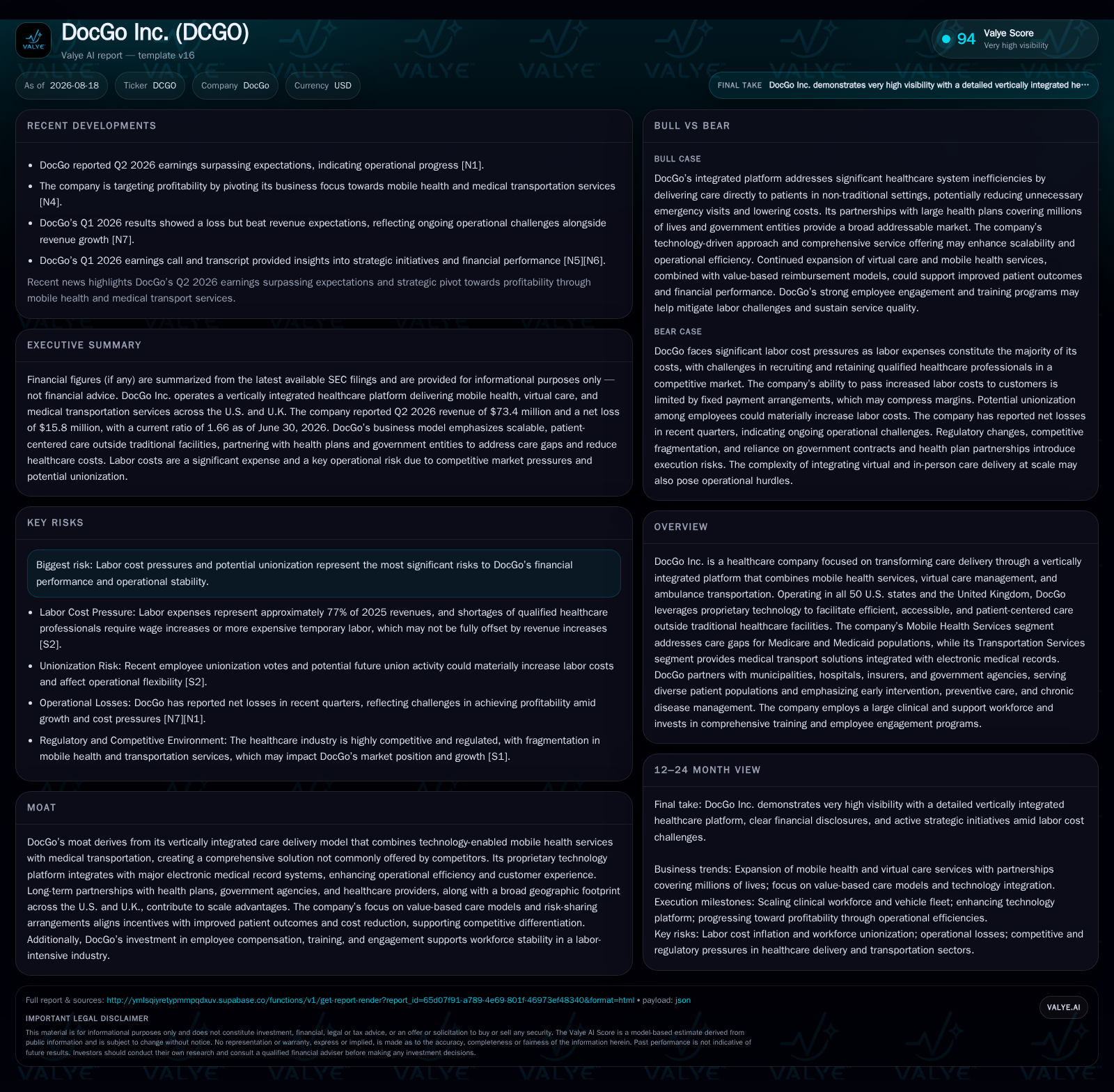
In its latest quarterly filing, DocGo reported no fundamental changes to risk factors but highlighted labor as the most significant cost pressure, representing roughly three-quarters of revenue and posing challenges given wage inflation and a tight labor market [S2]. The company’s recent announcement of a merger agreement to acquire Hicuity Health complements its integrated mobile health, virtual care, and ambulance service platform spanning the U.S. and U.K., positioning it for scale advantages in patient-centered out-of-facility care [S3]. Despite strategic growth initiatives, DocGo faces regulatory scrutiny risks and financial covenant negotiations underlying capital constraints [S1], [S4]. Its vertically integrated model and technology integration with EMRs enhance differentiation but demand continuous investment amid dense competition and workforce challenges. Future growth hinges on execution of value-based contracts and operational efficiencies to offset fixed reimbursement structures challenged by rising labor expenses.
Recent Operating Update
DocGo's latest quarterly report filed on August 17, 2026 reiterates that labor costs remain the company's most significant expenditure, accounting for approximately 73% of revenue in 2025, underscoring acute wage inflation pressures in its clinical workforce including EMTs, paramedics, RNs, LPNs, and temporary personnel where recruitment challenges persist [S2]. Despite these pressures, there were no material changes reported to existing risk factors, including regulatory or liquidity challenges.
A key strategic development occurred on August 16, 2026 when DocGo entered into a merger agreement with Hicuity Health, a move designed to expand its footprint in virtual care management within its integrated healthcare platform that already includes mobile health services and ambulance transportation across the U.S. and U.K [S3]. This acquisition seeks to combine complementary assets to enhance patient-centered care delivered outside traditional facilities while leveraging proprietary technology integrating electronic medical records (EMR) systems
The company's March 2026 annual report adds context to these moves by detailing its broad network of over 900 clinicians traveling more than 11 million miles to facilitate over 1.3 million patient interactions in 2025 alone [S1]. This scale evidences the operational intensity required to execute DocGo’s vision of a proactive healthcare revolution emphasizing accessibility outside four walls through technologically-enabled mobile health models under the supervision of advanced practice providers (APPs) supported by nurses
Business Model Analysis
DocGo monetizes primarily through contracts with healthcare payors—such as Medicare and Medicaid—hospitals, municipalities, insurers, and government agencies that fund mobile health visits, ambulance services, and virtual care management fees. Its business model uniquely blends three interconnected segments: Mobile Health Services delivering direct clinical interventions typically at patients’ homes or workplaces; Transportation Services providing ambulance transport tightly integrated with EMR systems; and Corporate activities supporting operational efficiency.
Revenue volume is closely tied to patient interactions facilitated by clinicians covering wide geographies while complexity varies across service categories—from routine phlebotomy to emergency response. Pricing is often anchored in fixed or prospective payments common in Medicare/Medicaid settings that limit DocGo's ability to pass along input cost increases like rising labor wages. Consequently, operating margins are sensitive to clinician utilization rates, labor cost control measures, technology adoption enhancing routing/scheduling efficiencies, and contract composition favoring value-based arrangements that share financial risk based on outcomes rather than volume alone [S1], [S2].
A critical element shaping the business is DocGo’s vertically integrated approach which simultaneously delivers mobile healthcare services with ambulance transportation leveraging proprietary software platforms compatible with major EMR systems used by partner hospitals or insurers. This orchestrated delivery model aims to optimize logistics for timely access while maintaining clinical oversight through virtual APP support — differentiating it from pure-play transport companies or standalone telehealth platforms.
Industry Structure and Competitive Position
DocGo operates at an intersection combining mobile healthcare providers with emergency medical transportation operators across highly regulated markets including all U.S. states plus the U.K., placing it within a fragmented yet consolidating sector marked by high regulatory scrutiny around licenses, billing practices (e.g., FCA compliance), fraud avoidance protocols (anti-kickback statutes), HIPAA privacy mandates, and local EMS regulations [S9], [S16].
Peers span from established emergency medical service (EMS) providers under municipal contracts to telehealth companies focusing on virtual care without physical presence. Comparatively, companies like Ambulnz emphasize transport logistics whereas telehealth platforms lack mobilized clinician networks on site. Surgery Partners (SGRY) represents outpatient ambulatory care but lacks integration into transport infrastructure. DocGo's combined clinical-mobile transport offering provides competitive advantage through broad geographic coverage coupled with diversified payor contracts enabling value-based incentives.
The company must also contend with typical industry operational risks such as labor shortages impacting paramedic/nurse supply chains — intensified by recent partial unionization votes among employees — complex compliance across jurisdictions with varying telehealth laws/patient consent requirements, high capital intensity from maintaining vehicle fleets alongside digital platform investments, plus competitive pressure from hospital-based outreach programs expanding their own mobile care capabilities.
Growth Drivers
Demographic shifts toward an aging population elevate demand for home-based medical services aimed at chronic disease management reducing hospital readmissions—a central opportunity for DocGo’s mobile health segment.
Additionally, government policy incentives promoting value-based care encourage partnerships where providers like DocGo share financial rewards for quality outcomes rather than fee-for-service volume alone; this aligns well with its risk-sharing contracts that integrate preventive interventions alongside emergency transport solutions [S1]
Technological adoption advances—such as improved EMR connectivity enhancing scheduling algorithms or expanded virtual APP networks—support expansion of service offerings at comparatively lower marginal cost.
Recent acquisitions to build out branded telehealth networks serving Fortune 10 clients solidify DocGo’s entry into white-label virtual care markets augmenting organic growth beyond classic Medicaid/Medicare base customers.
Geographical expansion remains another vector given regulatory complexities slowing entry; however full national coverage combined with UK operations create cross-border scale advantages unusual for many peers focused solely domestically.
Risks and Watchpoints
Labor cost inflation remains paramount as wage increases may outpace rate-setting due to fixed reimbursement contracts common in government payor mixes. Unionization encroachment could further exacerbate margin pressures [S2]
Regulatory environment complexity could cause interruptions or require costly compliance investments especially concerning healthcare fraud enforcement actions under False Claims Act audits arising from billing practices or documentation oversights documented industry-wide [S9], [S21].
Credit facility covenant discussions reveal ongoing liquidity discipline needs despite nominal reported debt levels (~$207K total debt vs ~$25M cash reserves as of June 30) given operational cash burn linked to scaling expenses including fleet maintenance/capital expenditures on technology platforms supporting integrated service delivery [F1], [S4].
Execution risk exists around successfully integrating Hicuity Health post-merger—aligning workflows across virtual modalities while preserving clinical quality—and achieving anticipated efficiency gains needed to leverage size into positive operating leverage.
Competition could intensify from both digitally native telehealth platforms enhancing their physical care network joints or incumbent EMS providers deepening municipal reach.
Current assets totaled approximately $120 million versus current liabilities of about $72 million, yielding a current ratio of roughly 1.66—indicative of moderate short-term liquidity coverage but still necessitating prudent cash flow management given ongoing covenant discussions under its credit agreement entered August 2025 [F1], [S4].
The company’s constrained ability to raise prices due to fixed payment models tightens margins further complicating path toward operating income break-even absent operational leverage improvements or successful ramping of higher-margin contracted services such as value-based care programs potentially realized through recent acquisitions like Hicuity Health enhancing revenue mix quality over time.
It does not constitute investment advice but serves as a detailed examination of DocGo Inc.’s business dynamics within its industry context.
Disclaimer: This is research-only, informational analysis and not investment advice. It may include AI-generated interpretation and general industry context. Always verify important details using primary sources.

Comments