
Greenland Mines Ltd's Dual Focus on Gene Therapy and Mining Reshapes Growth Trajectory
The company advances early-stage gene therapy programs alongside biosimilar drug commercialization, now expanding into critical minerals mining.
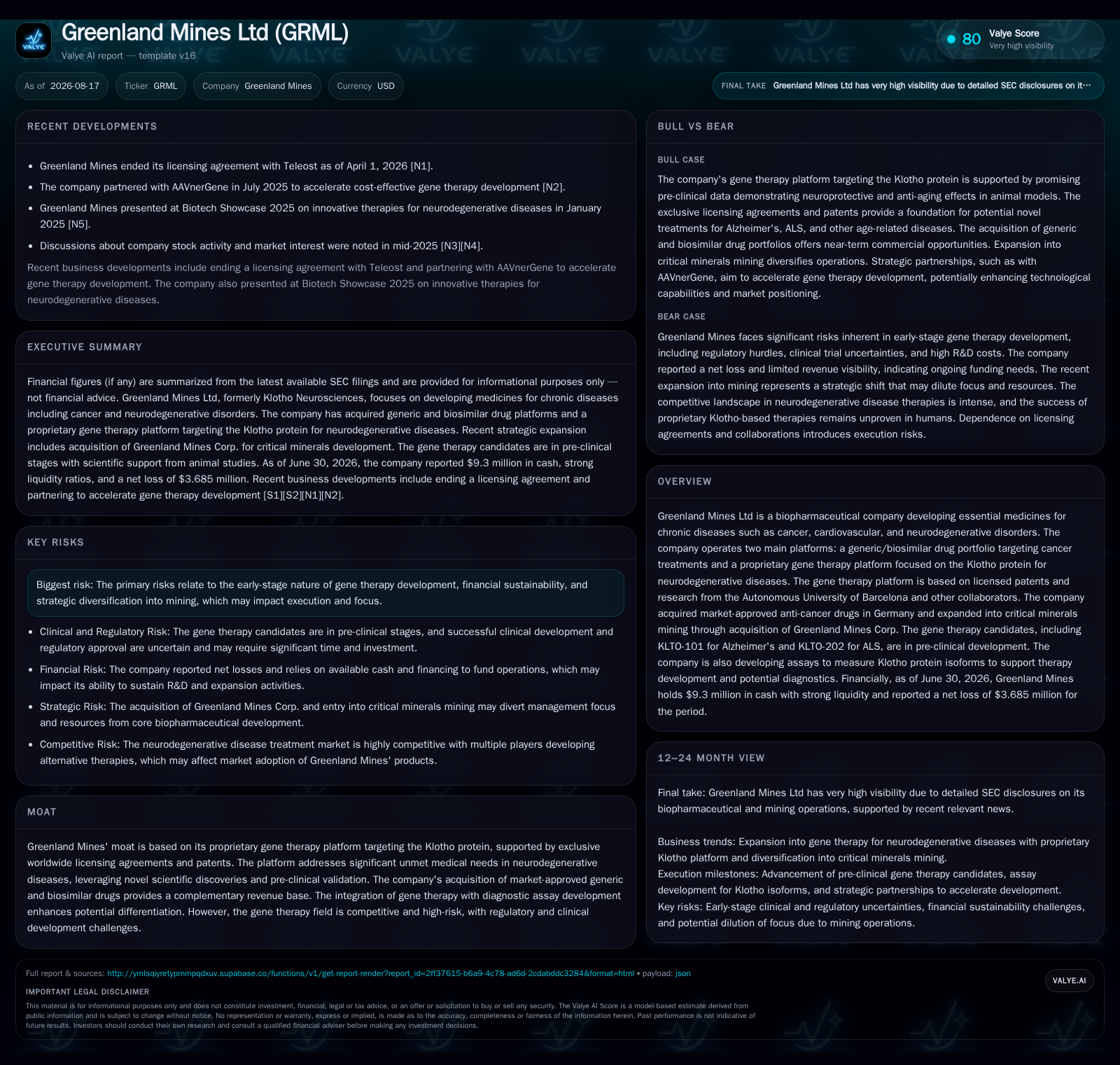
Greenland Mines Ltd recently completed its acquisition of Greenland Mines Corp., marking a strategic diversification from its core biotech operations into critical minerals mining. Operating a two-pronged biotech platform, the company targets heavily unmet needs in neurodegenerative disease gene therapies centered on the Klotho protein, alongside a biosimilar and generic oncology drug portfolio acquired in Europe. Despite no current revenues and ongoing R&D expenses, Greenland Mines maintains strong liquidity as it navigates the complexities of clinical development and regulatory approval while managing emerging risks associated with its mining business expansion.
Recent Operating Update
Greenland Mines Ltd's latest Form 10-Q filing dated August 17, 2026 [S2] highlights a pivotal moment for the company: having completed the acquisition of Greenland Mines Corp. earlier this year in March 2026 [S1], it significantly shifted its operational scope by entering the mining industry focused on critical minerals. This transaction introduces a dual-business model where biotechnology development coexists with resource extraction ventures—a move that is unusual but strategically designed to balance long-cycle pharma R&D with resource sector opportunities.
From an operational standpoint, the biotech side remains pre-revenue but progressed with licensed platforms for generic/biosimilar cancer treatments approved in Germany since late 2022 [S1]. More critically, Greenland Mines continues to advance proprietary gene therapies targeting the Klotho protein for neurodegenerative diseases, including Alzheimer's and ALS candidates in preclinical stages [S1]. The company disclosed no new revenues but recorded increased operating costs reflecting research expansion, legal compliance as a public entity, and integration efforts following recent acquisitions [S1, S24]. Importantly, liquidity remains robust with about $9.3 million in cash and equivalents and a strong current ratio exceeding 10 as of June 30, 2026 [F1], providing operational runway despite negative operating income.
Business Model Analysis
Greenland Mines' business model centers around two primary biotech platforms complemented by the newly acquired mining assets. The first platform consists of a portfolio of generic and biosimilar oncology drugs targeting established markets in Europe, specifically leveraging five previously market-approved anti-cancer drugs notable for their inclusion in widely used regimens like FOLFOX and FOLFIRI for colorectal and gastric cancers [S1]. These products provide a potential near-term revenue path through drug sales or licensing arrangements given their existing market authorization—a distinct advantage compared with novel therapeutics still under development.
The second platform is a proprietary gene therapy pipeline based on exclusive worldwide licensing from academic sources such as the Autonomous University of Barcelona [S1]. This platform uses novel gene therapy techniques to introduce the Klotho protein inside patients’ bodies aiming to address chronic neurodegenerative diseases marked by high unmet medical need. This pipeline is characterized by inherent challenges typical in gene therapy R&D: long timelines from preclinical studies to clinical trials (not yet begun), substantial research expenditures ($634k reported recently on R&D expenses for 2025 [S24]), stringent regulatory scrutiny, and uncertain market access pathways.
Milestone payments tied to licensing agreements form a material component of future financial expectations—licenses require staged payments triggered upon advancement into clinical phases (e.g., Phase 1 start) plus royalties on net sales capped at low single digits [S1]. Such arrangements align incentives yet impose upfront cost obligations that add to negative cash flows during early-stage development.
The incorporation of mining—focused on critical and precious metals—introduces another revenue dimension but diverges markedly from biotech value-chain dynamics. Mining operations are capital intensive with long lead times to production; hence near-term financial impact remains ambiguous. This diversification reflects an unusual strategic trade-off between potential resource sector upside against possible distraction from core biotech focus.
Industry Structure and Competitive Position
Greenland Mines operates across heterogeneous segments. In biotechnology, it straddles gene therapy developers working on orphan or age-associated diseases (similar in archetype to Bluebird Bio or uniQure) and biosimilar/generic biologics companies addressing oncology markets akin to Sandoz or Mylan's legacy portfolios.
The gene therapy segment faces intense competition, high failure rates, regulatory barriers including IND approvals, and substantial capital requirements. Greenland's exclusive licensing rights around the Klotho protein provide a differentiated scientific premise but remain early-stage without clinical validation so far [S1]. Success relies heavily on progressing through preclinical milestones toward clinical trials—a lengthy process that demands sustained investment.
In the biosimilar oncology space, competition is centered on price competitiveness, regulatory approvals across jurisdictions, physician adoption trends, and payer reimbursement policies—factors that pressure margins but also allow incremental revenue generation once products are marketed. Greenland's acquisition of German-approved drugs positions them advantageously within European pathways though scale effects versus larger incumbents remain limited by its relatively small portfolio size.
Mining introduces divergence from core biotech peers entirely; here competitive dynamics revolve around mineral deposit quality, exploration success rates, permitting/ESG challenges, commodity price cycles, operational efficiency, and capital structure. This unfamiliar competitive environment amplifies execution risk due to industry complexity disparities.
Growth Drivers
Growth vectors for Greenland Mines blend organic pipeline progressions with inorganic expansion:
- Advancing gene therapy programs into Investigational New Drug (IND) enabling preclinical data packages will be crucial—milestones linked to clinical phase initiation will unlock milestone payments per license agreements [S1]. Early success in Klotho-based therapies may also attract partnerships or out-licensing deals enhancing valuation.
- The biosimilar/generic oncology business has potential for geographic market extensions beyond Germany if regulatory approvals can be secured in additional territories.
- Diagnostic assay developments aimed at quantifying Klotho isoforms could complement therapeutic efforts by enabling patient stratification or treatment monitoring—a value-added differentiation often noted among personalized medicine approaches.
- Mining activities focused on critical minerals such as those needed for electronics or green energy technologies stand poised to capitalize on rising global demand amid geopolitical emphasis on supply chain security [S10]. Resources identification updates like Technical Report filings increase project visibility.
- Capital raising flexibility supported by strong liquidity enables funding both biotech R&D scale-up and exploration/development activities in mining without immediate constraint.
Risks and Watchpoints
Key risks threatening Greenland Mines stem from both sectors:
- Clinical development risk is significant; failure or delay in moving gene therapy candidates through preclinical safety/toxicity studies or clinical trial startups would materially impair prospects [S1]. Regulatory rejection or protracted timelines exacerbate uncertainty.
- Lack of current revenues forces reliance on financing activities; rising operating expenses cross multiple domains heighten burn rate concerns even with $9 million cash on hand as of mid-2026 [F1]. Cash management will be critical until product commercialization or licensing inflows materialize.
- Market acceptance hurdles exist for biosimilars given payor reimbursement pressures amidst managed care emphasis highlighted in disclosures [S1]. Pricing dynamics may compress gross margins substantially compared to originator biologics.
- Diversification into mining carries execution risks due to dwarfed management domain expertise relative to dedicated miners; operational setbacks or capital intensity could strain overall corporate focus.
- Nasdaq listing compliance issues previously noted necessitate continued shareholder engagement reflected by postponed special stockholder meetings up to September 2026 [S3], indicating ongoing governance attention required.
- Intellectual property protection longevity is vital—any potential patent challenges could erode exclusivity around gene therapy technology licensing agreements integral to future royalties/milestones [S1].
What To Watch Next
Market participants should monitor these near-term indicators:
- Timing and content of Investigational New Drug applications submission for KLTO series gene therapies.
- Updates on biosimilar product registrations outside Germany or expansions within EU markets.
- Financial disclosures regarding operating expense trajectory versus cash burn pace monitored quarterly.
- Progress reports from mining project exploration drilling results or resource estimations impacting asset valuation.
- Corporate governance developments including outcomes of reconvened shareholder meetings scheduled September 3, 2026 [S3].
- Potential licensing partnerships or out-licensing agreements announced that leverage Klotho platform patents or assay developments enhancing pipeline validation.
Financial Profile Discussion
As of June 30, 2026, Greenland Mines reported $9.3 million in cash and equivalents against modest liabilities producing an exceptionally strong current ratio above 10 (10.09) indicating ample short-term liquidity [F1]. Total debt stands low at approximately $300k reflecting little leverage risk (data best-effort as November 2022) [F1].
Cash flow from operating activities was negative $5.9 million during calendar year 2025 reflecting intensified program activity requiring ongoing financing support predominantly through equity issuances totaling over $13 million net proceeds reinforcing dependency on capital markets access [S23]. Thus maintaining funding alternatives will be crucial until revenue streams emerge either via commercial sales or milestone-linked inflows enabled by successful regulatory transitions across each platform segment.
In summary, Greenland Mines reflects typical characteristics of an early-stage biotech balancing innovation risk with emerging generics revenue potential compounded uniquely by mineral assets acquisition dilution effect necessitating close monitoring of capital allocation effectiveness against execution milestones going forward.
Disclaimer: This is research-only, informational analysis and not investment advice. It may include AI-generated interpretation and general industry context. Always verify important details using primary sources.

Comments