
Sandisk Corp’s Capital Commitments and Share Repurchase Signal Financial Confidence
Sandisk's latest quarterly filing reveals improved working capital efficiency, early debt repayment, and a sizable share buyback program reinforcing its strong liquidity amid capital-intensive manufacturing.
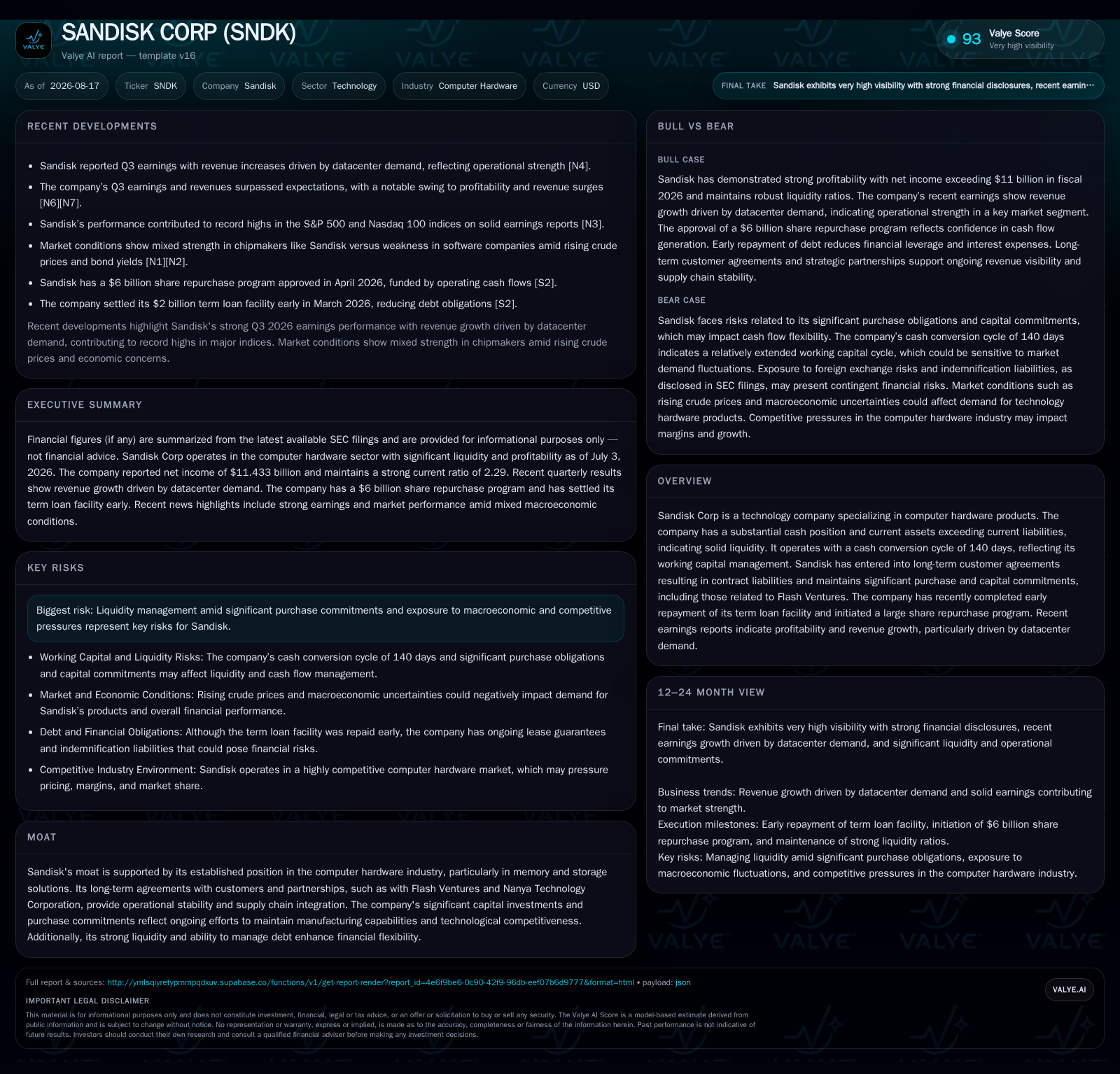
In Q3 2026, Sandisk Corp demonstrated enhanced financial flexibility through reduced days sales outstanding (DSO), increased inventory aligned with demand growth, and extended days payable outstanding (DPO). The company completed early repayment of its $1.9 billion term loan facility and announced a $14 billion share repurchase program by August 2026, signaling management confidence. Sandisk’s business model is capital intensive due to manufacturing capacity investments via the Flash Ventures joint venture, requiring significant purchase commitments and capital expenditures. Its entrenched supply chain partnerships and long-term OEM contracts support operational stability and revenue visibility. Nonetheless, sizeable purchase obligations and market cyclicality remain key risks to watch.
This 11-day improvement primarily reflected stronger revenue volumes coupled with continued disciplined collections processes [S2]. Meanwhile, the company strategically increased its inventory levels by eight days—from 150 to 158 days—to build buffer stock consistent with expected demand ramp-ups. This inventory accumulation suggests confidence in near-term order growth but also increases working capital outflows temporarily [S2]. Simultaneously, the company extended its days payable outstanding (DPO) by seven days to 60 days through routine timing variations in purchases and payments, enhancing cash flow flexibility through vendor relationship management tactics [S2]. These shifts collectively compressed Sandisk’s cash conversion cycle by ten days from 150 to 140 days over last year, signaling tighter coordination of receivables and payables against inventory investment.
Aside from working capital improvements, in August 2026 the Board authorized an aggressive $14 billion share repurchase program intended to be funded from operating cash flows under favorable market conditions [S3]. The magnitude of this buyback underscores management's confidence in intrinsic business value and anticipated free cash flow generation
Capital-Intensive Manufacturing at the Core of Sandisk’s Model
Sandisk’s business model centers on designing and manufacturing flash memory products including NAND flash-based solid-state drives (SSDs) sold largely under long-term agreements with OEMs and datacenter customers. Manufacturing is heavily dependent on the Flash Ventures joint venture with Kioxia which owns substantial wafer fabrication facilities—a critical part of keeping pace technologically with competitors like Micron or Samsung Electronics [S1][S6]. Capital expenditures reached $134 million during the nine months ended April 2026 focused on equipment upgrades and capacity maintenance at this JV, reflecting ongoing investments needed due to rapid flash memory technology evolution and high fixed costs involved in semiconductor fabs.
Purchase obligations summarized at nearly $5 billion excluding Flash Ventures reimbursements amplify the industry's capital intensity. Flash Ventures-related commitments alone total approximately $6.5 billion over coming years covering equipment leases, research & development funding, depreciation payments on owned fab assets, and manufacturing service agreements [S6]. Many of these are partially cancellable or subject to conditional terms but represent significant planned outflows that require careful liquidity management—especially if demand softens or supply chains face disruption.
Supply Chain Partnerships Anchor Operational Stability
Beyond owning stakes in fabrication through Flash Ventures, Sandisk’s strategic investments extend into Nanya Technology with nearly a billion-dollar equity commitment finalized in Q2 FY26 [S6][S13]. Such ventures strengthen supply chain integration by aligning component sourcing with production requirements for key memory modules while defraying some capital intensity through shared investment risks
Flash Ventures also leasing back equipment from financial institutions reduces upfront capex burdens but introduces contingent liabilities under lease guarantees that Sandisk must monitor closely. These arrangements create operational resilience uncommon among smaller or less vertically integrated peers who are more exposed to external fab constraints or pricing volatility.
Competitive Position Amid Industry Peer Landscape
Gross margin trends or competitive pricing pressures remain industry-wide themes influenced heavily by product mix shifts towards higher-density SSDs demanded by datacenters—a domain where Sandisk has established long-term contracts boosting revenue visibility [S1][S17]
Growth Anchored in Datacenter Demand and Innovation Cycles
Sandisk’s revenue growth is strongly correlated with increased global data generation driving expansion of cloud infrastructure demanding faster and larger storage solutions based on flash memory technologies [S1][S2]. Long-term agreements with OEMs and datacenter operators underpin reliable volume forecasts providing headroom for capacity planning at Flash Ventures manufacturing sites
Technological advances enabling higher bit density per wafer improve product competitiveness while offering potential margin uplift if R&D investments continue effectively. However, sustained growth depends on maintaining pace with innovation cycles amid intense competition requiring predictable capex alongside flexible procurement commitments.
Risks from Capital Commitments and Market Dynamics
The company's large purchase obligations totaling nearly $13 billion including Flash Ventures introduce liquidity risk especially if macroeconomic factors dampen demand or supply chain disturbances raise component costs unexpectedly [S6][S9]. Market pricing pressure inherent in commoditized memory products threatens gross margins cyclically [S9][S21]. Geopolitical tensions impacting semiconductor equipment availability or regulatory shifts across regions further complicate supply chain predictability posing execution risks relative to peers relying more heavily on foundries outside cooperative alliances
What Investors Should Monitor Next for Execution Clarity
Looking forward, key indicators confirming Sandisk’s positive trajectory would include continued reductions or stable DSO signaling smooth receivables collections amidst scaling revenues; disciplined DIO control aligned with sell-through rates; stable or extended DPO without supplier pushback; sustained free cash flow sufficient to support ongoing CapEx plus accelerated buybacks [S3][S2]
Announcements regarding expansions or extensions of long-term supply contracts would bolster revenue visibility while updates on Flash Ventures capital investment pacing may signal readiness for next-generation technology transitions required for competitiveness.
Deviations such as unexpected inventory surpluses or purchase commitment cancellations could flag caution around demand softness or supply chain issues.
Financial Profile Discussion: Cash Liquidity and Capital Structure
As of July 3, 2026, Sandisk reported a strong liquidity position featuring approximately $4.76 billion in cash and equivalents against zero total debt—a rare stance among semiconductor memory manufacturers that often carry significant leverage associated with capital spending cycles [F1]. The early full repayment of a $1.9 billion term loan facility reduced interest expense going forward and eliminated fixed financing covenants providing management greater freedom for discretionary capital allocation including the newly announced $14 billion share repurchase plan which can be funded predominately from operational cash flows without reliance on external financing sources [F1][S3][S6]. Nonetheless, given substantial procurement commitments linked directly to growth plans via Flash Ventures partnerships such financial flexibility will require ongoing careful monitoring amid evolving market conditions.
This analysis integrates Sandisk Corp's recent regulatory disclosures highlighting an improving operating picture reinforced by exceptional financial discipline evident in shareholder return initiatives amid the highly capital-intensive computer hardware storage sector characterized by complex manufacturing alliances. Careful observation of working capital KPIs alongside broader market developments will be essential for assessing execution continuity.
This article synthesizes facts drawn strictly from disclosed filings without offering investment advice.
Disclaimer: This is research-only, informational analysis and not investment advice. It may include AI-generated interpretation and general industry context. Always verify important details using primary sources.

Comments