
NexMetals Mining Advances Exploration While Maintaining Strong Liquidity Position
Recent quarterly disclosures highlight NexMetals’ advancing drilling and metallurgical programs in Botswana, underscoring progress toward resource delineation alongside a solid capital base that supports ongoing exploration activities amid typical junior mining risks.
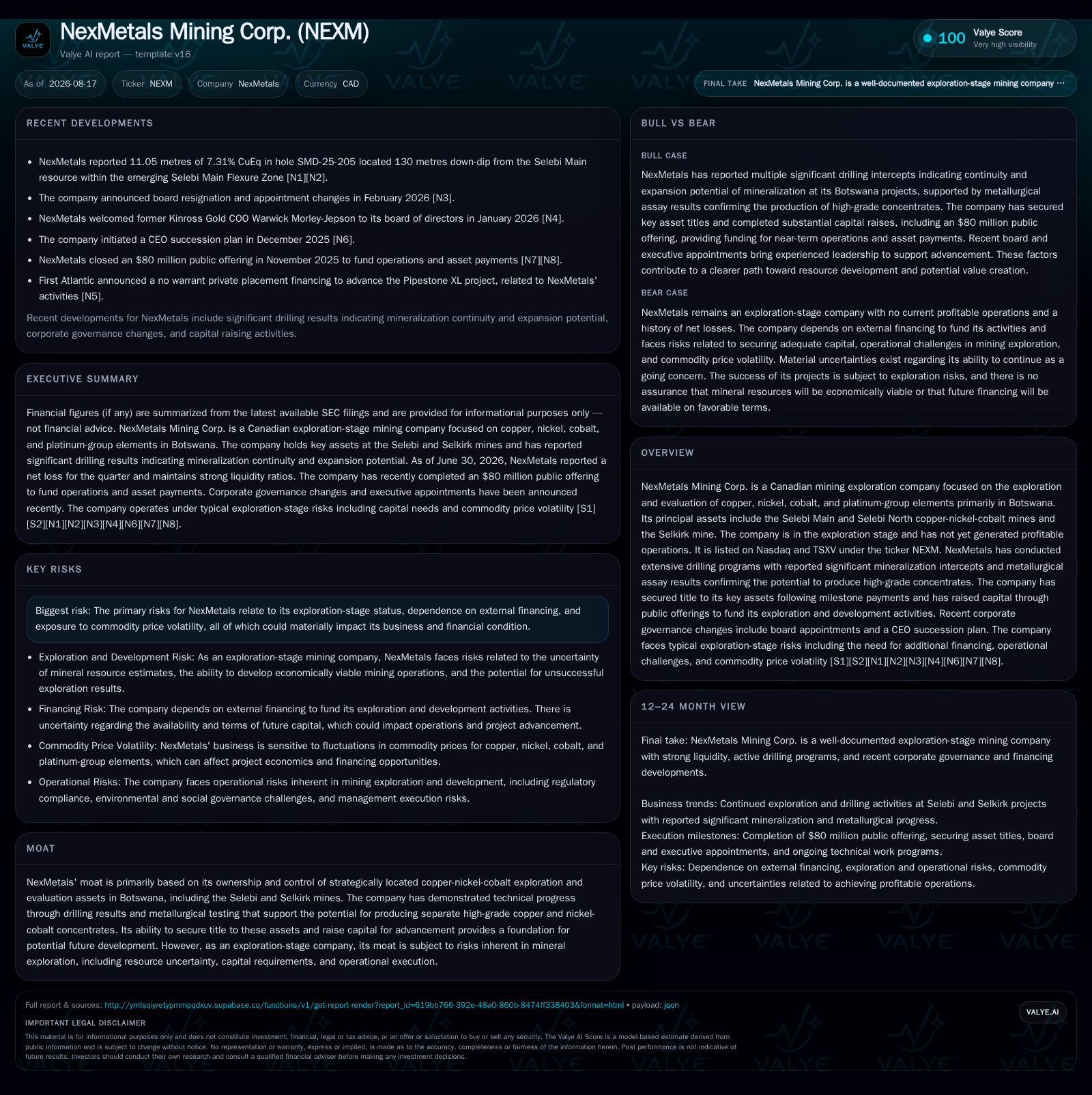
NexMetals Mining’s August 2026 filings reveal meaningful technical progress at its Selebi and Selkirk copper-nickel-cobalt projects, with assay results confirming high-grade mineralization and metallurgical tests supporting the potential for economically viable concentrates. Secured title to key assets reduces permitting risk, while a cash position of CAD 16.96 million and a strong current ratio provide financial flexibility for continued exploration. Despite positive market drivers from growing battery metal demand, the company faces standard exploration-stage risks including resource uncertainty, reliance on equity financing, and regulatory challenges as it aims to advance toward indicated/inferred resource classifications.
Recent Operating Update: Advancing Drilling and Metallurgical Programs
NexMetals Mining’s most recent quarterly filings dated August 17, 2026, report significant progress in its surface drilling campaigns targeting copper-nickel-cobalt mineralization across the Selebi and Selkirk properties in Botswana [S2][S3]. The company disclosed notable assay results from drill hole SMD-26-219 among others, revealing multi-percentage grades over economically relevant intervals that suggest robust ore grade continuity. These findings are crucial as they directly enhance geological confidence necessary for defining mineral resources under regulatory frameworks such as SEC S-K 1300. Complementing these results, metallurgical testing has demonstrated promising recovery rates capable of producing separate high-grade copper and nickel-cobalt concentrates. This separation potential is important because it can improve downstream processing flexibility and concentrate marketability.
Strategic Asset Control Anchors Project Viability
NexMetals maintains secured ownership over its key Botswana assets—the Selebi Main, Selebi North, and Selkirk mines—through milestone-linked purchase agreements fulfilled via prior equity raises [S1][S2]. This title security notably reduces the typical permitting uncertainties encountered in junior mining jurisdictions by establishing clear legal control over exploration licenses. Such stability is essential for advancing projects through pre-development phases without significant risk of regulatory or ownership disputes. Holding these strategically located mineral rights enhances NexMetals’ competitive positioning within the region’s mining landscape.
Capital Structure Supports Ongoing Exploration Activities
The company's financial position as of June 30, 2026 reflects prudent capital management aligned with its exploration-stage status. Cash and equivalents stood at CAD 16.96 million against current liabilities of CAD 3.63 million, resulting in a strong current ratio exceeding five times [F1]. Total debt was approximately CAD 1.42 million, with a net cash position indicated by cash holdings exceeding debt [F1]. Nonetheless, continued operating losses reflect the capital-intensive nature of drilling programs and metallurgical testing. This underscores ongoing dependence on equity markets to fund exploration expenditures while balancing dilution risk.
Peer Context: Drilling Efficiency and Assay Quality
Relative to other junior explorers active in African base metals sectors—particularly those focused on copper-nickel-cobalt—NexMetals’ drilling intensity (meterage per hole) aligns with industry standards used to rapidly delineate mineralized zones ahead of feasibility studies. Assay grades reported demonstrate mid-single-digit percentages of copper and nickel-cobalt minerals that compare favorably to peer early-stage projects where sub-3% copper grades are common. The metallurgical recovery results further enhance NexMetals’ standing by supporting quality concentrate production requirements demanded by smelters globally.
Industry Dynamics: Demand Tailwinds Amid Commodity Price Volatility
NexMetals’ focus on battery metals such as cobalt and nickel alongside copper aligns with broader global trends driven by accelerating electrification efforts—most notably electric vehicle adoption—and renewable energy infrastructure deployment [S1]. These sectors require increasing volumes of high-grade cathode materials derived from these metals. However, commodity price volatility remains a significant factor affecting junior explorers’ valuations and capital access due to cyclical supply-demand imbalances and geopolitical risks.
Risks Specific to Exploration Stage Companies
The company’s risk disclosures reiterate common challenges endemic to exploration-stage miners including resource uncertainty where geological data still requires expansion through ongoing drilling [S2][S1]. Additionally, reliance on intermittent external equity financing introduces dilution risk amid fluctuating market conditions. Execution risks encompass potential setbacks in drill programs or metallurgical complexities unresolved until comprehensive studies conclude. Regulatory uncertainty within Botswana introduces geopolitical considerations impacting permitting timelines or community relations.
Upcoming Milestones: Resource Classification and Feasibility Advancement
Looking ahead, NexMetals aims to complete its current drill campaigns focused on primary deposit zones where initial assay data has been promising but infill drilling remains necessary for robust geological modeling under SEC S-K 1300 standards aligned with NI 43-101 reporting [S2]. Achieving indicated or measured resource status will enable preparation of technical reports suitable for prefeasibility or feasibility studies—critical steps toward demonstrating economic viability and attracting development capital.
Financial Profile Discussion
Disclaimer: This is research-only, informational analysis and not investment advice. It may include AI-generated interpretation and general industry context. Always verify important details using primary sources.

Comments