
Wolfspeed Q3 2026: High Debt and Customer Concentration Challenge Growth Prospects
Wolfspeed reports significant leverage and customer concentration risks amid silicon carbide market expansion efforts in Q3 2026.
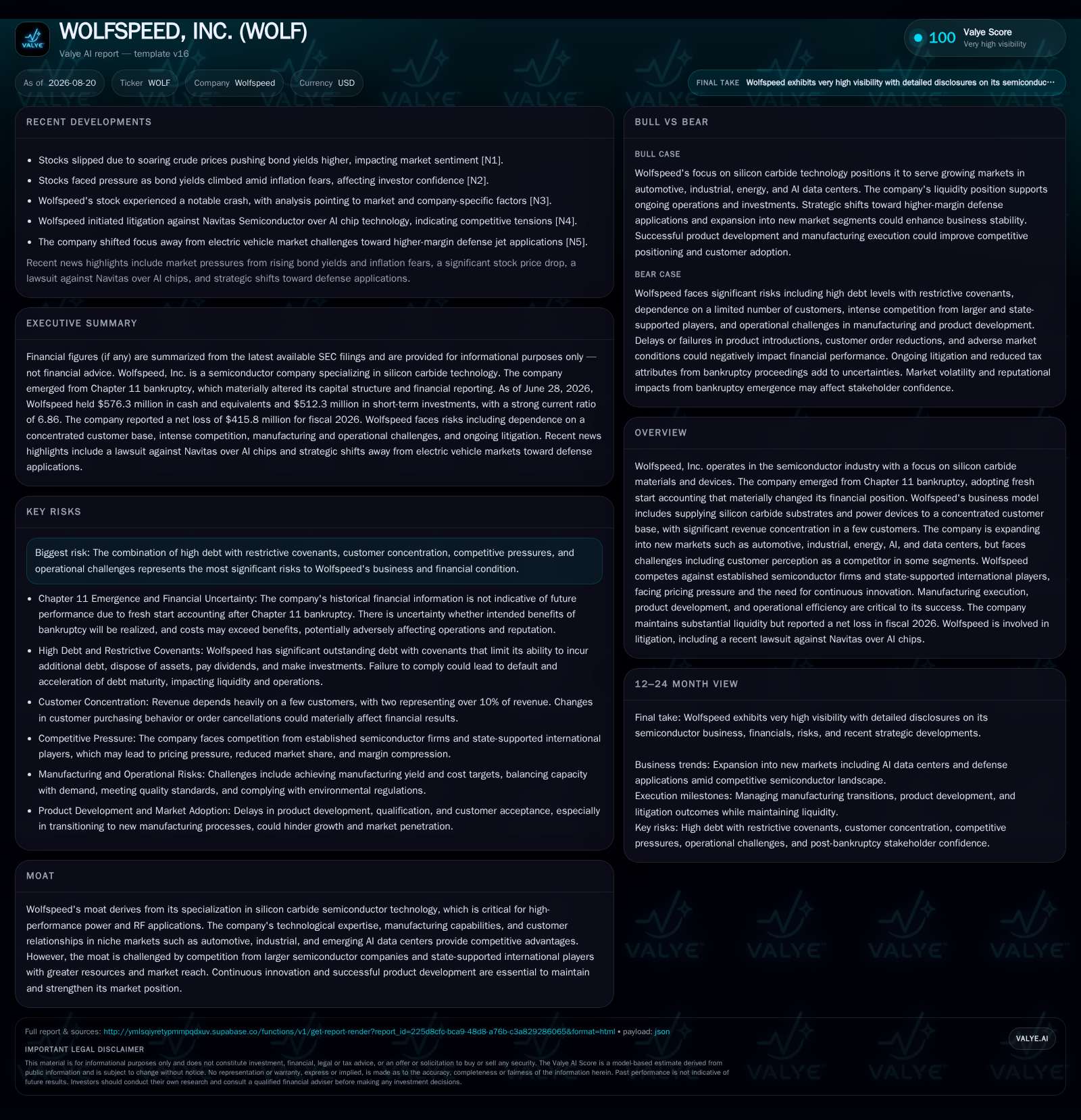
In its Q3 2026 update, Wolfspeed, Inc. disclosed total debt of $2.47 billion and cash reserves of $576 million, resulting in net debt of approximately $1.89 billion and a current ratio of 6.86, highlighting strong liquidity but substantial leverage. The company’s revenue remains heavily concentrated among a few customers, increasing business risk. Operational challenges in manufacturing yield and capacity utilization persist, while competitive pressures from established semiconductor firms and state-supported players constrain pricing power. These factors collectively pose structural risks that could limit Wolfspeed’s ability to sustain profitable growth in silicon carbide semiconductors.
Wolfspeed, Inc. reported in its Q3 2026 operating update for the fiscal quarter ended June 28, 2026, that it continues to operate with high leverage while holding current assets of $1.59 billion against current liabilities of $232 million, resulting in a current ratio of 6.86 [S2]. This indicates available short-term liquidity, although the company also faces persistent customer concentration and ongoing operational and market risks, which could affect its ability to execute growth strategies in the silicon carbide semiconductor market amid competitive and market uncertainties [S1].
The company’s revenue remains highly concentrated among a small group of customers, a factor that increases business risk by exposing Wolfspeed to demand shocks or credit issues within this limited base [S1][S2]. This concentration risk is a critical structural challenge, as reliance on few customers can lead to volatility in revenue streams and complicate growth sustainability.
Business Model and Market Position
Wolfspeed operates in the silicon carbide (SiC) semiconductor segment, producing substrates and power semiconductor devices primarily sold to automotive, industrial, energy, AI, and data center sectors [S1]. These products are essential for high-performance power and radio frequency applications, where silicon carbide offers advantages over traditional silicon-based semiconductors.
Revenue generation depends on sales to a concentrated customer base, which creates inherent risks but also reflects the specialized nature of the market [S1]. Wolfspeed’s efforts to expand into new end markets aim to diversify this customer concentration, though perceptions of the company as a competitor in certain segments may limit penetration.
The company faces significant competitive pressure from established semiconductor firms and state-supported international players. This competitive landscape constrains Wolfspeed’s pricing power and necessitates continuous innovation and operational efficiency to maintain market position [S1]
Risks and Operational Challenges
Operational execution remains a key determinant of Wolfspeed’s financial performance. Manufacturing yield rates and capacity utilization directly impact margins and the company’s ability to meet customer demand cost-effectively [S1][S2]. The latest filings highlight ongoing challenges in achieving production yield goals and improving utilization at manufacturing facilities.
These manufacturing issues, coupled with the company’s high leverage and customer concentration, represent structural risks that could limit Wolfspeed’s ability to sustainably convert silicon carbide market growth into profitable revenue expansion [F1][S1][S2]. The need to balance production capacity with evolving quality standards and customer requirements adds complexity to operational execution.
Competitive pressures from both established semiconductor companies and state-backed international players further exacerbate margin constraints by limiting pricing flexibility [S1][S2]. Additionally, Wolfspeed’s reliance on a few large customers increases vulnerability to demand fluctuations and credit risks, which could adversely affect revenue stability.
Scenario Analysis and Outlook
One possible upside scenario is that Wolfspeed successfully improves manufacturing yields and expands its customer base beyond the current concentrated accounts. Under this scenario, the company could achieve sustainable margin expansion and revenue growth driven by the structural growth in silicon carbide semiconductor demand across automotive, industrial, and data center markets [S1][S2]. Confirmation of this scenario would come from improved quarterly margins, greater revenue diversification, and new customer contract announcements.
Conversely, if manufacturing challenges persist and competitive pressures intensify, Wolfspeed could face margin compression and revenue volatility [S1][S2][F1]. This bear case is supported by the semiconductor sector’s competitive and cyclical nature, combined with Wolfspeed’s high leverage and customer concentration risks. Evidence confirming this downside would include declining margins, revenue contraction, or negative customer commentary.
Business Economics and Watchpoints
Wolfspeed’s business economics hinge on manufacturing yield improvements and capacity utilization to drive margin expansion and cash flow generation. The capital-intensive nature of silicon carbide semiconductor manufacturing requires efficient production to offset high fixed costs and debt servicing obligations.
Customer concentration remains a critical watchpoint, as diversification efforts will be essential to reduce revenue volatility and improve growth sustainability. Monitoring quarterly manufacturing yield metrics, capacity utilization rates, and margin trends will provide insight into operational execution progress.
Additionally, tracking debt servicing and refinancing developments is important given the substantial net debt position. Competitive dynamics, including pricing pressure and innovation pace, also warrant close observation as they influence Wolfspeed’s market positioning and profitability.
The ability to overcome manufacturing execution challenges and diversify its customer base will be pivotal in determining whether Wolfspeed can capitalize on the growing silicon carbide semiconductor market while sustaining profitable growth.
Disclaimer: This is research-only, informational analysis and not investment advice. It may include AI-generated interpretation and general industry context. Always verify important details using primary sources.

Comments