
Seafarer Exploration Corp Q2 2026: Critical Working Capital Deficit and Technology Development Challenges
Seafarer Exploration’s Q2 2026 results highlight a severe liquidity deficit, ongoing operating losses, and defaulted debt that raise significant risks to its operational continuity.
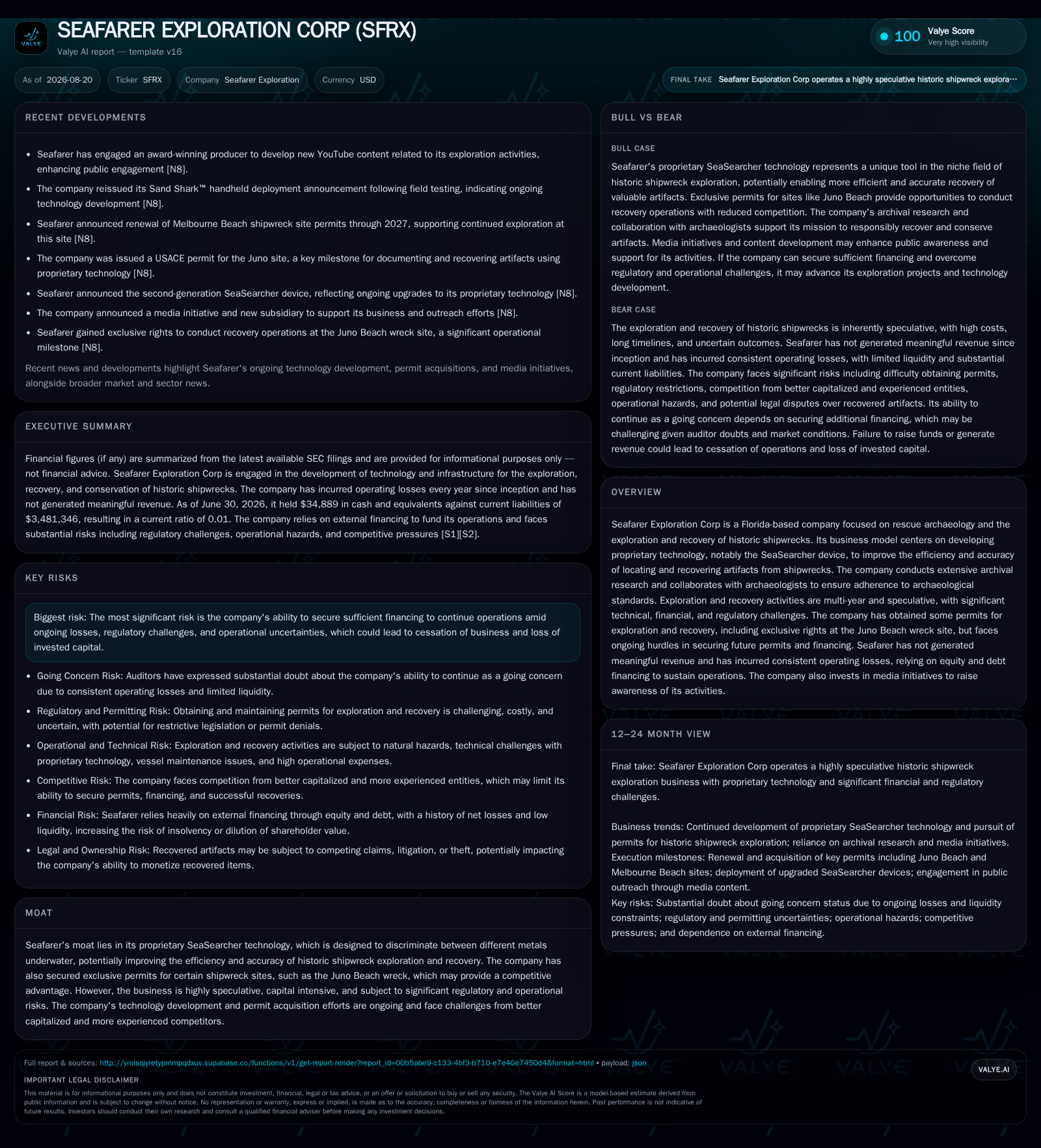
Seafarer Exploration Corp reported a critical liquidity shortfall as of June 30, 2026, with current assets of just $27,620 against current liabilities exceeding $3.48 million, resulting in a current ratio of 0.01. The company sustained a net operating loss of approximately $1.15 million in the first half of 2026, reflecting ongoing high costs related to its proprietary SeaSearcher technology development and exploration activities. Multiple convertible and promissory notes remain in default, posing significant risks of lender foreclosure and shareholder dilution. Without immediate capital raising, Seafarer faces substantial doubt about its ability to continue operations.
Seafarer Exploration Corp reported a sharp decline in its liquidity position for the quarter ended June 30, 2026, with the current ratio falling to 0.01 due to current assets of only $27,620 against current liabilities of $3,481,346 [F1]. This severe working capital deficit indicates significant liquidity constraints and challenges in covering immediate obligations, which may raise substantial doubt about its capacity to continue operations without additional financing. The sustained net loss from operations further adds to these financial challenges, underscoring the risks facing Seafarer in advancing its multi-year, high-risk historic shipwreck exploration business [S2][S1].
Compounding this liquidity shortfall, Seafarer has multiple convertible notes and promissory notes in default as of Q2 2026 [S2][S7]. These defaults expose the company to the risk that lenders may initiate foreclosure proceedings on collateral securing these obligations, which could force the company to significantly scale back or cease operations. The convertible notes also carry conversion rights at prices generally lower than the current market price of the company’s shares, creating a potential for significant shareholder dilution if conversions occur. The absence of refinancing sources for these defaulted debts further heightens the risk of operational disruption or cessation.
Operating cash flow remains negative, with the company’s cash burn consistent with prior periods, reflecting ongoing expenditures related to research, development, and administrative costs [S2][F1]. Management anticipates that available cash will be exhausted within approximately one month absent new financing, underscoring the immediacy of the liquidity challenge.
Operating Performance and Technology Development
Seafarer’s net loss from operations for the six months ended June 30, 2026, was approximately $1.15 million, consistent with its historical pattern of sustained operating losses [S2]. These losses primarily reflect the capital-intensive nature of its business, including substantial ongoing costs related to the development of its proprietary SeaSearcher technology.
The SeaSearcher device is central to Seafarer’s business model, designed to improve efficiencies in the exploration and recovery of historic shipwrecks through underwater metal discrimination technology. Despite significant technical challenges, particularly due to the unique environmental conditions at the Juno Beach exploration site, the company continues to invest heavily in advancing this technology [S1]. The company’s business model depends on securing exclusive exploration permits, developing proprietary technology like SeaSearcher, and ultimately monetizing recovered artifacts. However, this model is inherently speculative, with multi-year exploration cycles and significant operational risks.
Revenue generation is contingent on successful artifact recovery and monetization, which have not yet materialized for Seafarer [S1]. The company currently relies entirely on capital raised from investors and lenders to fund its research, development, and exploration activities. In this case, the company may be forced to cease operations, leading to a complete loss of invested capital and potential foreclosure by lenders [F1][S2][S7]. Confirmation of this scenario would include public announcements of foreclosure or bankruptcy filings and further deterioration of liquidity metrics in subsequent filings.
Conversely, a base case scenario involves Seafarer successfully raising sufficient capital through equity or debt issuance to sustain operations and continue technology development. Confirmation of this scenario would be improved liquidity and cash runway in subsequent filings, alongside progress on technology milestones and permit acquisitions.
Conclusion and Watchpoints
Seafarer Exploration Corp’s Q2 2026 results expose a critical liquidity shortfall with a current ratio of 0.01 and a working capital deficit exceeding $3.4 million, severely constraining its operational capacity absent immediate capital infusion [F1][S2]. Ongoing operating losses and multiple defaulted convertible notes further elevate the risk of operational disruption or cessation, with potential lender foreclosure and shareholder dilution looming [S2][S7].
Given the speculative and capital-intensive nature of the historic shipwreck exploration industry, Seafarer’s viability hinges on its ability to secure additional financing, advance its proprietary SeaSearcher technology, and eventually generate revenue from artifact recovery.
Key watchpoints for investors and stakeholders include:
- Updates on liquidity and cash runway in subsequent quarterly filings.
- Announcements of capital raises or debt restructuring efforts.
- Progress reports on SeaSearcher technology development milestones.
- Status of permit acquisitions for new shipwreck exploration sites.
- Changes in the default status of convertible notes and promissory notes.
Monitoring these factors will be critical to assessing whether Seafarer can navigate its current financial challenges and progress toward operational sustainability.
Disclaimer: This is research-only, informational analysis and not investment advice. It may include AI-generated interpretation and general industry context. Always verify important details using primary sources.

Comments