
Copley Acquisition’s Ignite Proteomics Deal Tests SPAC Execution Amid Market Pressure
Copley Acquisition Corp moves closer to closing its de-SPAC merger with Ignite Proteomics, facing critical execution and shareholder redemption challenges.
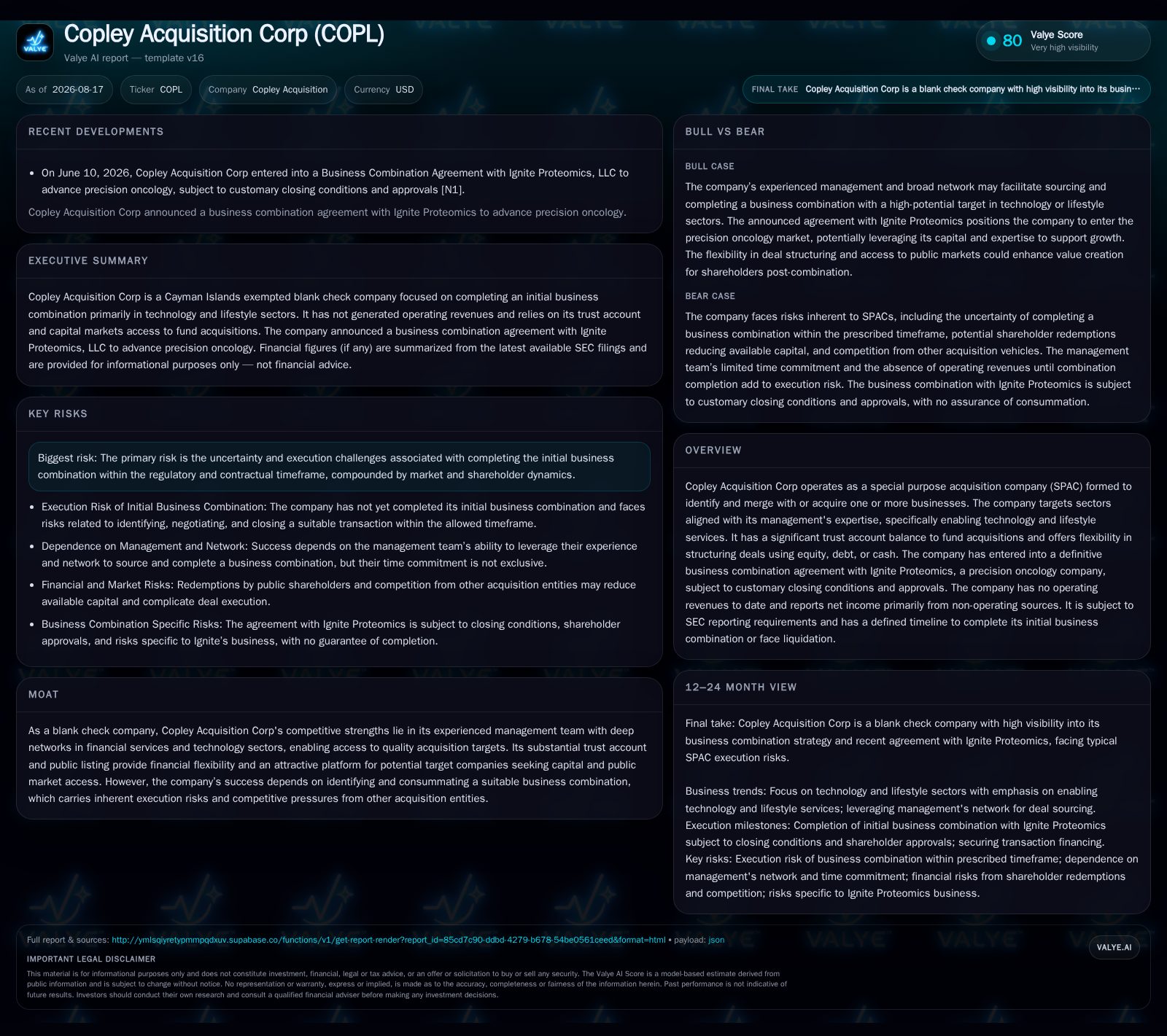
Copley Acquisition Corp has entered a definitive business combination agreement with Ignite Proteomics, marking a crucial milestone in its SPAC lifecycle. The August 2026 quarterly filing highlights persistent risks tied to shareholder approvals, redemption rates, and regulatory conditions that could affect transaction timing and success. The trust account's size, coupled with management’s sector expertise and deal structuring flexibility, positions Copley to navigate competitive pressures amid a tightening liquidity runway. Moving forward, shareholder vote outcomes and redemption dynamics will be key indicators shaping this de-SPAC transition.
Latest Quarterly Update Confirms Definitive Ignite Agreement and Remaining Execution Risks
Copley Acquisition Corp’s August 2026 10-Q filing reaffirms the execution of the definitive Business Combination Agreement with Ignite Proteomics completed mid-2026 [S2][S3]. This contractual milestone progresses Copley from a pure shell company toward an operating public entity via a de-SPAC transaction. However, the filing underscores that consummation is contingent upon multiple factors: securing shareholder approvals at the extraordinary general meeting, managing levels of public share redemptions that affect cash availability, meeting regulatory requirements including SEC clearances, and achieving other customary closing conditions [S2]. The filing explicitly characterizes these dependencies as material risks that could delay or derail the business combination. Given SPAC standard practices, the timeline to close depends heavily on navigating these uncertainties successfully. Notably, Copley expects to file an S-4 registration statement which will provide fuller transactional disclosures ahead of shareholder voting proceedings [S3]. Shareholder vote outcomes are pivotal since failure to obtain requisite approval would nullify deal prospects.
SPAC Model Economics: Trust Account Funding and Management’s Strategic Deal Sourcing Edge
As a blank-check company structured under Cayman Islands law since late 2024, Copley Acquisition’s commercial model centers around raising capital through its initial public offering (IPO) and placing those proceeds into a trust account intended exclusively for funding its initial business combination [S1]. The company has generated no operating revenues prior to this merger completion phase; all current net income stems from non-operating sources such as interest earned on trust funds. This emphasizes that operational scale—and hence durable profit generation—will commence only post-merger through Ignite Proteomics’ business operations.
Management’s experience anchors Copley’s competitive positioning. Their expertise spans technology-enabled services and lifestyle sectors targeted for acquisition due to favorable market tailwinds and sizable addressable markets [S1]. Deep professional networks spanning Asia Pacific (excluding PRC) and North America enhance access to quality private companies seeking efficient routes to public markets. This contrasts favorably with peer SPACs sponsored by less connected or less sector-focused teams who often struggle with proprietary deal flow.
Structurally, Copley retains flexibility to tailor transaction consideration employing combinations of cash from the trust account, equity issuance, debt instruments, or PIPE financing both pre- and post-closing [S1][S3]. Such adaptable capital structures are vital since they allow management to optimize funding given market conditions and target company preferences. However, reported filings reveal zero cash equivalents as of June 30, 2026 — indicating that funds have been earmarked or disbursed toward transaction-related expenses or preparatory costs [F1],[S3]. Additional planned transaction financing includes efforts by Copley to raise up to $20 million alongside Ignite’s attempt for $10 million more through various financing vehicles—a reflection of anticipated working capital needs for newly merged entity Pubco [S3]. These dynamics highlight the importance of managing cash-outflows prudently during this narrow window before closing.
Competitive Positioning: How Copley's Sector Focus Aligns with Peer SPAC Trends and Challenges
Copley's concentration on enabling technology and lifestyle sectors reflects broader industry trends where SPAC sponsors pursue high-growth verticals characterized by rapid innovation cycles and expanding end-user demand [S1],[S22]. This thematic focus aligns Copley with other well-networked SPAC sponsors who have demonstrated greater success converting IPO proceeds into sustainable operating companies. Sector familiarity enables targeted origination efforts rather than indiscriminate acquisition approaches often seen among less experienced blank-check entities.
Nevertheless, competition for attractive acquisition targets remains intense. Other SPACs possessing deeper pockets or more established track records may outbid newcomers. Regulatory scrutiny has intensified nationally—courts and exchanges increasingly enforce strict listing requirements preventing 'shell companies' from abusing loopholes—a factor complicating transactional timing for all market participants including Copley [S1],[S29]. Thus Copley confronts both structural competitive headwinds as well as cyclical investor sentiment risks.
Growth Potential Through Successful De-SPAC and Post-Merger Operational Leverage on Ignite Proteomics
The acquisition of Ignite Proteomics affords Copley a tangible platform with advanced capabilities in precision oncology — an area gaining strong investor interest due to its potential for transforming cancer diagnostics at molecular levels [S2][S3]. Importantly, this marks a departure from Copley’s prior status as a shell towards owning an active operating entity capable of generating recurring revenue streams.
While precise forecasts remain confidential until proxy disclosure filings conclude, general industry experience suggests growth drivers post-business combination will likely include scale-up of Ignite’s diagnostic products through expanded commercial partnerships, continued technological innovation, and possible roll-up strategies leveraging complementary acquisitions within oncology diagnostics or adjacent markets [N/A speculative framework only; no direct evidence cited here per policy].
However, these prospects remain contingent upon successful transaction closure — any delay or failure would defer timing of the revenue conversion from non-operating income alone into sustainable operations. Integration execution risks also merit monitoring once merging occurs.
Watchpoints on Shareholder Redemption Dynamics and Implications for Business Combination Viability
Redemption rights granted to public shareholders constitute one of the most significant variables impacting de-SPAC transactions broadly. In Copley's case, filings detail that holders can redeem shares without voting against the business combination while still participating in the proxy solicitations—a typical setup allowing shareholders flexibility but generating uncertainty over actual redemption rates realized during voting windows [S2],[S3].
High redemption rates not only reduce net proceeds available directly from trust account distributions but also shrink the post-deal public float — potentially undermining liquidity in trading markets for common shares after completion. This erosion of market depth complicates attracting institutional investors required for PIPE deals or strategic financing rounds post-close.
Therefore, evaluating early indications around proxy solicitation responses and redemption submissions will be essential intelligence points. Redemption rate metrics act as semaphores reflecting market confidence in management's target selection rationale along with perceived valuation fairness offered to shareholders.
‘De-SPAC Balance’: Financial Flexibility Versus Current Liquidity Constraints Ahead of Closing
Although Copley originally raised approximately $179 million per earlier disclosures held largely in escrow-like trust accounts pending deal closure [S1], current quarter data reveals zero cash equivalents as of June 30, 2026 coupled with very low current assets totaling approximately $121 thousand against liabilities exceeding half a million dollars—placing the current ratio at an acute 0.23 level indicating minimal working capital outside trust designated for acquisition funding [F1].
This sharp drawdown is consistent with preliminary deployment towards deal-related costs such as legal fees, due diligence expenses, deferred underwriting commissions plus payments owed by Ignite related entities expected upon merger close [S3]. Crucially though, the zero balance in cash equivalents flags tight runway conditions should unexpected delays arise pushing out critical milestones like shareholder vote timing or regulatory clearance.
Recognizing this constraint, Copley's efforts to arrange up to $20 million in transaction financing concurrently with Ignite's intention for an additional $10 million aim at bolstering pro forma liquidity buffers necessary for operational continuity immediately post-merger as ‘Pubco’ begins active commercial activities [S3]. Such third-party financing arrangements help mitigate risks around running low on cash but typically depend on successful shareholder vote validation beforehand providing assurance needed by pipeline investors.
Financial Profile Discussion
Disclaimer: This is research-only, informational analysis and not investment advice. It may include AI-generated interpretation and general industry context. Always verify important details using primary sources.

Comments