
Constellation Acquisition Corp I Faces Liquidity and Governance Hurdles Ahead of Business Combination Deadline
As a SPAC with a shrinking cash base and concentrated Sponsor control, CSTAF confronts operational continuity risks and governance trade-offs in completing a timely merger.
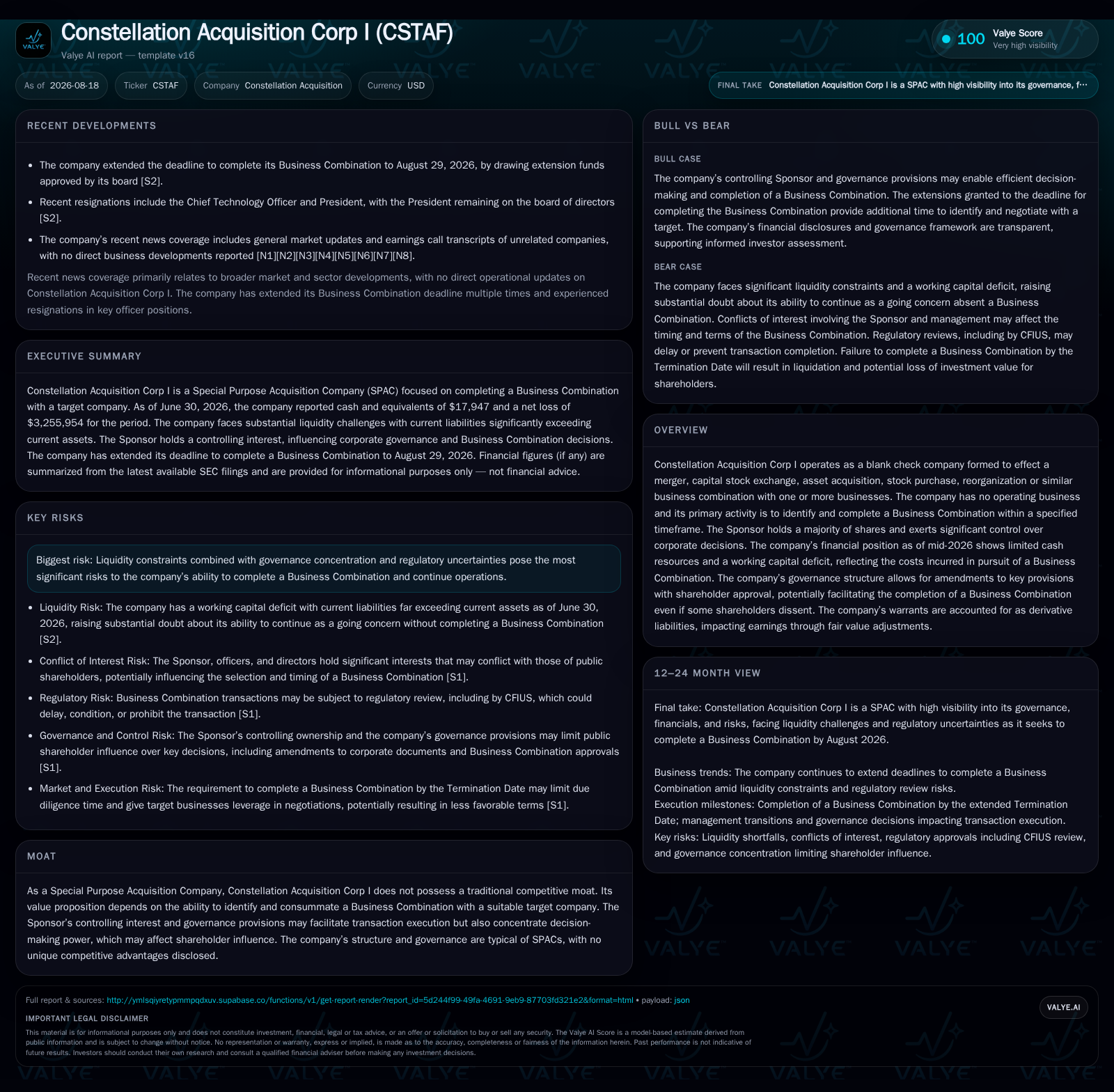
Constellation Acquisition Corp I operates as a Special Purpose Acquisition Company (SPAC) formed to merge with or acquire a private business, taking it public within a finite timeframe. Its latest quarterly filing reveals severe liquidity constraints, including near depletion of cash reserves and a substantial working capital deficit, heightening concerns about its ability to complete a Business Combination before mandatory liquidation. Governance provisions strongly favor the Sponsor's control, enabling amendments without shareholder approval but raising potential conflicts. These factors underscore the urgency to finalize a transaction or face winding down, reflecting common structural and market challenges in the current SPAC environment.
Recent Operating Update
Constellation Acquisition Corp I’s most recent 10-Q filing dated August 17, 2026, paints a stark liquidity picture essential to understanding its immediate operational constraints. The company reported only $17,947 in cash and equivalents on June 30, 2026, dramatically overshadowed by current liabilities of approximately $13.0 million, yielding a current ratio effectively at zero [F1]. This imbalance signals an inability to meet short-term obligations absent additional financing or a completed Business Combination that injects capital.
Compounding this financial stress are recent executive resignations disclosed in an August 7, 2026, Form 8-K filing: both the Chief Technology Officer and President departed effective immediately while one stayed on the board [S3]. Although these changes are not unusual in SPAC lifecycle phases, they may disrupt deal sourcing or integration planning efforts during what is typically an accelerated search period preceding the Termination Date.
Business Model Overview
As a SPAC—a publicly listed shell entity formed without commercial operations—Constellation Acquisition Corp I’s model centers exclusively on raising funds through an initial public offering (IPO) into a trust account and pursuing a "Business Combination" typically within 18-24 months. The goal is to merge with or acquire one or more private companies seeking an alternative route to public markets through this De-SPAC process. CSTAF itself does not generate operating revenues but incurs search-related expenses as it evaluates potential targets.
Revenue generation materializes post-Business Combination when the target company becomes publicly listed under CSTAF’s corporate shell [S1]. Until then, CSTAF’s valuation and viability hinge largely on its cash in trust (buffering redemptions), sponsor equity stakes including Founder Shares and warrants (private placement warrants), and its ability to negotiate favorable terms amid shareholder redemption risk. The Sponsor's majority ownership grants significant influence over timing and strategic decisions
Pricing mechanisms during the deal phase can vary based on redemption levels—where public shareholders electing out receive their pro rata share from funds held in trust—potentially diluting remaining investors and complicating financing strategies such as PIPE investments critical to closing deals. Given CSTAF’s scant cash reserves relative to liabilities, any significant redemptions could drastically impair transaction feasibility.
Industry Structure and Competitive Position
CSTAF operates within the broader SPAC segment where competition revolves primarily around sponsor reputation, access to attractive private targets, timing discipline aligned with limited lifespan mandates (Termination Dates), and efficient governance structures that balance investor protections with deal execution flexibility. Peer vehicles such as Pershing Square Tontine Holdings or Churchill Capital Corp exemplify larger-scale SPAC sponsors with extended networks facilitating higher-profile acquisitions.
Unlike operating companies competing via product innovation or market share expansion, CSTAF’s competitive positioning is predicated upon its ability to quickly identify viable targets amid intensifying regulatory scrutiny following industry volatility. The recent trend toward tighter SEC disclosure requirements and enhanced due diligence processes elevates search costs and compresses timelines for firms lacking robust capitalization or experience.
Moreover, inherent conflicts arise from Sponsor concentration where officers hold outsized decision rights but may simultaneously engage in other ventures competing for similar acquisition opportunities—posing alignment risks between Sponsor interests and public shareholders [S1]. CSTAF’s governance framework explicitly permits amendments to foundational agreements without shareholder consent, potentially streamlining negotiations yet limiting minority stakeholder input.
Growth Drivers
Primary growth drivers for CSTAF rest heavily on external capital market receptivity to alternative public market access routes via SPACs—a dynamic shaped by cycles of investor appetite for speculative instruments versus traditional IPO pathways. Increasing demand among private firms seeking expedited liquidity underpins SPAC relevance.
Regulatory developments that clarify permissible practices or disclosures can also support growth by reducing uncertainties that historically tempered institutional backing for SPAC transactions. However, much depends on execution efficiency against final deadlines since failure triggers mandatory liquidation—nullifying all preparatory investments.
Risks and Watchpoints
Foremost among risks is liquidity exhaustion before consummation of a Business Combination—the crux of CSTAF’s near-term survival challenge given its dwindling cash balance juxtaposed against significant current liabilities [F1][S1][S2]. Failure here precipitates automatic winding-up procedures mandated by governing charters.
Redemption risk poses an additional threat; if disproportionate numbers of public shareholders opt out post-announcement due to skepticism over target quality or deal terms, available transaction funding shrinks markedly unless supplemented by PIPE financing on uncertain terms.
Governance concentration introduces potential conflicts between Sponsor incentives focused on fee realization versus the best interest of outside investors who bear dilution risk from warrant exercises or founder share conversions. Moreover, the ability to amend agreements without broad shareholder approval might expedite deals but undermine minority protections.
Geopolitical upheavals cited—including military tensions affecting global markets—add volatility that could depress valuations of prospective partners or complicate cross-border negotiations [S1]. Executive turnover during critical navigation phases may weaken operational continuity further undermining delicate deal sequencing.
What to Watch Next
Upcoming milestones include adherence to binding timelines culminating in the Termination Date by which CSTAF must consummate its Business Combination to avoid liquidation. Monitoring quarterly filings for updates on candidate evaluations, changes in cash position beyond June 30 figures, amendments invoked under governance provisions, as well as disclosures regarding PIPE financing progress will be instructive.
Redemption rate disclosures following any announced merger agreement will indicate market confidence levels among retail investors—a key factor influencing whether new capital cascades into closing funding gaps. Any further executive leadership changes should also be evaluated for impact on transaction momentum.
Continuous regulatory commentary from securities authorities may affect disclosures required from SPACs like CSTAF going forward; relevant guidance updates should be examined closely given their bearing on compliance costs and investor protections.
Financial Profile Discussion
Disclaimer: This is research-only, informational analysis and not investment advice. It may include AI-generated interpretation and general industry context. Always verify important details using primary sources.

Comments