
BT Brands' Strategic Merger Attempt and Restaurant Spin-Off amid Industry Challenges
BT Brands navigates operational pressures in its multi-concept restaurant portfolio while pursuing a complex merger with Aero Velocity and a planned spin-off of its restaurant business.
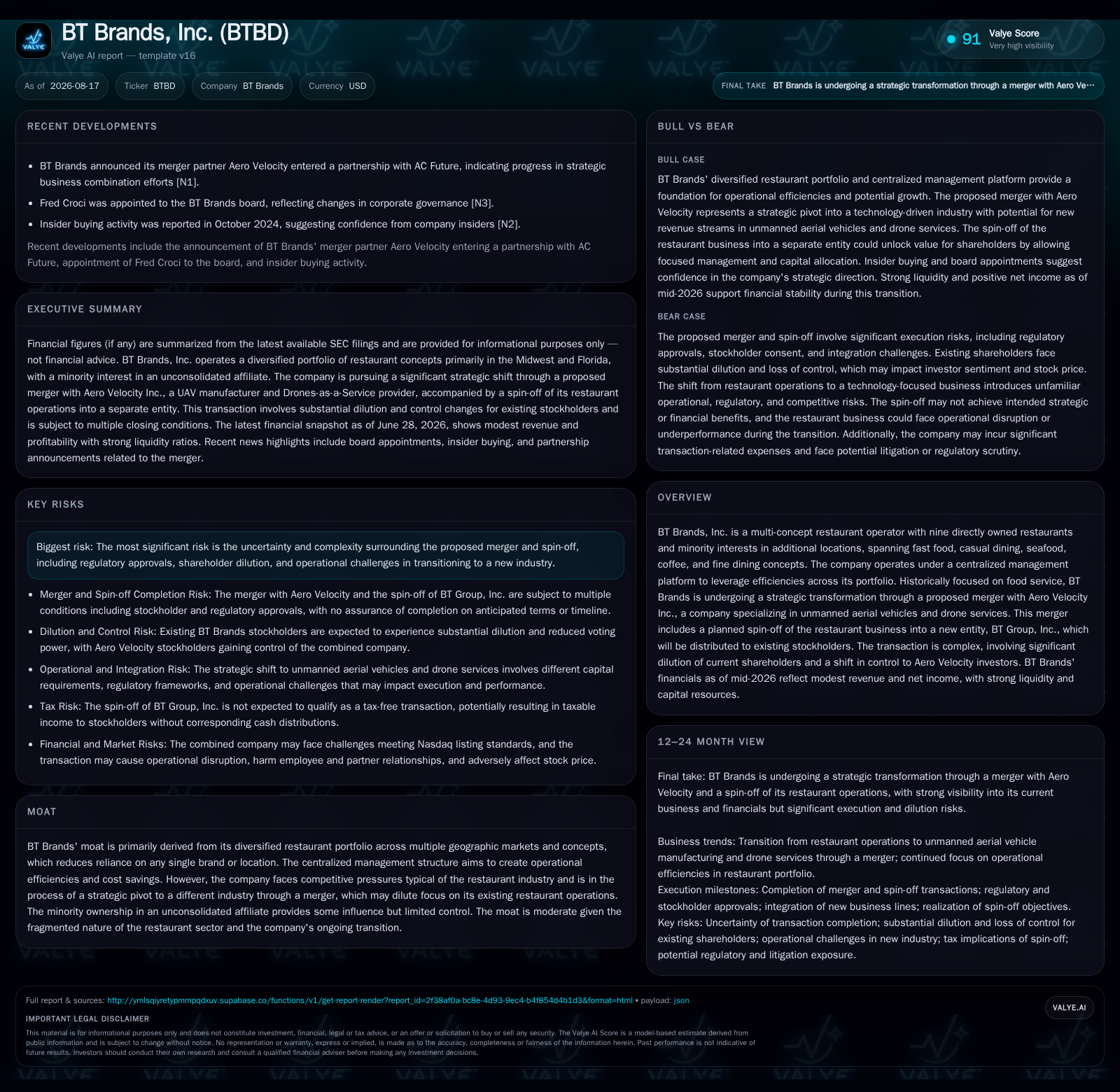
BT Brands, Inc. operates nine directly owned restaurants across diverse food service concepts alongside minority stakes in additional locations. The company is currently engaged in a transformative strategic transaction involving a proposed merger with unmanned aerial vehicle manufacturer Aero Velocity Inc., which would result in spinning off its restaurant operations into a separate entity, BT Group, Inc. Recent filings reveal ongoing challenges, including the termination of the initial merger agreement due to regulatory delays, significant shareholder dilution concerns from the transaction, and operational pressure reflected in modest revenues and losses. The company’s centralized management platform and diversified portfolio provide some stability but also face risks heightened by industry competition and corporate transition complexity.
Recent Operating Update
The quarter’s most material corporate event relates to the proposed merger with Aero Velocity Inc., an unmanned aerial vehicle (UAV) manufacturer [S1], which would transform BT Brands’ business model away from its core food service operations. Importantly, this filing confirms that the transaction contemplates spinning off its restaurant assets into a new entity named BT Group, Inc., to be distributed to existing stockholders [S1]. However, the proposed business combination was terminated as of May 1, 2026 due to regulatory delays—specifically non-effectiveness of required SEC registration statements by April 30—and subsequent disputation from Aero Velocity on termination validity has surfaced [S12].
Business Model
BT Brands operates primarily as a multi-concept restaurant operator with direct ownership concentrated in fast food (six Burger Time locations), casual dining (Keegan's Seafood Grille), coffee shop/bakery (Pie In The Sky Coffee), and fine dining (Schnitzel Haus) concepts primarily located across the Midwest and Florida [S1]. The company also holds a significant minority stake (40.7%) in Bagger Dave's Burger Tavern (five casual dining units), accounted for under the equity method given lack of control but notable influence [S1]. With fourteen total operating sites including affiliates as of late 2025, BT Brands benefits from diversification across concepts and geography—a structural advantage that can mitigate volatility linked to any single brand or market.
Monetization follows standard restaurant industry mechanics: revenue is derived from consumer sales of prepared food and beverage offerings through company-owned stores. Revenue growth drivers include new unit openings (which have been limited due to select closures reported through July 2025) and same-store sales improvements achievable via menu innovation and marketing efforts [S1]. Profitability hinges critically on net food cost containment—which can fluctuate with commodity prices—and labor cost efficiency during rising wage pressures common industry-wide. The use of a centralized management structure aims to optimize support functions such as purchasing, marketing, and back-office overheads across diverse brands to enhance operating margin potential.
Notably absent are franchise revenues; all units operated are either owned directly or secured through equity investments without franchising fees reported—a model that concentrates operational risk but may support margin retention if execution is effective.
Industry Structure and Competitive Position
Within the broader restaurant and food service industry—which encompasses fast food chains like McDonald's, multi-brand operators such as Dine Brands Global or Brinker International, casual dining leaders like Darden Restaurants, coffee-focused Starbucks models, and fine dining boutique operators—BT Brands situates itself as a small-scale multi-concept operator focused heavily on regional presence rather than national scale.
Its portfolio covers differentiated segments but remains modest in scale relative to peers offering long-established brands nationally. This positioning results in competitive pressure from multiple fronts: price-sensitive quick-service competitors challenge Burger Time units; casual dining faces entrenched competitors in localized markets; coffee shops operate against specialty chains; fine dining’s premium segment demands distinctive experiential quality.
Nevertheless, BT Brands' mix provides some revenue stability through diversification but requires continued investment in brand awareness and menu innovation to maintain customer traffic amid evolving consumer preferences. The company confronts typical industry profit constraints caused by rising input costs (labor inflation especially) compounded by limited pricing power inherent in smaller operators without widespread brand cachet.
Growth Drivers
BT Brands’ pathway for growth remains twofold: internally through improved operations at existing restaurants and structurally via corporate transactions.
Operationally, focusing on same-store sales growth via targeted marketing campaigns tailored per concept could boost average check sizes or customer frequency metrics—though no explicit recent same-store sales data has been reported publicly [S1]. Emphasizing menu innovation leveraging local tastes or healthier options may attract repeat customers amid shifting demographic preferences.
Geographic expansion is presently measured; closures over recent years signal possible retrenchment rather than aggressive footprint enlargement [S1]. More promising is potential unlock through the intended spin-off creation of BT Group post-merger completion— enabling shareholders direct exposure to pure-play restaurant operations potentially better positioned for focused capital allocation or third-party investment interest.
Additionally, minority investments like those held in Bagger Dave's offer avenues for indirect expansion without full operational burdens while diversifying revenue streams. Centralized management efficiencies could further improve margins if overhead costs decrease as a percentage of revenue through scale or automation technologies.
Risks and Constraints
The principal risk enveloping BT Brands is transactional uncertainty arising from its strategic merger with Aero Velocity Inc.—a significant pivot away from restaurants into aerospace technology [S1]. The deal’s complexity includes anticipated shareholder dilution whereby Aero investors gain majority control and preferred stock issuance carries enhanced voting rights disproportionate to economic ownership—a structural governance challenge diminishing existing owners' influence [S1].
Regulatory approval delays led management to terminate the initial merger agreement in May 2026 [S12], triggering legal disputes regarding contractual rights that inject further uncertainty about deal closure timeline or success.
Moreover, the intended spin-off does not qualify for tax-free treatment under U.S. federal law for shareholders potentially creating unexpected tax liabilities upon receipt of BT Group shares—an issue that may affect investor reception [S1]
From an operational perspective within the restaurant business itself, risks remain significant: ongoing margin squeeze driven by inflationary input costs on food ingredients and wages persists alongside intense competition from both chain operators benefiting from economies of scale and local independents capturing niche clientele. Recent permanent closures indicate site-level challenges possibly linked to location selection or competitive displacement [S1]. Dependence on key executive leadership sustaining centralized management adds organizational vulnerability amid transition stressors.
What To Watch Next
Investors should monitor:
- Progress on resolving legal disputes related to the terminated merger agreement with Aero Velocity alongside regulatory filings indicating renewed transaction attempts or alternative strategic plans.
- Announcements on timing or execution details around the spin-off formation of BT Group which will house the restaurant assets,
- Operational KPIs such as any reported same-store sales growth figures per concept,
- Margin trajectory influenced by inflationary pressures vs efficiency gains delivered from centralized management,
- New unit openings versus closures signaling confidence or retrenchment,
- Changes in minority investments or partnerships potentially reshaping portfolio exposure.
Progress on these fronts will clarify whether BT Brands can successfully navigate both corporate transformation risks while stabilizing or growing its traditional restaurant operating business.
Financial Profile Discussion
While detailed quarterly income statements are not fully disclosed beyond historical context [F1], BT Brands’ financial strength is underscored by its conservative leverage profile as of June 28, 2026: total debt approximated at $2 million offers limited financial strain relative to cash balances exceeding $7 million measured more recently [F1]. The current ratio near 4.5 signals ample liquidity supporting near-term obligations comfortably without immediate refinancing pressure [F1].
However, historical operating losses near $1.8 million along with net loss over $2.3 million recorded as of year-end 2024 emphasize persistent profitability challenges common among small multi-concept operators balancing growth investments against thin margins [F1]. Cash flow from operations was not detailed recently but ability to sustain operations likely hinges on continued capital support given negative earnings trends.
In summary, BT Brands maintains structural financial resilience despite weak earnings fundamentals reflecting typical sector dynamics compounded by ongoing strategic upheaval.
This analysis synthesizes detailed SEC disclosures alongside standard industry dynamics without constituting investment advice. Future outcomes depend heavily on resolution of corporate transactions alongside execution efficacy within the intensely competitive U.S. restaurant sector.
Disclaimer: This is research-only, informational analysis and not investment advice. It may include AI-generated interpretation and general industry context. Always verify important details using primary sources.

Comments