
Skyline Builders Advances with US Mineral Acquisitions While Managing Hong Kong Construction Risks
Skyline Builders expands into US mineral properties amidst steady Hong Kong civil engineering operations facing customer and subcontractor concentration challenges.
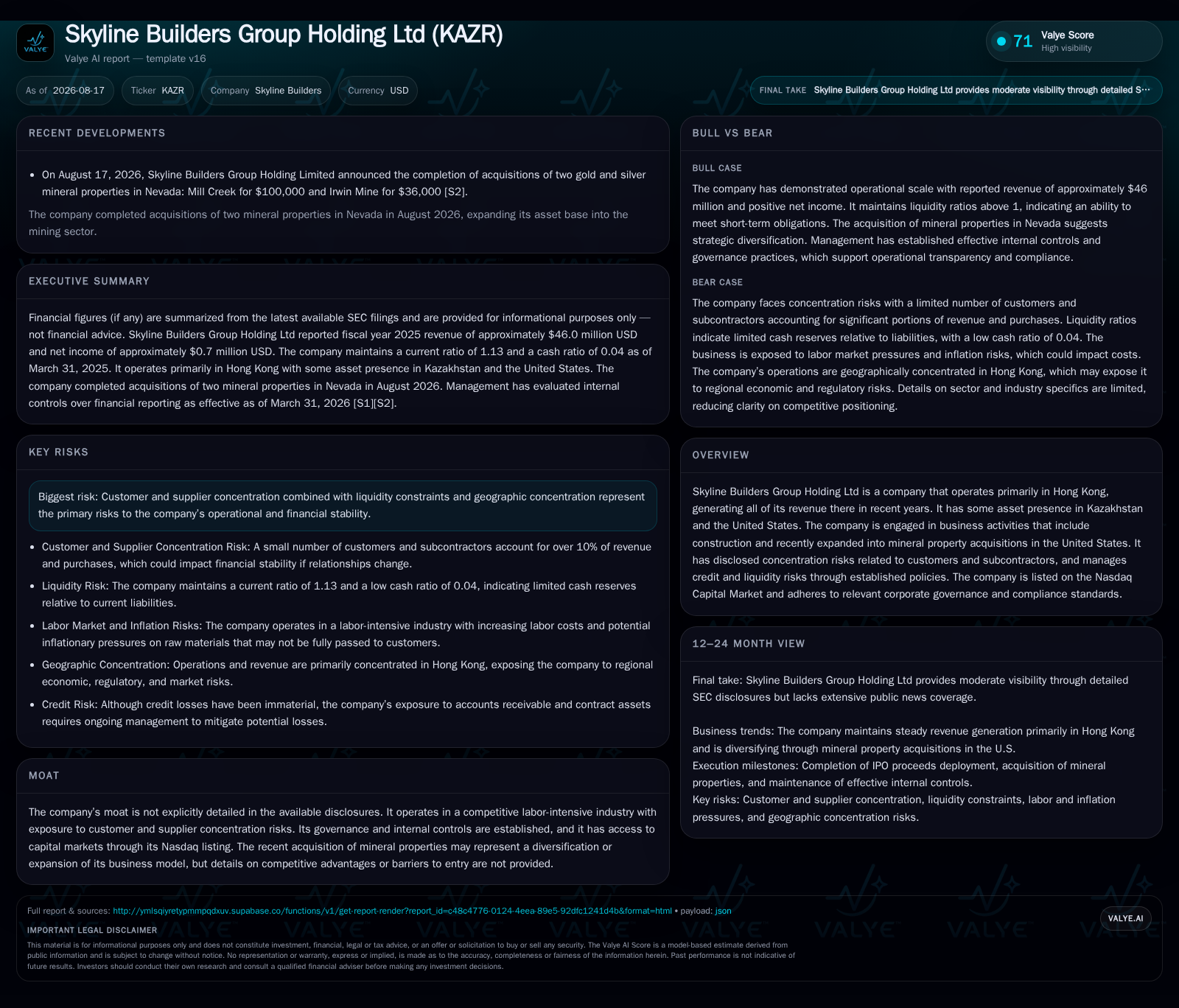
Skyline Builders Group Holding Ltd recently completed acquisitions of two gold and silver mineral properties in Nevada, marking a notable diversification from its core civil engineering business centered on public works in Hong Kong. Despite this expansion, the company’s revenue remains fully derived from Hong Kong infrastructure projects focused on roads and drainage, predominantly executed through subcontracting with growing main contractor involvement since 2020. Concentration risks among a limited number of customers and subcontractors persist, amplifying liquidity and cash flow considerations. The company’s strategy balances leveraging public infrastructure spending in Hong Kong while exploring new growth avenues via its newly formed US subsidiary.
US Mineral Property Acquisitions Signal Strategic Diversification Beyond Core Hong Kong Operations
On August 17, 2026, Skyline Builders announced the completion of acquisitions for two highly prospective gold and silver mineral properties in Nevada — Mill Creek at $100,000 and Irwin Mine at $36,000 — executed through its wholly owned Delaware-registered entity Global Critical Minerals LLC [S2]. This move marks the company's first material step outside its established civil engineering domain based in Hong Kong. While these acquisitions introduce a new asset class to Skyline's portfolio, current disclosures portray this as an investment holding position without active business operations, indicating early-stage exploration rather than an immediate operational pivot or revenue contributor [S1]. The modest purchase prices reflect speculative positioning rather than transformative capital deployment.
The strategic rationale appears oriented towards diversifying revenue streams or value creation optionality beyond Skyline's established footprint. However, the lack of disclosed timelines or near-term monetization plans limits assessment of expected impact. It raises key questions about management focus balancing ongoing core construction execution against resource allocation towards mining ventures that bear distinct operational profiles from public works contracting.
Consistent Civil Engineering Revenue Reflects Stability Despite Customer Concentration Risks
Skyline's principal business revolves around providing public civil engineering services primarily within Hong Kong's infrastructure sector focused on roads and drainage projects. The company reported total civil engineering revenues of $50.1 million for the fiscal year ended March 31, 2026 — up 8.9% year-over-year from $46 million — underscoring steadiness amid competitive pressures [S1]. Notably, all revenue is generated within Hong Kong despite diversified asset holdings including Kazakhstan (34% of assets) and US (2%), highlighting geographic concentration risk on operating cash flows [S1].
Customer concentration metrics reveal a tightening base: revenue contribution from customers generating over 10% fell from five last year to three this year; similarly, purchases show dependence on a few subcontractors accounting for significant proportions of total expenditure [S1]. Accounts receivable concentrations mirror this trend with three customers holding over 10% share as of FY2026-end. These factors elevate risk profiles related to cash flow volatility and underline the importance of robust credit risk management practices that Skyline states it has embedded through periodic financial evaluations and allowance provisions maintaining immaterial credit losses historically.
Subcontracting Focus Versus Main Contractor Ambitions: Cost Management in a Competitive Market
Historically functioning mainly as a subcontractor within the value chain executing portions of broader civil engineering contracts, Skyline gained full qualifications to bid as main contractor after registration on Hong Kong's Approved Contractors List in March 2020 (Group B Roads & Drainage category) [S1]. This regulatory milestone enables direct tendering for public works contracts potentially augmenting contract size visibility and gross margin capture by internalizing more stages of project delivery.
Cost of revenue predominantly comprises subcontracting charges alongside material consumables, direct labor costs, and attributable overheads including plant/equipment depreciation [S1]. This suggests managerial agility in balancing internal labor deployment versus third-party specialists to maintain cost effectiveness amidst labor shortages or wage inflation common across the industry.
Industry Landscape: Competitive Intensity and Barriers Within Hong Kong’s Public Works Sector
Skyline operates within a mature yet labor-intensive sector shaped significantly by public infrastructure investment programs controlled by governmental agencies. The company competes alongside regional heavyweight contractors such as China State Construction Engineering Corporation (CSCEC) and Gammon Construction Limited who benefit from scale advantages, broader project portfolios spanning private sectors, and deep balance sheet liquidity underpinning bid competitiveness.
Entry barriers include stringent eligibility criteria exemplified by inclusion on Approved Contractors Lists—a prerequisite for public tender submissions—further regulated certification schemes addressing specialized trades such as piling or foundation work where Skyline holds specific registrations [S1],. These factors consolidate market access among incumbents but simultaneously limit rapid entrant proliferation. Project success hinges critically on effective subtrade management given reliance on specialized subcontractors impacting cost control and timely execution.
Key Risks: Customer & Supplier Concentration, Liquidity Constraints, Geographic Concentration
Repeated disclosures emphasize operational risks arising from concentrated revenue sources where limited key customers contribute disproportionately to income generation—and concomitant accounts receivable—thereby magnifying exposure to individual credit or payment delays that could impair liquidity positions especially given typical long payment cycles in civil construction projects [S1]. Supplier dependence similarly adds vulnerability if principal subcontractors face capacity or financial constraints.
Geographically skewed operations confined predominantly to Hong Kong exacerbate risk profiles exposing Skyline to localized economic downturns or policy shifts limiting diversification buffers. Liquidity risks persist due to working capital timing mismatches between outflows for materials/labor/subcontracts versus inflows from progress billings or milestone payments requiring attention through financing arrangements or strict cash management policies documented in filings [S4], [S5].
Growth Drivers: Public Infrastructure Spending, Tender Eligibility Expansion, and Acquisition Potential
Continued government infrastructure expenditure forms the backbone underpinning Skyline’s stable contract pipeline given persistent urbanization trends necessitating transportation network upgrades alongside utilities maintenance within Hong Kong’s dense metropolitan framework. Registration enabling direct main contractor bidding since 2020 opens opportunities for higher-margin engagements by capturing comprehensive contract sums reducing reliance on lower-margin subcontract roles.
Further growth potential derives from strategic moves into complementary sectors like mineral property acquisition through Global Critical Minerals LLC providing optionality beyond traditional construction activity though still nascent with no disclosed production timelines or related revenue forecasts yet available to quantify near-term material impact on consolidated results [S2],.
What To Watch: Execution on New Ventures, Project Backlog Development, and Cash Flow Timing
Near term milestones warrant monitoring include any announcements clarifying exploration progress or commercialization strategy regarding new US mineral assets which will test management bandwidth across disparate industries [S2]. Operationally relevant KPIs comprise contract backlog size evolution signaling visible future revenue streams along with margins reflecting mix shifts between main contractor engagements versus subcontracting roles.
This analysis is based solely on publicly available filings as referenced herein up to August 17, 2026. It aims to provide sector-aligned interpretive insight without extrapolating proprietary forecasts or investment research views.
Disclaimer: This is research-only, informational analysis and not investment advice. It may include AI-generated interpretation and general industry context. Always verify important details using primary sources.

Comments