
Mitesco’s Capital-Light Data Center Pivot Faces Financial Strain and Competitive Challenges
Transitioning from shuttered clinic operations to cloud services, Mitesco struggles with liquidity while betting on scalable co-location and AI-driven applications.
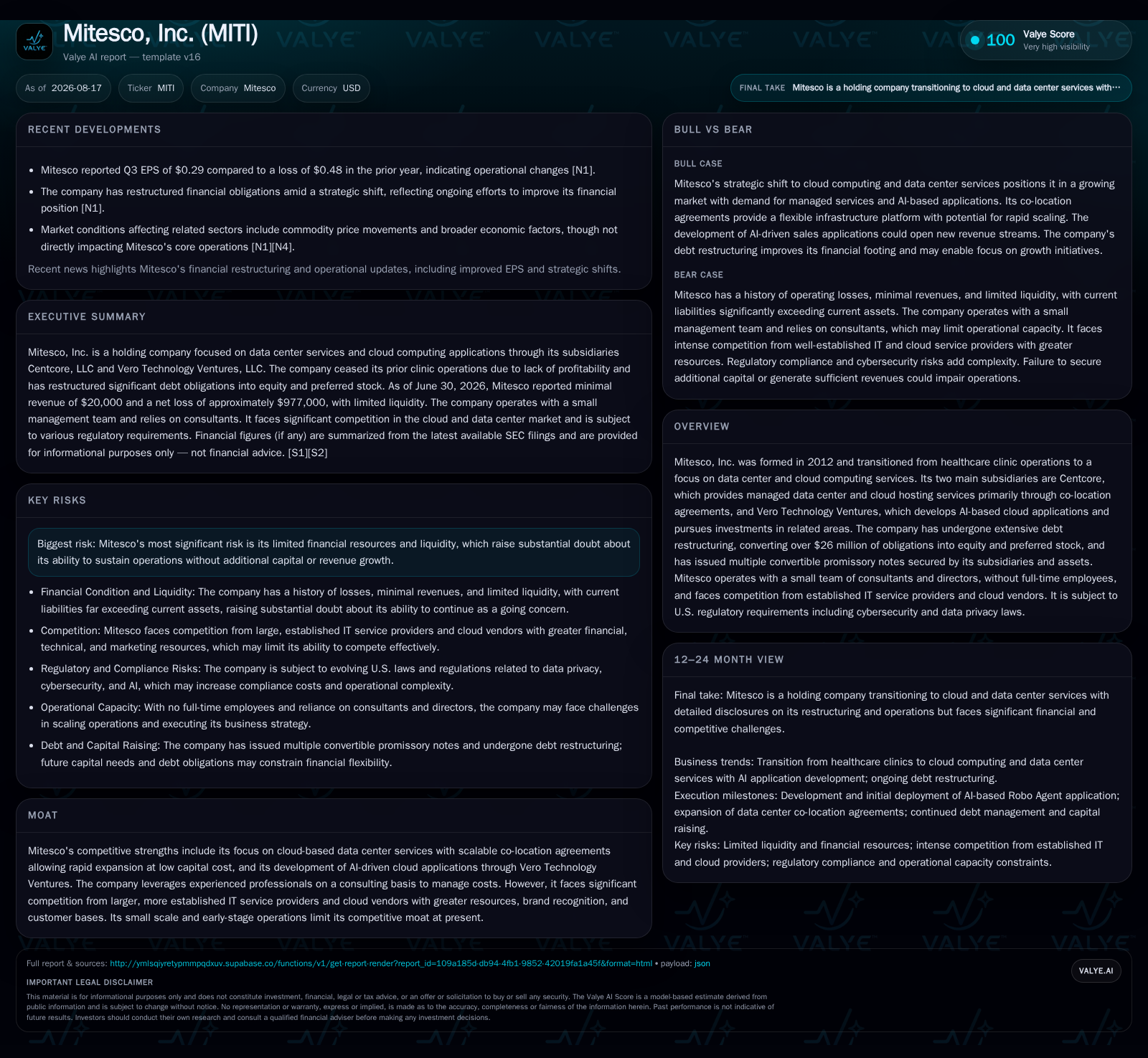
Mitesco, Inc. has shifted its strategy from operating healthcare clinics to providing managed data center and cloud computing services through its subsidiaries Centcore and Vero Technology Ventures. The company leverages co-location agreements to expand capacity efficiently and is developing AI-based cloud applications to diversify revenue. However, its limited financial resources, substantial legal obligations from past operations, and competition from large cloud providers cloud near-term growth prospects. The lack of meaningful recurring revenue coupled with a minimal cash runway underscores the critical importance of successful capital raising or operational scaling.
Recent Operating Update and Strategic Pivot
Mitesco's latest quarterly filing highlights a continuation of its strategic pivot away from healthcare clinic operations toward data center services and AI-focused cloud applications. Since shuttering its nurse practitioner clinics by the end of 2022 due to persistent unprofitability, the company has centered its efforts on two wholly owned subsidiaries formed in mid-2024: Centcore LLC focusing on managed data center services through co-location arrangements, and Vero Technology Ventures LLC (VTV) targeting AI-driven software solutions tied to cloud platforms [S1], [S4]. This transition represents a fundamental redefinition of the company's business model amid challenging legacy burdens.
The most recent filings report no material changes to risk factors since the annual report issued earlier in 2026 [S2], emphasizing ongoing uncertainties surrounding execution and liquidity.
Business Model Specifics
Mitesco operates as a holding company leveraging its subsidiaries for core revenue generation. Centcore's primary offering is managed hosting via co-location agreements rather than through owning physical data center assets. This arrangement allows quick scaling by leasing space within established facilities—currently grounded in a key data center located in Melbourne, Florida with access to partnerships spanning eight international centers [S4], [S14].
This capital-light model reduces upfront capital expenditure—a critical advantage given Mitesco's constrained financial resources—but depends heavily on securing client contracts that generate subscription or usage-based recurring revenue streams common in managed IT services.
The company's operational staffing deliberately avoids traditional full-time employees; instead, it retains seasoned consultants for data center management, cybersecurity compliance, and software development duties. This flexible cost structure aims to align expenses closely with business activity but may limit scalability or rapid responsiveness compared to firms with dedicated internal teams [S14].
Revenue generation metrics crucial for this sector—such as monthly recurring revenue (MRR), contract renewal rates, customer acquisition cost (CAC), and data center utilization—are not explicitly disclosed but are pivotal for validating future growth claims.
Industry Structure and Competition
Mitesco positions itself within the midstream tier of the data center/cloud computing value chain by providing physical hosting space (via co-location) alongside managed infrastructure services. Its cloud application initiatives attempt to differentiate through AI innovation.
This sector is dominated by major public cloud providers like Amazon Web Services (AWS), Microsoft Azure, and Google Cloud Platform that offer vast service breadths—including IaaS, platform-as-a-service (PaaS), SaaS—and hold entrenched relationships across enterprise IT departments worldwide. Their scale delivers exceptional pricing power, integration ecosystems, compliance certifications, global availability zones for latency optimization, high service uptime guarantees (>99.9%), robust security postures against evolving cyber threats, and continuous technological innovations.
In contrast, Mitesco's smaller scale restricts differentiation mostly to niche client needs or bespoke application development via VTV. Market penetration faces high barriers stemming from brand awareness gaps, limited capital for capacity expansion beyond co-location reliance, and competition against established managed service providers with deeper direct sales channels.
Growth Drivers
Industry-wide demand drivers include enterprise digital transformation agendas catalyzing accelerated migration from on-premises systems to flexible cloud infrastructures; growing appetite for scalable compute/storage capacity accessible via subscription models; surging interest in AI/ML capabilities embedded within cloud platforms; regulatory requirements elevating cybersecurity/compliance needs; and outsourcing IT infrastructure management to specialized service vendors.
Mitesco aims to tap these tailwinds by:
- Expanding co-location agreements worldwide leveraging partner networks allowing rapid capacity scaling at modest CapEx commitments.
- Delivering managed hosting that bundles compute resources with application hosting under recurring fee contracts (potentially improving gross margins over raw space leasing).
- Developing proprietary AI-powered applications addressing market-specific pain points such as sales automation ('Robo Agent') which can diversify revenue beyond infrastructure fees.
- Maintaining low fixed overhead through consultant engagements preserving cash burn flexibility during scale-up phases.
Nonetheless, converting these enablers into tangible bookings and retention metrics represents a critical hurdle given the company's fledgling status.
Risks and Constraints
The most significant threat lies in Mitesco’s precarious financial foundation: as of June 30, 2026 quarters end, cash reserves were just $7,984 against total debt approximating $639,416—yielding net debt around $631,432—with an alarming current liability tally exceeding $22 million likely linked to historical obligations tied to discontinued clinic operations [F1], [S10].
These liabilities cast considerable doubt on going concern assumptions absent successful capital infusions or meaningful operating cash flow improvements highlighted repeatedly by auditors [S18]. Additionally:
- Customer acquisition risks persist because contracts are often short-term subscriptions without guaranteed renewals; economic uncertainty could prompt customers towards lower-cost competitors or reducing usage.
- Competitive intensity from dominant cloud titans limits pricing power and pressures margin resilience.
- Regulatory compliance demands around cybersecurity frameworks (e.g., NIST standards), data privacy laws (e.g., CCPA/GDPR), and emerging AI governance create ongoing operational burdens.
- Legal exposures from residual clinic business settlements introduce unpredictable costs that could hamper reinvestment capacity.
- Reliance on partner-operated co-location facilities constrains direct control over infrastructure reliability or expansion timing.
- Limited internal human capital may delay product development cycles or inhibit robust customer support necessary for scaling reputation.
What To Watch Next
lidation points as will tracking operating expense reductions relative to scaled revenue gains.
Financial Profile Discussion
This narrow financial runway underscores dependency on successful fundraising efforts enabled through advisory contracts finalized in July/August 2026 encompassing compensation packages partly paid via restricted stock issuances as a non-cash conservation tactic [S17], [S23]. Investors should focus on capital inflow timeliness against planned growth expenditures before positive operating leverage can emerge.
Conclusion
Mitesco’s evolution into a niche player focused on capital-light co-location driven managed services combined with innovative AI application development targets relevant secular trends in digital transformation and cloud adoption. However, execution challenges are considerable given the limited financial cushion following extensive restructuring of prior indebtedness arising from shuttered clinic businesses. The company’s competitive moat remains thin compared to large-scale incumbents dominating cloud infrastructure markets. Growth hinges critically on securing recurring contracts under subscription models that validate both Centcore’s hosting platform scalability and Vero Technology Ventures’ application pipeline milestone achievements while navigating cybersecurity regulations typical of this industry segment.
Disclaimer: This analysis is solely for informational purposes based on publicly available SEC filings as of August 17, 2026. It does not constitute investment advice or a research view.
Disclaimer: This is research-only, informational analysis and not investment advice. It may include AI-generated interpretation and general industry context. Always verify important details using primary sources.

Comments