
TAO Synergies’ SPAC Status Highlights Capital Structure Complexity and Liquidity Strength
TAO Synergies maintains significant liquidity amid ongoing net losses, with convertible preferred stock and embedded derivatives shaping its financial reporting.
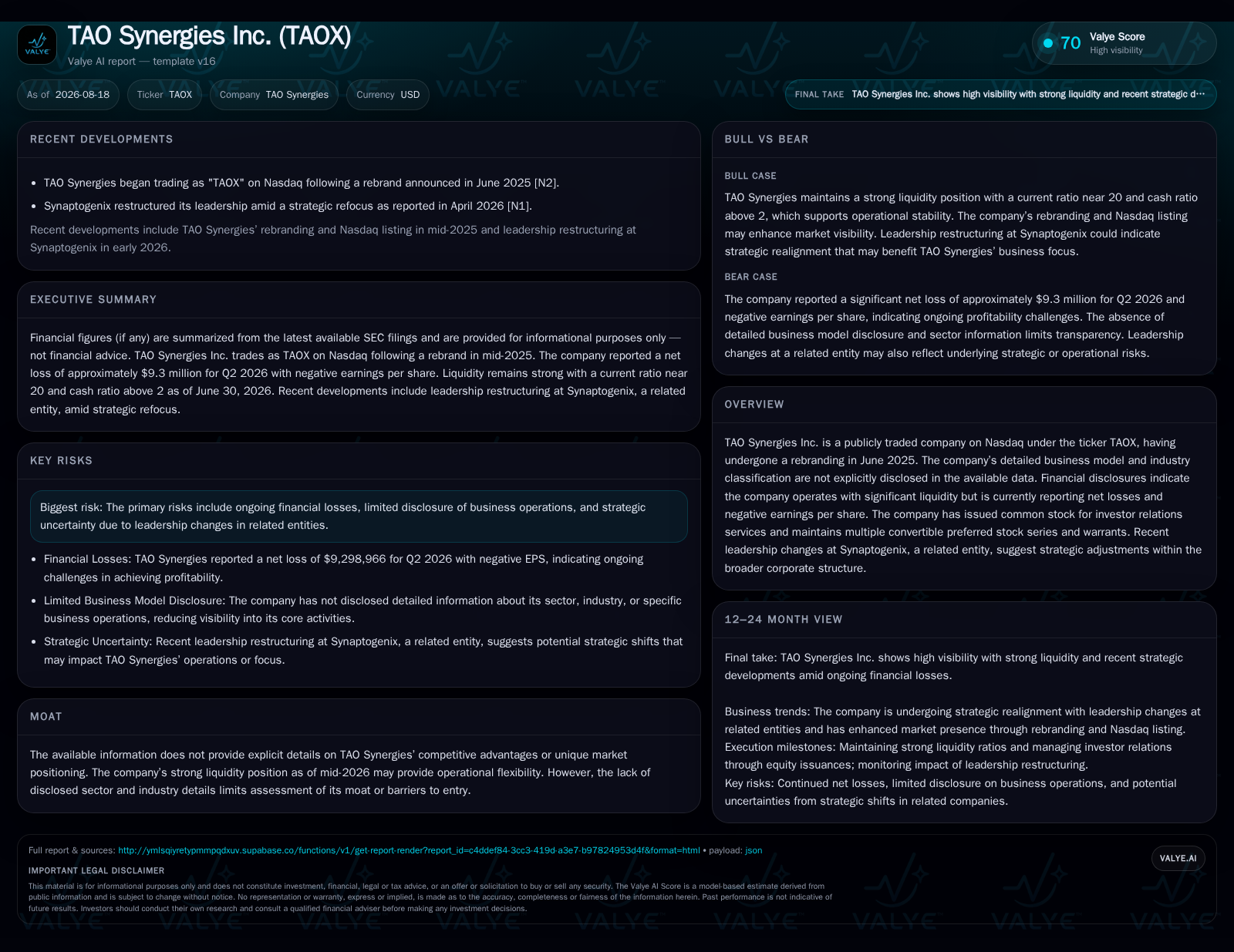
TAO Synergies Inc. (TAOX) operates as a Special Purpose Acquisition Company (SPAC) with no disclosed commercial operations, focused on completing a business combination. Its recent quarterly filing confirms continued net losses and issuance of common stock for investor relations, while convertible preferred stock with embedded derivatives complicates its capital structure. The company’s solid current ratio and liquidity provide operational flexibility but also highlight typical SPAC risks related to timing, dilution, and market sentiment. Leadership changes in affiliated entities add to strategic uncertainty without clear near-term resolution.
Recent Operating Update
TAO Synergies Inc.’s latest quarterly filing dated August 13, 2026, confirms its ongoing status as a shell entity consistent with a Special Purpose Acquisition Company (SPAC) archetype [S2]. The company reported no material operational changes but recorded further issuance of common stock to third parties for investor relations services earlier in 2026. No revenues or commercial operations were disclosed; instead, the quarterly statement emphasized continued net losses reflecting the cost base for corporate functions [S2].
This persistence of losses and non-revenue-generating status aligns with a SPAC awaiting a de-SPAC transaction [S2]. Notably absent were announcements regarding progress toward or timelines for a business combination target, leaving the company profile unchanged from prior periods
Business Model and Capital Structure Complexity
TAO Synergies functions primarily as a public shell company designed to raise capital through an initial public offering and then identify a private company target for acquisition or merger. Until such a de-SPAC transaction is completed successfully, the company does not generate operational revenues but incurs expenses related to maintaining public listing status, compliance, administration, and sponsor incentivization [S1].
A critical facet of TAO Synergies’ financial structure is its multiple series of convertible preferred stock issued over time, including recent Series E preferred stock sold in October 2025 [S1]. These preferred shares have been classified predominantly as debt-like instruments rather than straightforward equity due to embedded conversion features that are economically similar to liabilities. Consequently, these embedded derivatives require ongoing fair value measurement adjustments at each reporting date, injecting additional complexity into financial reporting.
The presence of such convertible preferred stock with embedded derivatives tends to obscure the equity base from a straightforward valuation perspective. It implicates potential dilution risks upon conversion or exercise and creates volatility in reported earnings due to mark-to-market derivative accounting — typical characteristics noted among SPACs sponsoring PIPE financings or engaging complex capital raises prior to closing an acquisition [S1].
Industry Context: SPACs Amid Market Dynamics
As a publicly traded vehicle without direct product lines or customers, TAO Synergies fits squarely within the SPAC industry segment focused on facilitating private-to-public transitions.
Key performance indicators relevant here include the company's ability to complete the business combination within mandated timeframes, maintain trust account liquidity sufficient to meet redemptions, manage dilution impacts from warrants and convertible instruments effectively, and align sponsor incentives with shareholder returns. Public data do not reveal measures such as redemption rates or PIPE investor participation specifics for TAO Synergies but given the structural features disclosed, these typical measures will be closely watched going forward.
Peer entities such as Churchill Capital Corp and Social Capital Hedosophia illustrate the strategic importance of deal flow quality and sponsor reputation in overcoming execution risks.
Growth Drivers
The primary growth driver for TAO Synergies lies outside traditional operational expansion; instead it depends fundamentally on identifying an attractive private acquisition target that can withstand public market scrutiny post-merger. Favorable market conditions for IPO alternatives via SPACs enhance the probability of successful capital raising through PIPE investments supporting larger deals.
Investor appetite for speculative yet potentially high-growth de-SPAC entities can fuel valuation uplift post-transaction if aligned with strong governance and clear strategic vision.
Monitoring these factors will provide evidence points regarding the transition from a dormant shell towards an operating enterprise underlying future revenue prospects.
Financial Profile Discussion
As of June 30, 2026, TAO Synergies reported cash and cash equivalents totaling approximately $2.37 million alongside total current assets near $20.6 million against current liabilities around $1.03 million resulting in an exceptionally high current ratio close to 20 [F1]. This strong liquidity buffer is positive from an operational flexibility standpoint especially since it must preserve funds held in trust for potential shareholder redemptions amid pending transactions.
However, persistent operating losses are evident including nearly $9 million negative operating income and almost $29 million net loss as of end-2025 [F1], underscoring absence of operating revenue streams typical for pre-deal SPACs. Ongoing expenses relate mainly to administration, compliance costs tied to maintaining public listings, fair value adjustments on embedded derivatives relating to convertible preferred stock instruments, and payments for investor relations services often compensated via equity issuance rather than cash outlays [S1][S2].
The inclusion of multiple debt-classified convertible preferred stock series complicates leverage assessment but reflects strategic funding approaches prevalent among contemporaneous SPAC structures backed by PIPE investors seeking downside protection via liquidation preferences coupled with upside through conversion options [S1]
Taken together, the financial stance highlights TAO Synergies as principally a capital vehicle awaiting transactional transformation more than an operating concern generating positive cash flows thus far.
This analysis is based solely on publicly available information including SEC filings dated up to August 13, 2026 [S1][S2][F1] and should not be construed as investment advice or research view. The firm’s classification as a SPAC entails unique structural risks distinct from operating businesses; readers should consider this context when evaluating disclosures herein.
Disclaimer: This is research-only, informational analysis and not investment advice. It may include AI-generated interpretation and general industry context. Always verify important details using primary sources.

Comments