
Capstone Companies Faces Critical Liquidity Constraints Amid Strategic Pivot Challenges
The company’s failure to commercialize its Connected Chef product and ongoing funding shortfalls highlight significant execution risks as it attempts to transition into the health, fitness, and social activities sector.
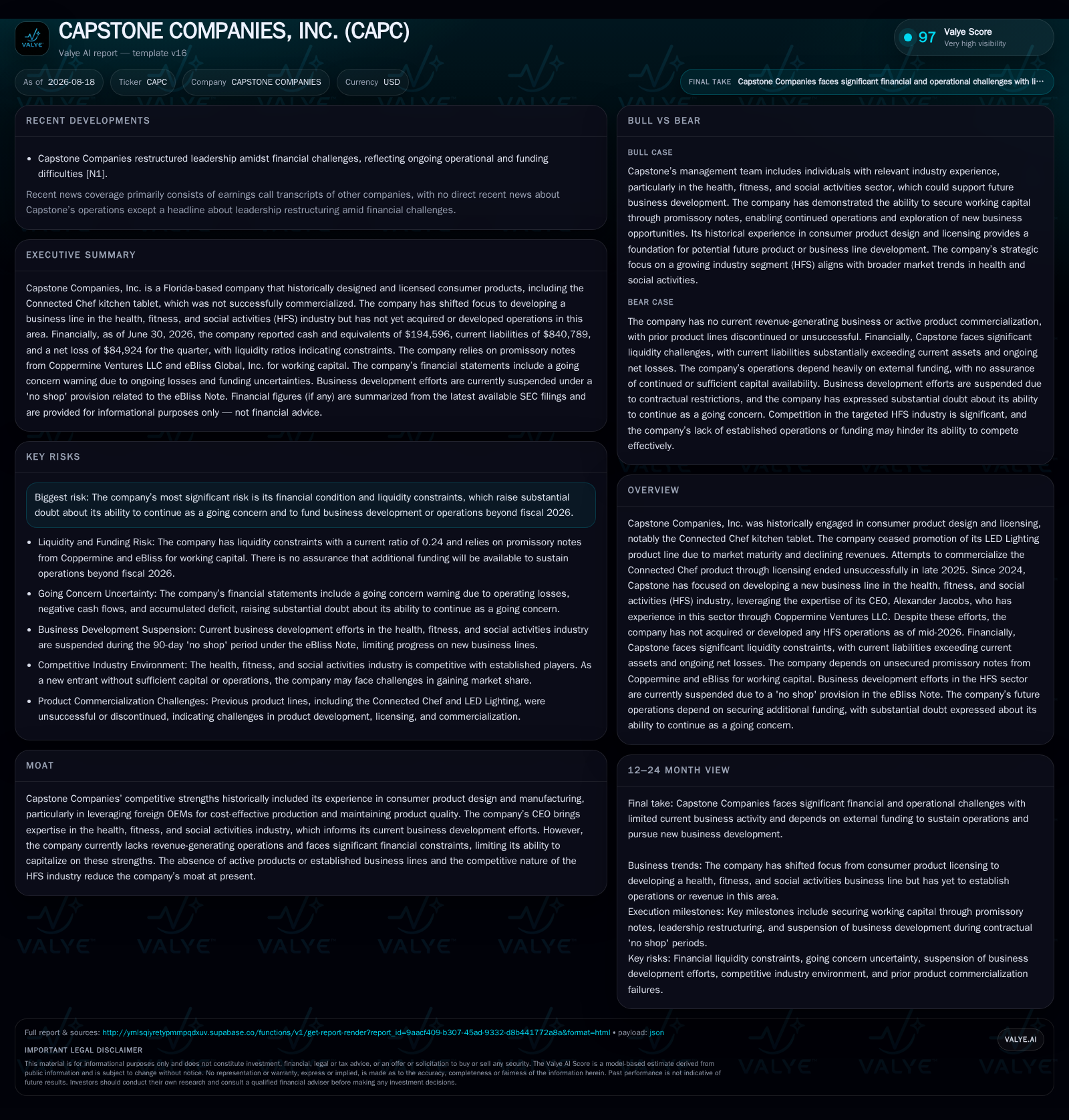
Capstone Companies, Inc. is confronting severe financial distress following the unsuccessful commercialization of its Connected Chef kitchen tablet and the discontinuation of its LED lighting business. Its strategic pivot toward the health, fitness, and social (HFS) activities industry has yet to yield acquisitions or operational traction due to limited working capital. The recent termination of a Letter of Intent with eBliss Global further delays potential transformative transactions. With current liabilities far exceeding current assets and operating losses mounting, Capstone’s ability to continue operations through fiscal 2026 hinges on securing additional funding and successfully executing its pivot strategy.
Recent Operating Update
While unsecured promissory notes from related parties Coppermine Ventures LLC and eBliss Global have temporarily funded essential operations and regulatory compliance costs, these sources fall short of enabling product commercialization or acquisition activities without additional capital before fiscal year-end [S2]. Notably, efforts to consummate a strategic transaction with eBliss Global terminated in August after extended due diligence failed to reach agreement [S3]. This event also lifted exclusivity restrictions that had previously constrained alternative deal pursuits earlier in the year [S13].
Business Model and Strategic Position
Historically focused on designing and licensing consumer technology products aimed at simplifying daily living, Capstone’s most recent flagship was the Connected Chef kitchen tablet. Despite integrating Google Mobile Services and an accessory platform for food preparation tools, licensing efforts faltered in 2025 during manufacturing challenges exacerbated by US-China tariff impacts that compromised cost competitiveness with Asian OEM partners [S1][S22]. Prior to this failure, Capstone’s legacy LED Lighting product line experienced steep revenue declines through 2024 leading to discontinuation though some inventory liquidation continued into early 2025 [S1].
Following loss of licensing arrangements for Connected Chef by late 2025 and cessation of LED Lighting sales, Capstone lacks any active revenue-generating business lines or confirmed commercial pipeline [S19]. Management has pivoted toward the health, fitness, and social activities (HFS) sector—a fragmented but expanding market segment—with CEO Alexander Jacobs bringing relevant prior experience from Maryland-based ventures under Coppermine Ventures LLC.
This transition illustrates common challenges facing consumer tech licensors confronting shrinking legacy markets: entering service-oriented segments demanding operational scale and facility management requires deeper capital resources and organizational capabilities than IP licensing.
Industry Structure and Competitive Positioning
Consumer products technology companies often generate revenue via proprietary design combined with partnerships with OEM manufacturers who provide cost-effective production at scale. Licensing models depend heavily on securing reliable manufacturing supply chains alongside third-party distributors or licensees who absorb commercialization costs while delivering royalty income back to IP owners.
Capstone’s historical reliance on Chinese contract manufacturers became problematic following tariffs imposed circa 2018 that disrupted pricing structures—undermining competitiveness for products like Connected Chef under licensing agreements affected by higher manufacturing costs passed through tariffs [S1][S22]
The HFS pivot aligns with broader trends among consumer technology firms seeking growth in wellness and social engagement markets (akin to wearable device makers expanding services). Yet Capstone faces barriers competing against entrenched operators with established brands commanding customer loyalty. Managing physical facilities or leagues entails operational expertise distinct from product licensing.
Growth Drivers
Potential growth depends on several factors:
- Securing sufficient working capital to acquire or develop viable HFS businesses capable of generating steady cash flows.
- Leveraging CEO Jacobs’ experience to design offerings appealing across diverse demographic groups rather than narrowly targeting adult sports enthusiasts.
- Identifying strategic acquisition targets or partnership alliances robust enough to marshal complementary resources.
- Potentially repositioning legacy IP such as Connected Chef if an external distributor or licensee willing to shoulder commercialization costs emerges.
Absent concrete milestones such as signed strategic partnerships or closed acquisitions supported by committed financing, growth prospects remain speculative.
Risks and Constraints
Capstone’s financial condition raises substantial doubt about its ability to continue as a going concern following consecutive years of operating losses exceeding $1 million annually without offsetting positive cash flow ventures [F1][S2]. The pronounced imbalance between current liabilities and assets poses imminent solvency risks if external funding ceases unexpectedly.
Heavy dependence on related-party unsecured promissory notes entails execution risk given lack of binding long-term financing commitments. Failure thus far to secure third-party financing or close transformative deals undermines operational continuity.
Additional risks include:
- Intense competition in both consumer electronics licensing (dominated by better-capitalized firms) and fiercely contested HFS markets where brand equity drives customer retention.
- Tariff regimes affecting international contract manufacturers integral to hardware production.
- Operational challenges inherent in pivoting business models lacking scale or distribution networks.
- Absence of recurring revenue streams intensifies cash flow vulnerabilities.
These factors collectively heighten execution risk over coming quarters absent immediate liquidity stabilization.
What To Watch Next
Near-term indicators include:
- Progress on securing alternative funding beyond Coppermine Ventures LLC and eBliss—including third-party debt or equity—to sustain overheads and enable business development [S2].
- Any revival or new licensing arrangements involving Connected Chef signaling monetization potential.
- Identification and closure of acquisition targets within HFS sectors following eBliss Letter of Intent termination [S3][S17].
- Quarterly metrics showing improved liquidity ratios or positive operating cash flow would indicate stabilization.
- Management updates clarifying adjusted pivot strategies if prior HFS approaches prove unviable.
Without clear signs of funding adequacy matched by tangible business progress, Capstone remains vulnerable to liquidity-driven restructuring outcomes.
Financial Profile Discussion
As of June 30, 2026, Capstone held $194,596 in cash equivalents against current liabilities approximating $840,789—resulting in a critically low current ratio near 0.24 indicative of severe liquidity stress [F1]. Total debt stood around $505,755 as last reported September 30, 2025. Operating losses exceeded $1 million in calendar year 2025 alone with net income negative $920,168; no subsequent revenues have been recorded post-2024’s modest $143,269 total [F1]. Negative operating cash flow reflects absence of active revenue-generating products after discontinuation of Connected Chef licensing efforts and LED Lighting sales cessation [F1][S1][S2].
Reliance on unsecured promissory notes from related parties introduces refinancing risk given lack of binding long-term commitments. Without collateralizable assets or significant investor interest—exacerbated by penny stock status—raising affordable capital remains challenging despite stated management intentions to explore equity issuance or strategic partnerships [S5][S7][S25]
Overall financials depict a distressed startup struggling amid transition pressures compounded by resource constraints limiting capacity for effective product commercialization or competitive positioning outside legacy core areas.
Disclaimer: This is research-only, informational analysis and not investment advice. It may include AI-generated interpretation and general industry context. Always verify important details using primary sources.

Comments