
BioXcel Therapeutics Faces Critical Financing and Trial Milestones as BXCL501 Advances
With no current product revenue and a substantial debt burden, BioXcel Therapeutics is prioritizing late-stage clinical development of its neuropsychiatric drug candidate while managing liquidity risks.
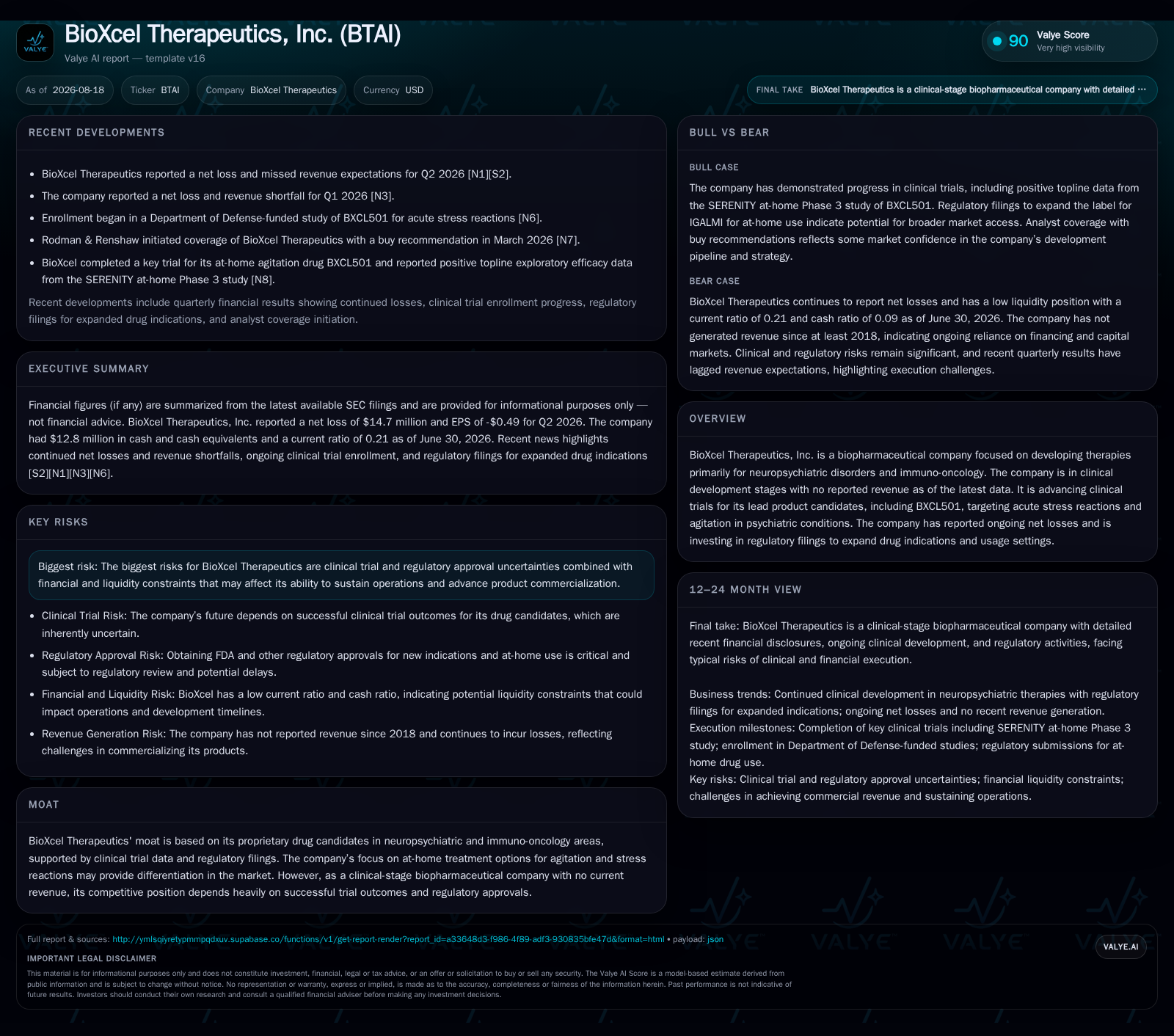
BioXcel Therapeutics remains a clinical-stage biopharmaceutical company focused on developing novel treatments for neuropsychiatric disorders and immuno-oncology, with no reported revenue to date. Its lead candidate BXCL501, approved as IGALMI® for agitation in schizophrenia and bipolar disorder, is undergoing regulatory filings to expand indications to at-home use. The latest quarterly filing highlights ongoing net losses and clear financial strain with substantial debt and a low current ratio necessitating urgent capital solutions. Commercialization efforts remain minimal following strategic reprioritization toward core neuroscience assets. BioXcel's future depends heavily on successful trial outcomes, regulatory approvals, and the ability to secure refinancing or partnerships.
Recent Operating Update and Implications
BioXcel Therapeutics filed its latest quarterly report on August 13, 2026, revealing key developments that shape its current operating profile [S2]. The company reported zero product revenues consistent with its status as a clinical-stage biopharmaceutical firm [F1]. Notably, BioXcel submitted a supplemental New Drug Application (sNDA) on January 14, 2026, seeking FDA approval to expand the labeled indication of IGALMI® (BXCL501) to allow at-home treatment of agitation associated with bipolar disorders or schizophrenia [S1]. This submission followed the successful completion of the SERENITY pivotal Phase 3 trial designed specifically for the at-home setting—marking a critical regulatory milestone that could significantly broaden patient access beyond institutional settings.
From a commercial perspective, IGALMI® remains supplied through existing channels but with minimal marketing expenditure following a strategic Clinical Reprioritization initiated in 2024 which substantially reduced headcount and redirected resources toward key neuroscience assets [S1]. This represents a classic biopharma tradeoff where scarce resources are concentrated on late-stage programs with near-term regulatory catalysts while maintaining market presence without aggressive sales efforts.
Concurrently, BioXcel’s immuno-oncology program represented by BXCL701 is being deprioritized except for specific ongoing efforts within its subsidiary OnkosXcel Therapeutics—a pivot aligning with common early-stage biotech practice of focusing investment on the most promising pipeline candidates given capital constraints [S1].
Financially significant is the company’s strained liquidity position detailed in an August 11 event filing where lenders agreed to reduce the minimum cash liquidity covenant from $6.25 million to $3 million and extended the deadline for reaching capital solutions or loan repayment agreements to August 21, 2026 [S3]. These amendments highlight acute financing pressure. As of June 30, 2026, BioXcel reported $12.8 million in cash against $107.2 million in total debt, with current liabilities exceeding current assets by a wide margin resulting in an alarmingly low current ratio of approximately 0.21—indicative of near-term liquidity risk without additional funding or refinancing [F1].
Business Model Overview
BioXcel operates primarily as a drug discovery and clinical development company leveraging proprietary artificial intelligence technology to identify novel therapeutic uses for existing drugs or compounds. Its business model is typical among clinical-stage biotech firms: invest heavily in research and development (R&D) activities with no direct product revenue until achieving regulatory approval and commercial launch.
The company’s lead commercial product IGALMI® is an orally dissolving sublingual film formulation of dexmedetomidine for acute agitation in schizophrenia and bipolar I/II disorder adults and represents BioXcel's first FDA-approved therapy from its pipeline. Monetization hinges on eventual commercialization either by direct sales or licensing partnerships orchestrated through healthcare providers along regulated distribution channels [S1]. Revenue drivers post-approval would be unit volumes augmented by pricing per film dose and geographic expansion via label extensions. However, no foreign market applications have been filed yet.
Without active commercialization scale currently due to resource prioritization strategies, BioXcel depends almost entirely on funding injections—including equity raises and milestone payments—from licensing deals or credit facilities—to finance ongoing R&D including pivotal trials such as SERENITY At-Home.
Cash conversion is tightly linked to burn rates driven by trial enrollments pace and success milestones.
Industry Structure and Competitive Position
In the broader biotechnology sector focusing on neuropsychiatric disorders and immuno-oncology therapies, success is governed by navigating complex clinical trial pathways—particularly Phase 3 studies—as well as meeting rigorous FDA regulatory standards before commercial launch.
BioXcel's competitive positioning rests on several pillars: innovative utilization of AI-driven drug re-invention accelerating identification of promising candidates; ownership of intellectual property related to these molecules; strategic differentiation via delivery forms such as orally dissolving films designed for patient-friendly administration; and focus on unmet needs like agitation management outside institutional environments.
Peers include other clinical-stage biotech firms exploring neuropsychiatric therapeutics using novel mechanisms or delivery platforms where clinical trial success rates average roughly 10-20% from phase 2 onwards—highlighting inherent development risks. Unlike traditional pharmaceuticals focusing purely on molecular discovery, BioXcel’s approach emphasizes repurposing known drugs which may afford faster timelines but still faces regulatory scrutiny around new indications.
Limited scale commercialization compared with established pharmaceutical companies means BioXcel must rely heavily on partnerships or licensing agreements to maximize market reach post-approval.
Growth Drivers
Key growth drivers center around advancing clinical trials successfully especially for BXCL501’s expanded usage scenarios including at-home care—a segment showing promise due to increased acceptance of outpatient treatment options that improve patient experience while reducing institutional care costs.
Regulatory approvals obtained via sNDA submissions are crucial go/no-go points that will unlock commercial opportunities beyond inpatient settings. Furthermore, any favorable label expansions into other neuropsychiatric conditions could substantially enlarge addressable markets.
Strategic partnerships or licensing collaborations could provide capital inflows via upfront fees or milestone payments while also contributing commercialization expertise needed given BioXcel’s limited infrastructure.
On the innovation front, renewed investment into proprietary AI platforms post-current funding constraints might enable further drug candidates identification accelerating future pipeline diversification.
Risks and Constraints
The most salient risks involve inherent uncertainties around clinical trials—patient recruitment speed, efficacy/safety outcomes—which if unfavorable can delay or permanently derail product launches affecting long-term viability.
Regulatory risk remains high given FDA's strict evaluation parameters especially for psychiatric drugs that impact central nervous system functions requiring extensive safety data.
Financial risk is acute given BioXcel’s leveraged balance sheet with net debt approximating $94 million against limited cash reserves as reported by June-end 2026—pressuring management to negotiate refinancing or equity issuance imminently under lender-mandated deadlines [F1,S3]. Failure could force costly restructuring or cessation of operations.
Market adoption risks post-approval depend on physician prescribing behavior towards new delivery formats like sublingual films relative to traditional injectables; payer reimbursement hurdles may arise impacting pricing power too.
Dependency on successful commercialization of IGALMI® without diversified revenue streams leaves the business exposed until additional products reach market readiness.
What To Watch Next
Investors and industry observers should monitor several critical upcoming milestones:
- FDA feedback regarding the sNDA filing for at-home indication expansion—the timing and conditions tied to approval decisions will materially affect commercial prospects.
- Clinical progression updates regarding other BXCL501 indications including agitation related to dementia which remains a focus area per prior disclosures [S1].
- Negotiations outcomes surrounding amendments/extensions of credit facilities or alternative capital raises prior to August 21 deadline dictated by lenders governing liquidity covenants [S3].
- Any announcements concerning partnerships aimed at accelerating commercialization capabilities beyond current minimal efforts.
- R&D expenditure trends giving insight into prioritization choices between neuroscience assets vs immuno-oncology pipeline activities adjusting resource allocation strategy.
Financial Profile Discussion
As summarized in the latest quarterly report ending June 30, 2026, BioXcel Therapeutics exhibited no top-line product revenues while registering ongoing substantial operating losses consistent with clinical-stage biotech norms [F1,S2]. Cash balances remained relatively modest at approximately $12.8 million juxtaposed against significant long-term obligations totaling over $107 million of debt presenting considerable leverage pressure with an approximate net debt position near $94 million [F1]. The stark imbalance between current assets ($28.7 million) and liabilities ($137.1 million) results in a critically low current ratio around 0.21—a metric flagged explicitly via lender covenant revisions that lowered minimum liquidity requirements from $6.25 million down to $3 million just weeks before reporting [S3]. Such financial tightness underscores an urgent need for refinancing through capital infusion or alternative restructuring arrangements scheduled imminently by August 21 per amendment terms agreed with lenders [S3].
R&D spending dominates expense lines underlying negative operating income trending persistently below zero reflecting both advanced-phase trials deployment costs along with prior platform development expenditures now somewhat scaled back amid reprioritization moves announced over recent years [S1]. Administrative expenses continue but have been carefully managed since workforce reductions initiated during Clinical Reprioritization starting mid-2024 aimed at extending financial runway while concentrating resources on core assets like BXCL501 [S9,S1].
In sum, BioXcel’s financial sustainability pivots critically around successful execution of near-term regulatory milestones paired with securing sufficient financial backing under constrained market conditions typical for small clinical-stage biotechnology companies dependent on external financing until product commercial traction develops.
This analysis incorporates information from BioXcel Therapeutics’ SEC filings up to August 13, 2026 ([S1]-[S3]) and financial data snapshots ([F1]) sourced from official disclosures. It does not constitute investment advice but aims to provide a comprehensive industry-informed evaluation grounded in verifiable corporate disclosures.
Disclaimer: This is research-only, informational analysis and not investment advice. It may include AI-generated interpretation and general industry context. Always verify important details using primary sources.

Comments