
PAVmed’s Multi-Subsidiary Diagnostic and Device Strategy Faces Commercial and Financial Scaling Challenges
Recent quarterly disclosures highlight continued commercialization efforts in diagnostics and digital health amid persistent losses and liquidity constraints.
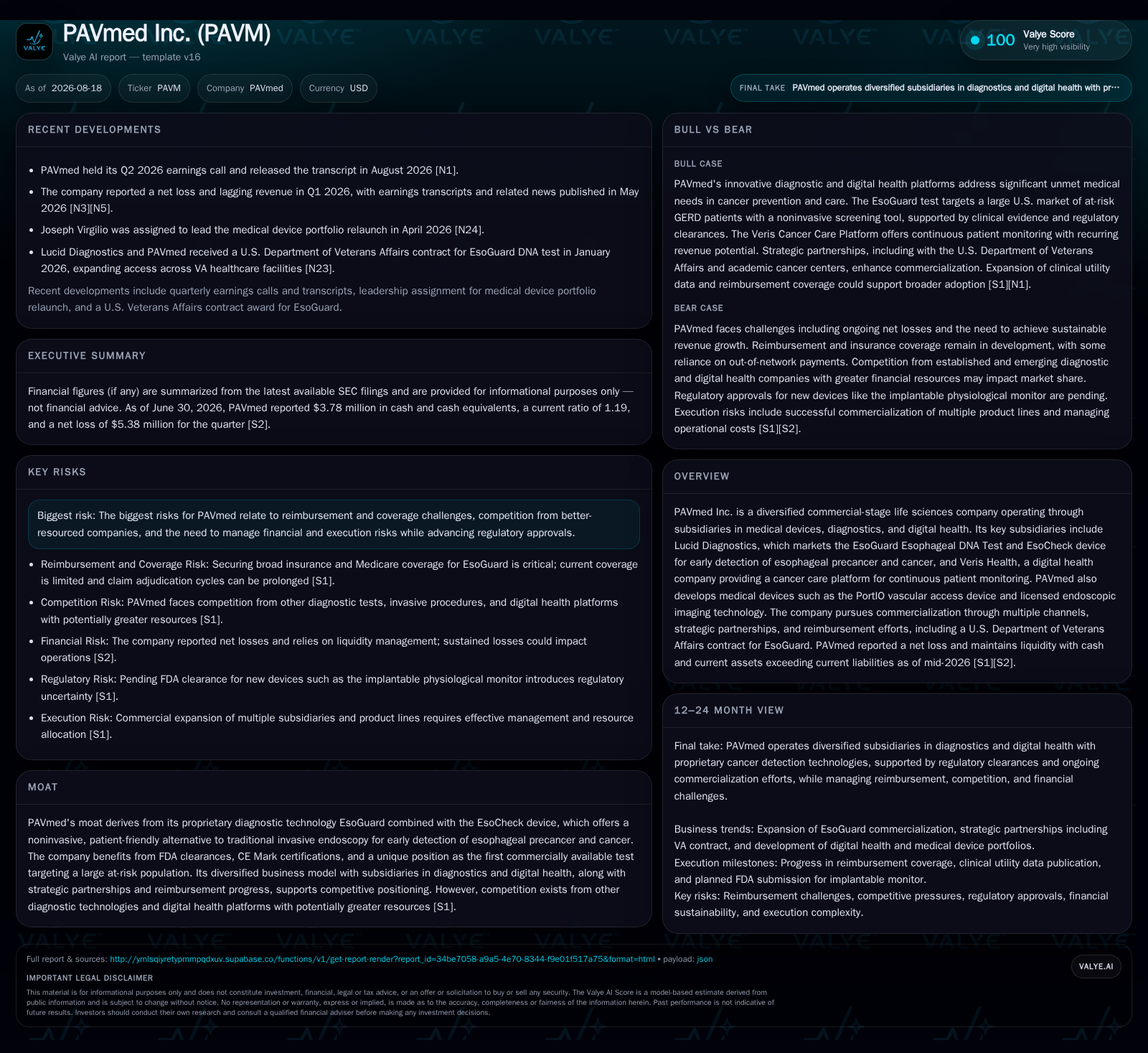
PAVmed Inc. operates a diversified life sciences portfolio through subsidiaries specializing in noninvasive cancer diagnostics, digital health platforms, and medical devices. The recent quarter showed minimal revenue generation with continued net losses, underscoring ongoing challenges in scaling commercial adoption and achieving sustainable profitability. Key assets include Lucid Diagnostics’ FDA-cleared EsoGuard test and the EsoCheck device targeting esophageal cancer detection, alongside Veris Health’s digital oncology monitoring platform. Despite proprietary technological advantages and strategic partnerships, PAVmed must navigate regulatory, reimbursement, manufacturing, and capital accessibility risks to expand market penetration. The company’s financial position is strained by high debt levels relative to cash reserves, raising ongoing going-concern considerations.
Recent Operating Update
In its Q2 2026 filing dated August 13, PAVmed disclosed continuing operational losses amidst nascent revenue generation: the company recorded less than $0.1 million in revenue for the quarter ended June 30, 2026 while incurring a net loss attributable to common shareholders of approximately $12.5 million over the first six months of the year [S2][S3]. This financial snapshot reinforces the early commercialization stage of PAVmed's product offerings despite marketing efforts across its subsidiaries.
Liquidity metrics reveal modest working capital at roughly $0.8 million with a current ratio of 1.19 as of mid-2026; cash and equivalents stood at approximately $3.78 million against total debt near $15 million, resulting in net debt around $11.2 million [F1][S2]. Additionally, part-redemption and reclassification of Series C Convertible Preferred Stock into mezzanine equity reflects ongoing capital structure adjustments designed to manage financing costs and shareholder dilution pressures [S2]. These factors collectively underpin substantial doubt about going concern status expressed periodically in filings.
Business Model Specifics
PAVmed’s operations center on advancing healthcare innovations through multiple independently financed subsidiaries under a shared services umbrella. The largest equity interest lies in Lucid Diagnostics (approximately 25%), which markets the EsoGuard Esophageal DNA Test combined with the EsoCheck Esophageal Cell Collection Device — an FDA-cleared (510(k)) and CE Mark-certified package that enables noninvasive collection of samples for detecting Barrett’s esophagus (BE) and esophageal adenocarcinoma (EAC) using targeted methylation biomarkers (VIM and CCNA1 genes) analyzed by next-generation sequencing (NGS) assays [S1]. This technology aims to provide an accessible alternative to traditional invasive endoscopy for high-risk gastroesophageal reflux disease (GERD) patients.
Lucid generates revenues primarily through sales of diagnostic tests run on collected samples plus associated consumables via healthcare providers focused on gastroenterology practices. Reimbursement coverage from private insurers and government payers like the Department of Veterans Affairs is central to commercial success — evidenced by a VA contract for EsoGuard enhancing institutional uptake prospects [S1]. However, revenue scaling remains tied closely to regulatory milestones confirming clinical sensitivity/specificity performance and payor protocols incentivizing use over standard-of-care procedures.
Beyond diagnostics, PAVmed owns a majority stake in Veris Health, a digital health company developing continuous oncology patient monitoring tools via implantable physiological devices integrated with a digital cancer care platform. Veris Health endeavors to capture recurring revenue streams through subscription-based digital services combined with device sales/licensing [S1]. Meanwhile, PAVmed advances its device portfolio by developing the PortIO intraosseous vascular access implant designed for critical care applications and recently licensed endoscopic imaging technology from Duke University — demonstrating an evolving pipeline that combines implantable medical devices with diagnostic innovations aimed at improving procedural efficiency or patient compliance.
Industry Structure & Competitive Position
Operating within the medical devices and diagnostics sector marked by stringent FDA regulatory oversight and intense clinical validation requirements, PAVmed faces both structural opportunities and headwinds. Regulatory approvals such as FDA clearances or Premarket Approvals (PMA), along with CE Mark certifications for European markets, function as gatekeepers to commercialization but also confer competitive moats once attained.
The key industry drivers include expanding diagnostic precision via molecular techniques targeting methylation biomarkers detectable through NGS assays — areas where PAVmed’s EsoGuard offers differentiation. However, competition arises from larger diagnostics companies like Exact Sciences or Guardant Health that have broader product portfolios, deeper R&D budgets, more extensive reimbursement infrastructure, and established clinician relationships which may accelerate their adoption curves compared to smaller firms like Lucid Diagnostics within PAVmed’s corporate family.
Digital health integration exemplified by Veris Health reflects an emerging trend where longitudinal patient monitoring platforms capitalize on data analytics for personalized treatment management — an asset class where companies like Tempus or GRAIL serve as benchmarks.
Nonetheless, commercialization burdens are substantial given prevalent barriers: securing robust reimbursement coverage requires navigating payer policies often influenced by research view guidelines; manufacturing scale must be sufficient to meet fluctuating demand spikes without compromising quality or turnaround times; physician familiarity and trust are prerequisites for alternative diagnostic modalities replacing entrenched invasive procedures; plus regulatory compliance necessitates significant ongoing investment.
Growth Drivers
PAVmed's future expansion hinges on several interconnected vectors:
- Reimbursement Expansion: Increasing acceptance by private insurers and Medicare/Medicaid programs for EsoGuard testing will drive test volumes up significantly by reducing out-of-pocket costs for patients.
- Market Penetration among Gastroenterologists: Adoption rates depend on educational initiatives aligning physicians' prescribing behaviors towards noninvasive diagnostics for GERD patients at risk of esophageal adenocarcinoma.
- Regulatory Reinforcements: Additional approvals or clearances supporting new indications or geographic markets could broaden addressable patient populations beyond current target segments.
- Veris Platform Adoption: Enhancing recurring revenues from digital oncology monitoring services via enhanced functionality and implantation devices promises complementary growth alongside diagnostic sales.
- Strategic Partnerships: Collaborations with healthcare systems or technology firms could amplify distribution channels or facilitate bundled service offerings boosting overall share of patient care spend.
- Manufacturing Capacity Scale-Up: Expanded in-house or third-party capacity will be needed to fulfill rising sample processing demands efficiently without bottlenecks affecting clinical turnaround times critical for physician reliance.
- Data Commercialization & AI Integration: Leveraging rich patient biomarker data through analytics pipelines enhances personalized prognostics potentially opening new monetization avenues downstream.
Risks & Watchpoints
Key risks persist around topics integral to small-cap medical devices companies endeavoring early commercial entry:
- Reimbursement Uncertainty: If payers delay or deny adequate reimbursement coverage or impose onerous coding/pricing schemes restricting cost-effectiveness claims for EsoGuard testing, adoption may stall.
- Competitive Pressures: Entrenched invasive diagnostics backed by hospital networks or disruptive novel assays from deep-pocketed competitors could erode market share potential.
- Financial Sustainability: High cash burn ($5.3 million operating cash flows used YTD mid-2026) coupled with $15 million debt highlights dependency on additional capital raises amid volatile equity markets impacting dilution risk [S2][F1].
- Manufacturing & Logistics Constraints: Failure to ramp manufacturing throughput timely would impair ability to scale commercial assay processing effectively.
- Regulatory Delays/Compliance Burdens: Additional clinical trials required for label expansion entail time/cost risks; compliance failures can prompt penalties or reputational harm [S8][S9].
- Physician & Patient Acceptance: Skepticism towards novel technologies absent long-term outcomes data could impede market penetration trajectory.
- Legal/Liability Risks: As commercialization advances, exposure to product liability claims or intellectual property disputes grows potentially affecting operational focus further [S9].
- Subsidiary Operational Risks: Managing independently financed units introduces coordination complexity impacting unified strategic execution.
What To Watch Next
Investors should monitor the following milestones and indicators:
- Progression in reimbursement landscape updates particularly Medicare/National Coverage Determinations impacting EsoGuard use cases.
- Quarterly metrics reporting any increases in test volumes performed by Lucid Diagnostics signaling broader adoption trends.
- Regulatory communications alluding to label expansions or new market entrance licenses for existing products including PortIO device trials status.
- Financial statements reflecting changes in liquidity position especially cash runway relative to planned expenditures given sustained net losses.
- Partnerships announcements expanding distribution footprint or verifying technology integrations accelerating user acquisition on Veris platform.
- Manufacturing scalability efforts including any announced capacity investments mitigating previous bottleneck disclosures.
- Clinical trial results updates reinforcing sensitivity/specificity claims underpinning physician confidence building.
Financial Profile Discussion
As of June 30, 2026, PAVmed held approximately $3.78 million in cash against current liabilities near $4.09 million resulting in a current ratio of about 1.19—an indicator of marginal short-term liquidity adequacy but limited buffer against near-term obligations [F1]. Total debt stood at around $15 million leading to net leverage close to $11.2 million when offsetting cash holdings—a material burden notably for a company yet to generate meaningful revenue from operations [F1].
Operationally, negative cash flow continued through H1 2026 at approximately $5.3 million requiring ongoing financing either through equity issuance (including warrants) or debt restructuring measures highlighted by preferred stock redemption activities noted during the quarter [S2][S3]. The company’s ability to sustain its multi-subsidiary development programs while progressing commercialization depends heavily on accessing new capital at manageable terms without excessive dilution impact on existing shareholders.
PAVmed’s financial positioning typifies early-stage medical device enterprises balancing investment-heavy clinical validation/commercial launch costs against delayed top-line inflows amid complex regulatory pathways and reimbursement negotiations. Close scrutiny of quarterly liquidity trends paired with commercialization KPIs will offer vital clues regarding trajectory toward eventual operational breakeven feasibility.
This report incorporates publicly available SEC filings primarily from Q2 2026 disclosures alongside recent event filings providing detailed insights into PAVmed’s business composition within the medical devices and diagnostics industry framework. All facts cited are directly supported by referenced filings without speculative extrapolation.
Disclaimer: This is research-only, informational analysis and not investment advice. It may include AI-generated interpretation and general industry context. Always verify important details using primary sources.

Comments