
Yale Transaction Finders' Capital and Deal-Making Crossroads After Latest Quarter
The August 2026 quarterly filing highlights critical liquidity constraints and conditional financing that shape Yale Transaction Finders’ ability to close acquisitions and deliver shareholder value.
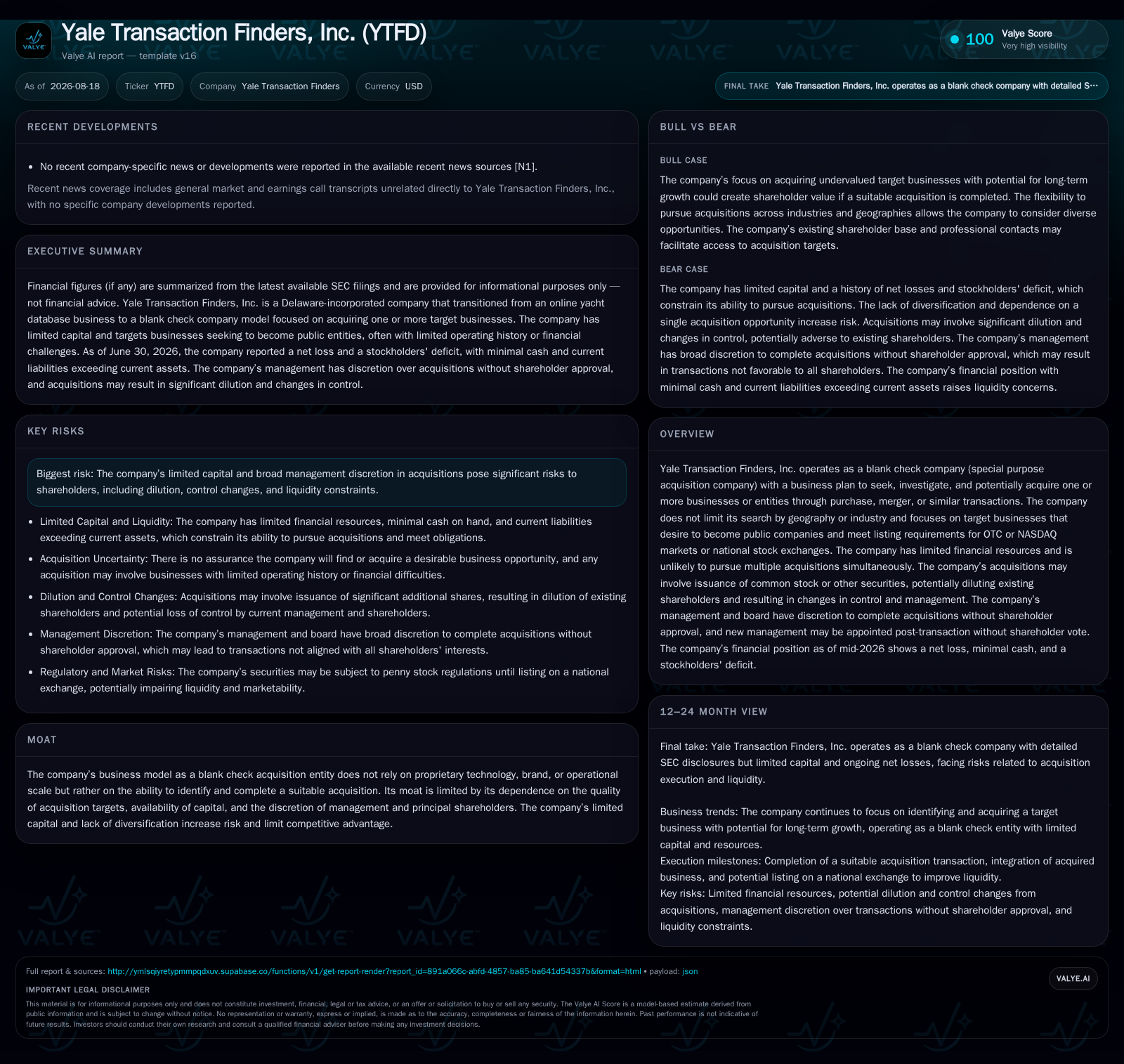
Yale Transaction Finders, Inc. operates as a blank check company (SPAC) with no ongoing commercial operations, relying exclusively on completing a business combination to generate positive cash flow and fulfill future obligations [S2]. The latest 10-Q reveals urgent funding needs, limited capital availability, and conditional loans from insiders that underscore a precarious financial position [S2]. Compared to high-profile SPAC peers with ample war chests, YTFD’s constrained resources limit its competitive position and deal execution capacity. Management retains broad discretion over acquisitions, creating risks of dilution and control shifts for shareholders absent guaranteed financing [S1][valye_report_excerpt].
Funding Limitations Spotlight Urgency for Acquisition Execution
The most recent quarterly report dated August 13, 2026, starkly outlines Yale Transaction Finders’ pressing liquidity constraints. The company states it will only meet future obligations and operating expenses by either raising additional funds or acquiring a profitable company capable of generating positive cash flow [S2]. This financing imperative reflects the absence of any ongoing commercial operations or organic revenue streams intrinsic to the SPAC business model. Importantly, while management members or shareholders may loan funds to bridge operational needs prior to acquisition completion, such support is discretionary and lacks binding commitment [S2]. This conditional funding environment poses material uncertainty regarding the company’s operational continuity absent an imminent business combination.
No off-balance sheet arrangements are reported that would materially alter the financial outlook, reaffirming that existing liquidity pressures are transparent in the current disclosures [S2]. With no significant capital reserves or alternative financing sources cited, the filing implicitly sets a narrow window for deal completion. Failure to consummate an acquisition soon could force costly financings on unfavorable terms or invoke potential liquidation scenarios. Thus, the quarter’s disclosures serve as a cautionary signal emphasizing how critically dependent Yale's near-term viability is on transactional execution.
Blank Check Business Model: Dependence on Successful Business Combinations for Value Creation
Yale Transaction Finders operates structurally as a Special Purpose Acquisition Company—a publicly traded shell entity with no existing commercial operations beyond seeking mergers or acquisitions that enable a private business to become publicly listed [S1]. The company's economic model centers on identifying suitable targets and completing a business combination (often referred to as a de-SPAC transaction), which ideally results in enhanced liquidity for previously private shareholders and value accretion for public investors.
The annual filing clarifies that Yale’s search focuses broadly across industries and geographies at businesses motivated by public-market access for capital raising or asset acquisition via securities issuance rather than cash transactions [S1]. This flexibility is common among SPACs seeking diverse deal flow but simultaneously exposes them to complex valuation challenges when targeting companies at varying development stages. Typically, target firms might lack extensive operating histories or be experiencing financial difficulties—traits that heighten execution risk in the absence of deep due diligence capabilities.
Without completed acquisitions generating operating cash flows, Yale essentially remains capital dependent on equity markets or insider loans. Economic outcomes for shareholders hinge entirely on management's ability to secure attractive transactions within prescribed timelines.
Market and Peer Reference: SPAC Capital Access and Execution Expectations Compared to Sector Leaders
In competitive terms, Yale Transaction Finders contrasts sharply with high-profile SPAC sponsors such as Pershing Square Tontine Holdings (PSTH), known for multi-hundred-million-dollar IPO proceeds providing substantial capital firepower for transactions. These larger SPACs enjoy better access to premium acquisition targets due to scale advantages, underwriting fee income potential, and expansive institutional investor networks. By comparison, YTFD's limited capitalization restricts it largely to smaller or more nascent firms often requiring longer paths toward profitability.
Other sector exemplars like Social Capital Hedosophia Holdings demonstrate how experienced sponsor teams coupled with significant upfront capital can streamline deal closing processes while managing shareholder redemptions effectively. In this landscape, Yale's comparatively modest resources pose headwinds both in sourcing high-quality pipeline candidates and negotiating favorable market terms.
This scale disparity also matters from an investor confidence standpoint—as publicly traded vehicles with constrained war chests tend to suffer from higher redemption risks and less robust post-merger market capitalization profiles. These factors collectively temper expectations regarding YTFD's likelihood of executing timely profitable business combinations relative to sector leaders.
Capital Raising Dynamics: Shareholder Dilution and Redemption Risks in Acquisition Financing
One hallmark risk inherent in the SPAC model visible in Yale’s filings is shareholder dilution driven by new equity issuances connected with business combinations. Although issuance of common stock or other securities can fund acquisitions without immediate cash requirements, it dilutes existing shareholders’ ownership stakes potentially causing valuation compression.
Moreover, shareholder redemption rights complicate capital availability by allowing investors who disapprove of proposed mergers to redeem shares prior to deal consummation. High redemption rates shrink trust account funds earmarked for acquisition financing—potentially necessitating PIPE (Private Investment in Public Equity) financing solutions that carry their own underwriting fees and pricing considerations.
Given Yale's small current capital base underscored in recent disclosures and reliance on management discretion regarding financing strategy, incremental dilution pressures appear likely unless counterbalanced by strong deal term negotiations or supplemental fundraises.
Deal Pipeline Quality: What Evidence Suggests About YTFD's Acquisition Readiness and Target Profile
A key operational complexity disclosed relates to the nature of prospective targets considered by Yale Transaction Finders. As noted in the annual report, candidate companies often desire public status primarily to access liquid equity markets supporting capital raises or asset growth plans rather than immediate earnings generation [S1]. Many targets may be recently formed entities with limited operating histories or suffering financial undercapitalization—and are therefore operationally fragile.
Dealing with this class of targets typically requires extensive due diligence depth given potential non-compliance with listing requirements at present—a structural barrier that extends timelines and raises fallback risks if regulatory qualifications remain unmet post-combination. This dynamic heightens exposure compared with peers capable of targeting larger late-stage private companies backed by venture capital or private equity.
Consequently, despite diligent management attempts facilitated through broker-dealer networks referencing possible opportunities, successful pipeline conversion remains uncertain especially under capital scarcity conditions highlighted this quarter.
Management Discretion and Governance: Assessing Decision-Making Power Against Shareholder Interests
Yale’s governance framework confers considerable autonomy on its management team and board regarding approval of acquisitions without mandatory shareholder consent. While this flexibility expedites transactional approvals when time-sensitive windows occur, it also concentrates power risking conflicts of interest—particularly if management pursues deals potentially detrimental from current shareholders' perspectives such as those involving heavy dilution or strategic shifts favoring insiders.
The absence of explicit shareholder veto rights amplifies scrutiny over transparency practices surrounding target evaluation criteria & deal structuring terms including earnout provisions or security issuance mechanics that can materially affect share count post-close. Such governance features underscore investor vigilance needed around disclosures specifying alignment safeguards—or lack thereof—between sponsors’ incentives and minority stakeholder protections.
Growth Opportunities: Accelerating Acquisition Outcomes Versus Structural Constraints
Despite challenges outlined above, market conditions remain relatively conducive toward SPAC transactions with regulators maintaining supportive stances permitting alternative public listing conduits amid recent IPO market uncertainty broadly. Innovations in PIPE financing structures introducing flexible pricing mechanisms also offer avenues enabling smaller SPACs like Yale Transaction Finders potentially quicker access to necessary acquisition capital upon agreed deal terms.
Expanding target industry verticals beyond narrowly defined sectors could increase quality deal flow while leveraging intensified broker-dealer relationships may accelerate pipeline maturation. Success in these areas would depend heavily on enhancing due diligence rigor coupled with adept negotiation tactics capable of balancing price discipline against market-driven valuation optimism prevalent among certain private issuers seeking expedited public exits.
Nonetheless growth morphology remains inherently tied to overcoming principal hurdles somberly highlighted by latest liquidity warnings requiring prompt transactional closures guaranteeing operational runways beyond mere bridge financings.
Risks Ahead: Dilution, Funding Uncertainty, and Timing Pressures on Business Combination Completion
Principal risks derived directly from recent disclosures include multiple converging factors: primary among these is the threat of failure within mandated timeframes causing automatic wind-back protocols returning capital less expenses; intense shareholder redemption activity diminishing available financing pools; significant equity dilution arising from securities issued in connection with acquisitions; continuing dependency on management obtaining discretionary insider loans during interim funding deficits; reputational damage stemming from any underperforming merged businesses impacting longer-term valuations; market volatility interfering with post-merger share price sustainability; regulatory environment shifts potentially complicating SPAC execution norms; plus basic liquidity shortfalls impeding timely payment obligations prior to closed transactions [S2]
All these interconnected pressures warrant close observation given their capacity cumulatively either catalyze value destruction or conversely herald consolidation prospects contingent upon effective governance responses.
Looking Ahead: Milestones, Regulatory Watchpoints, and Market Conditions That Will Signal Progress or Risks
Investors should monitor several concrete indicators reflecting progress metrics: first appearance of definitive merger agreements; updates on PIPE financing commitments easing trust account constraints; quarterly reports clarifying evolving shareholder redemption percentages signaling support levels; disclosures related to regulatory inquiries influencing transaction approvals; timely material announcements pertaining deal pipeline shifts; refreshed management commentary articulating strategic pivots regarding acquisition focus areas; trading volume dynamics conveying investor sentiment shifts following public news releases. These factors collectively compose actionable intelligence facilitating informed assessments concerning whether Yale Transaction Finders navigates its current crossroads effectively amid exigent operational realities.
Recent Debt Issuance Details, Cash Position, and Liquidity Context
The most recent financial archives reveal that as of early May 2026 three convertible notes totaling $17,500 ($12,600 + $3,150 + $1,750) were issued involving Ironbound Partners Fund LLC, Moyo Partners LLC, and Dakota Group LLC respectively at 5% annual interest maturing December 31st, 2026 [S2]. These notes convert upon either completion of a qualified financing event exceeding $500k or fundamental transactions such as mergers or asset acquisitions providing conditional funding dependent on transaction progress rather than unconditional liquidity injections.
Meanwhile historical balance sheet data shows effectively zero cash balances reported since 2011 while total debt metrics last available approximate $50k consistent with earlier insider financings indicating persistent tight funding posture over years without significant capital infusions recorded publicly [F1]. This juxtaposition between imminent note maturities needing resolution within months alongside scant cash reserves underscores acute ongoing liquidity insufficiency requiring rapid resolution through acquisition closings or external capital raises funded by investors prepared for elevated risk exposure.
In sum financial disclosures reinforce urgent need for catalytic events realigning cash flow generation mechanisms away from reliance solely on subordinated debt into viable operating revenues typical only achievable post de-SPAC transaction closure. Such realities frame Yale Transaction Finders at an operational lever poised precariously between successful transformation into an active enterprise versus protracted limbo dominated by speculative financing extensions.
Disclaimer: This is research-only, informational analysis and not investment advice. It may include AI-generated interpretation and general industry context. Always verify important details using primary sources.

Comments