
Avidia Bancorp Strengthens Local Banking Footprint Amid Market Pressures
Recent quarterly filings reveal Avidia Bancorp's focus on capital return and balanced revenue streams, navigating competitive and economic challenges in Massachusetts regional banking.
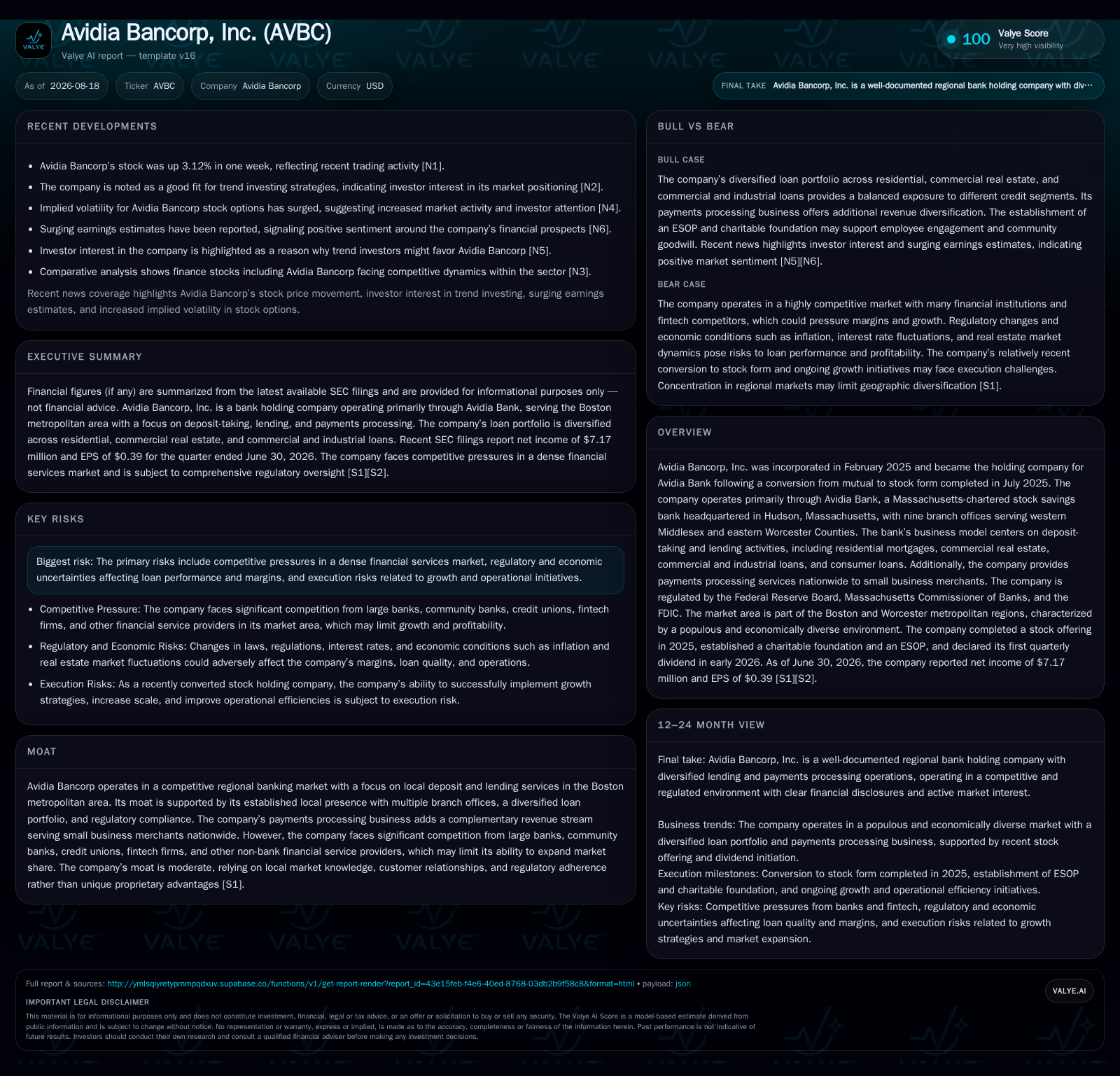
Avidia Bancorp's Q2 2026 report highlights a commitment to returning capital through dividends and a $30 million stock buyback plan, underscoring confidence in its liquidity and operational performance. The company's dual revenue model combines traditional deposit-taking and lending with payments processing services targeting small business merchants nationwide. Operating within the densely competitive Boston and Worcester metropolitan markets, Avidia contends with pressure on net interest margin and credit risk but leverages local customer relationships and regulatory compliance as moderating strengths. Monitoring loan portfolio quality, efficiency ratios, and payments processing growth will be key to assessing sustainable profitability amid evolving market dynamics.
Latest Quarterly Developments Affirm Capital Return Focus
In its August 13, 2026 10-Q filing, Avidia Bancorp announced that its Board declared a quarterly cash dividend of $0.06 per common share payable in late August 2026 to shareholders of record as of mid-August 2026 [S2][S19]. Furthermore, on August 4, the company authorized a sizable stock buyback program permitting repurchases up to $30 million in value through various market mechanisms over the subsequent year [S3][S19]. These capital deployment moves signal management's confidence in the institution's liquidity position and operating cash flows during a challenging regional banking environment.
This combination of steady dividend payments alongside active share repurchases indicates a disciplined capital allocation strategy balancing shareholder returns with the need to maintain regulatory capital buffers. Given the company's origin as a relatively recent conversion from mutual to stock form (completed in July 2025), these moves underscore evolving confidence in standardized public capital management reflective of stable earnings generation capacity [S1]
Business Model: Complementing Traditional Banking with Payments Services
Avidia Bancorp functions principally through Avidia Bank, a Massachusetts-chartered stock savings bank headquartered in Hudson with nine branches concentrated in western Middlesex and eastern Worcester Counties — part of the populous Boston-Worcester metro region [S1]. Its core banking business relies on attracting deposits from local customers to fund loan originations that span one- to four-family residential mortgages (fixed and adjustable rate), commercial real estate mortgages including multi-family properties, commercial & industrial loans often secured by business assets, as well as consumer loans such as automobile financing [S1].
The bank earns most of its revenue via net interest income generated from the spread between deposit funding costs and yields on its diversified loan portfolio. The variety within the loan mix helps balance credit risk concentrations though new construction lending retains heightened risk due to project completion uncertainties requiring prudent underwriting focused on borrower financial strength [S1]. Loan sales are managed flexibly; some fixed-rate short-term residential mortgages are sold while adjustable-rate products are typically retained to mitigate interest rate risk.
Non-interest income is augmented by payments processing services provided nationwide to small business merchants. This segment extends revenue beyond the local footprint by charging fees that help diversify income sources away from volatile interest rates [S1][N1]. This dual-revenue stream model enables Avidia Bancorp to partially insulate profitability from narrow local economic shocks or interest margin contractions prevalent among regional banks.
Competitive Dynamics in Massachusetts' Dense Financial Market
Operating within the highly competitive financial ecosystem of Massachusetts places Avidia Bancorp amidst considerable pressure stemming from large national banks with scale advantages, active community banks embedded in neighborhoods, credit unions leveraging member loyalty, as well as disruptive fintech lenders targeting similar small business borrowers or payment clients with digital-first approaches [S1].
The company's moat — moderate by nature — leans heavily on established branch presence fostering local relationships alongside thorough regulatory compliance enforced by Federal Reserve Board oversight coupled with state banking regulators and FDIC standards [S1]. While this regulatory rigor supports trustworthiness as an advantage relative to newer market entrants, it simultaneously imposes cost burdens affecting efficiency.
Efficiency ratios are a critical measure here; balancing legacy branch infrastructure expenses against investments needed for modern digital capabilities shapes operating margins relative to peers blending physical and online channels. Fintech competitors exert pricing pressure particularly on payment processing fees and consumer loan rates.
Loan Portfolio Composition and Credit Quality Trends Under Scrutiny
Avidia Bancorp’s loan portfolio mix reported includes residential real estate dominant segments alongside substantial commercial real estate loans particularly multi-family properties reflecting metro housing demand dynamics [S1]. Construction and land loans remain smaller but carry elevated inherent risk warranting tight underwriting focused on borrower creditworthiness plus comprehensive collateral assessment [S1]. The bank maintains regular reviews of non-performing loans (NPLs) with provision levels calibrated against observed delinquencies. Given macroeconomic uncertainty risks such as inflationary pressures or local market slowdowns, vigilance over asset quality metrics like allowance for credit losses as a percentage of total loans gains importance [S2][S1].
Recent quarterly disclosures do not indicate troubling spikes in charge-offs or impaired loans but maintaining stable credit quality will be crucial if economic headwinds intensify. Peer community banks often face comparable localized credit exposures requiring timely adjustments to provisioning; thus Avidia’s monitoring approach aligns with industry best practices.
Payments Processing as a Strategic Growth Lever Beyond Core Banking
Beyond traditional banking revenue mechanics rooted in net interest margin management, Avidia Bancorp’s payments processing services represent an increasingly important source of recurring fee income that aids overall profitability stability [S1][N1]. Serving small business merchants nationwide allows geographic diversification beyond its Massachusetts base while fostering stickier customer relationships through integrated banking-payment solutions bundles
However, this segment confronts scale limitations when competing against large fintech acquirers like Stripe or Square offering advanced technology platforms at competitive fees. Capturing incremental volume requires continuous investments into payment technology infrastructure balanced against thin margins typical in this sector.
Successful scaling could enhance operating leverage given fixed costs associated with systems maintenance spread over greater transaction volumes. Fee revenue also tends to be less correlated with economic cycles than interest income thus providing valuable earnings diversification.
Operational Efficiency Challenges Amid Regulatory Demands and Competition
Regulatory compliance mandates at both federal (Federal Reserve) and state levels impose substantive operational expenses including reporting systems upkeep, audit processes, anti-money laundering programs, cybersecurity protections, and capital adequacy monitoring—all essential but resource intensive activities that affect efficiency ratio outcomes (operating expenses relative to revenue) [S1]
Simultaneously maintaining a physical branch network increases fixed costs but is integral for sustaining local customer trust and brand recognition within targeted Massachusetts counties. Digital channel enhancements respond partly to shifting customer preferences yet require upfront technology investments that may delay efficiency improvements.
Given competitive pressures compressing interest margins and pushing down payment fees, continuous operational cost control remains vital for protecting net profitability. Gradual digital adoption coupled with selective branch rationalization or service model innovations could offer future margin enhancement opportunities.
Growth Drivers: Local Market Dynamics and Product Diversification Potential
The macroeconomic environment surrounding Avidia Bancorp — anchored by vibrant Boston-Worcester metropolitan area economies — supports sustained demand for housing finance especially one- to four-family residential mortgages corresponding with regional demographics trends favoring homeownership [S1][N1]. Commercial real estate financing also benefits from ongoing development activities including multi-family housing projects aligned with urbanization patterns.
Expanding payments processing volumes parallel e-commerce growth trends among small businesses seeking integrated banking solutions beyond traditional lending relationships. Cross-selling additional financial products into existing customer bases promises wallet share gains underpinning longer-term revenue growth.
Technological advances facilitating improved customer experiences enhance acquisition retention rates while strategic branch footprint optimization or partnerships can augment market reach without significant incremental cost burdens [S1][N1]
'Watchpoints': Credit Conditions, Interest Rate Sensitivity, and Competitive Pressures Ahead
Key risks demanding close observation include potential deterioration in credit quality if localized economic disruptions occur or construction project delays materialize given their embedded higher risk profiles [S1]. Interest rate fluctuation trends remain pivotal; unexpected compression in net interest margin caused by deposit beta effects (pass-through of rate changes to depositors) could pressure core earnings.
Competition from fintech entities offering innovative digital payment platforms or alternative lending could erode market share especially if Avidia cannot match technology agility or pricing competitiveness quickly enough. Regulatory changes increasing capital or liquidity requirements might constrain growth initiatives or weigh on return metrics.
Ultimately monitoring trends across loan loss provisions relative to non-performing assets ratio alongside capture rates within payments processing revenues will be instrumental early indicators reflecting how well Avidia balances risk-return tradeoffs going forward.
This analysis reflects facts drawn exclusively from recent SEC filings dated through August 13, 2026 ([S1], [S2], [S3]), supplemented by secondary news commentary ([N1]). All statements emphasizing company-specific details such as capital moves, loan portfolio characteristics, geographic footprint, business segments, competitive landscape insights rely directly upon cited evidence without speculative extrapolation. Sector insights frame performance context consistent with regional banking industry norms focusing on deposit/lending mechanics combined with ancillary payment services relevant to understanding Avidia Bancorp’s evolving operational profile.
Disclaimer: This is research-only, informational analysis and not investment advice. It may include AI-generated interpretation and general industry context. Always verify important details using primary sources.

Comments