
Mountain Crest Acquisition Corp. V Navigates SPAC Lifecycle with Focused Business Combination Efforts
Mountain Crest Acquisition Corp. V remains a search-stage SPAC focused on completing a business combination primarily in North America and Asia Pacific (excluding China), managing typical SPAC risks including Nasdaq compliance challenges and execution uncertainties amid geopolitical volatility.
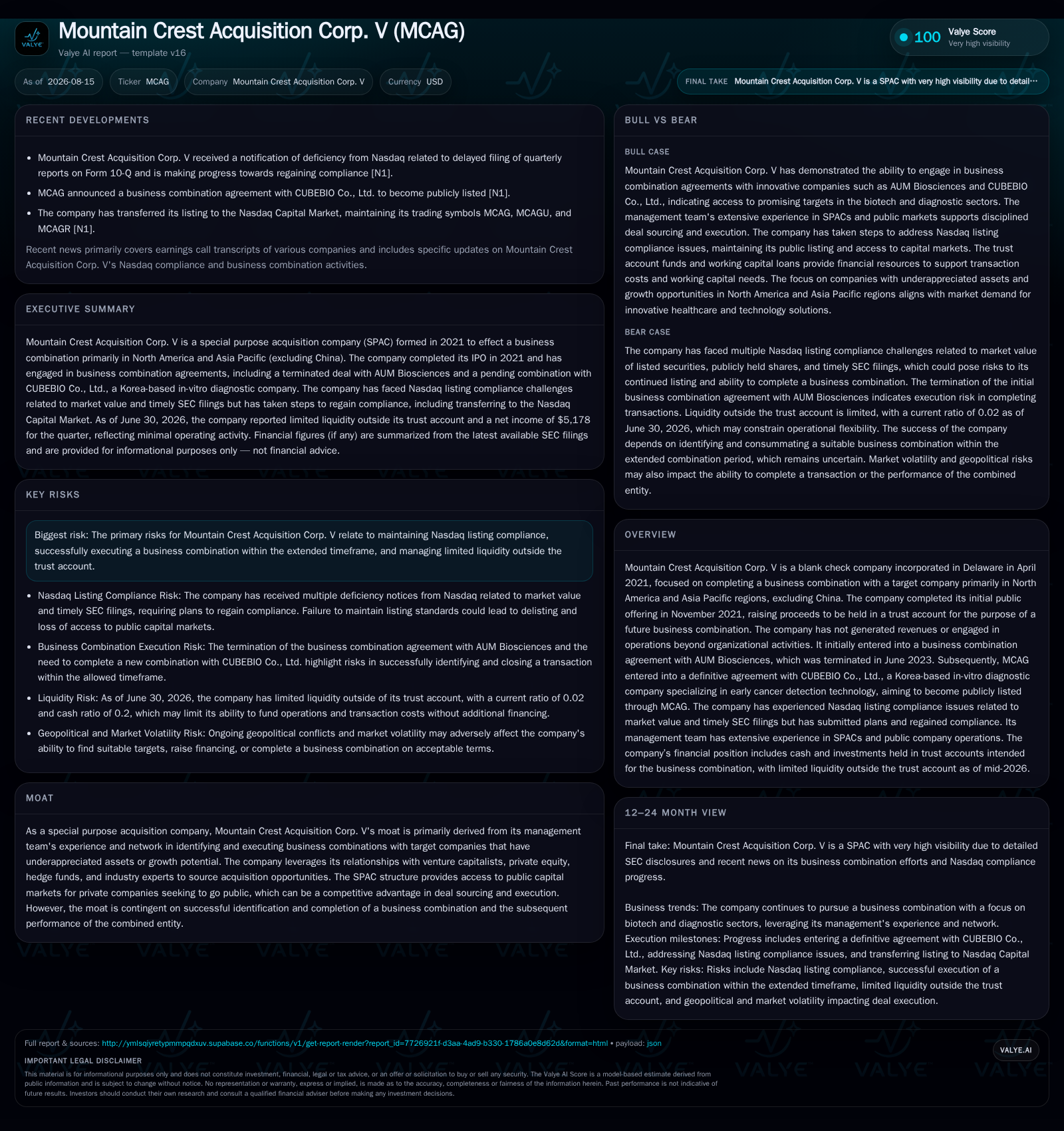
Mountain Crest Acquisition Corp. V (MCAG) is a blank check company formed to complete a business combination within an extended deadline of November 16, 2026. After terminating its initial agreement with AUM Biosciences in mid-2023, MCAG has pivoted to pursue a definitive agreement with South Korea-based CUBEBIO, specializing in early cancer detection diagnostics. The company resolved prior Nasdaq listing deficiencies by transferring to the Nasdaq Capital Market in late 2023. Despite minimal liquidity outside its trust account and reliance on unsecured sponsor loans, MCAG’s experienced management team leverages its network to identify undervalued targets. Key risks include the ability to consummate a deal within the extended timeframe, managing redemption rights that affect deal proceeds, and external geopolitical tensions impacting deal sourcing and market conditions.
Recent Operating Update and Strategic Positioning
Mountain Crest Acquisition Corp. V (MCAG) reported its latest quarterly results on August 14, 2026 [S2], reaffirming its status as a blank check company without operational revenues or commercial activities beyond administrative functions intrinsic to SPACs. The primary near-term objective remains executing an initial business combination before the current November 16, 2026 deadline [S6].
The termination of MCAG's prior definitive agreement with AUM Biosciences in June 2023 following multiple amendments and preparations for stockholder voting illustrates the inherent uncertainties in SPAC dealmaking where due diligence or market factors impede completion [S1][S8]. Subsequently, MCAG shifted focus toward CUBEBIO Co., Ltd., a Korean firm specializing in early cancer detection diagnostics via in-vitro technologies [S10][S17]. This pivot reflects strategic targeting of high-growth healthcare innovation sectors that benefit from structural demand trends.
In parallel, MCAG addressed significant Nasdaq listing challenges after being delisted from The Nasdaq Global Market due to non-completion of a business combination within the original timeframe [S9]. The company successfully transferred its securities to The Nasdaq Capital Market effective October 27, 2023 [S16], maintaining trading continuity while adjusting to less stringent listing requirements compared to the Global Market.
Business Model Overview: SPAC Mechanics and Sponsor Role
Incorporated as a blank check company in Delaware in April 2021 [S1], MCAG's business model centers on raising capital through an IPO completed in November 2021, placing proceeds into an interest-bearing trust account reserved for funding an eventual merger or acquisition with a private target [S5]. Units sold during the IPO included common shares paired with rights/warrants, supplemented by private placements purchased by sponsors.
Monetization occurs post-business combination when operating revenues flow from the acquired company's core activities. Prior to that event, MCAG incurs administrative expenses funded primarily through interest income on trust assets or sponsor-provided unsecured promissory notes [S13][S14][S21]. These non-interest bearing loans total approximately $1.2 million across multiple issuances between February and October 2023 and are critical for covering working capital needs related to transaction pursuit
Sponsor promote equity stakes align interests but introduce dilution risk typical of SPAC structures. MCAG emphasizes leveraging its management team's extensive network spanning venture capitalists, private equity firms, investment bankers, attorneys, and accountants to source targets exhibiting unrecognized value or growth potential primarily in North America and Asia Pacific excluding China [S1][S6].
Industry Context and Competitive Positioning
SPACs like MCAG serve as financial intermediaries connecting public investors with private companies seeking expedited public listings. While offering streamlined access relative to traditional IPOs, they face rigid completion deadlines—typically three years post-IPO—that impose execution pressure.
Peers such as Pershing Square Tontine Holdings and Churchill Capital exemplify variable success rates in completing combinations and subsequent stock performance that influence market perception of sponsor capability. MCAG's focus on healthcare diagnostics via CUBEBIO differentiates it from peers pursuing broad technology or consumer sectors but concentrates exposure within specialized health innovation niches.
Nasdaq listing compliance remains a key operational risk; MCAG’s transfer to the Capital Market addresses prior delisting yet underscores ongoing governance scrutiny relative to primary exchanges [S15][S16]. Shareholder redemption rights pose additional complexity by reducing available cash at closing proportionate to shares redeemed—a material factor given previous redemption volumes exceeding one million shares cumulatively across multiple votes since late 2022 [S5]. Effective management of these elements is essential for preserving transaction viability.
Growth Drivers
MCAG’s growth prospects hinge on structural shifts favoring alternative public listing routes amid increasing traditional IPO complexity globally. Additional drivers include:
- Targeting healthcare diagnostics aligns with demographic trends favoring early disease detection technologies characterized by sustainable innovation-driven expansion.
- Sponsor-funded promissory notes sustain operational runway enabling continued due diligence and negotiation capacity.
- Extension of business combination deadlines supported by incremental trust account deposits signals investor patience linked to perceived target quality [S10].
- Geographic diversification into Asia Pacific markets outside China offers exposure beyond saturated U.S.-centric SPAC pipelines while navigating geopolitical sensitivities.
Risks and Watchpoints
Key risks encompass:
- Failure to consummate a business combination by November 16, 2026 triggers mandatory liquidation returning trust funds net expenses but results in sponsor equity loss [S6].
- Geopolitical instability involving Russia/Ukraine conflict and Middle Eastern tensions may disrupt target sourcing or financial markets affecting valuations [S2].
- Minimal liquidity outside the trust account ($11,909 as of December 31, 2025) heightens reliance on discretionary sponsor funding which may not be indefinitely available [F1][S13].
- High shareholder redemption rates reduce net merger proceeds potentially deterring targets or requiring supplemental PIPE financing.
- Regulatory scrutiny over financial disclosures including promissory note conversions into equity adds complexity alongside evolving governance demands for listed entities transitioning exchanges [S12][S20][S21].
What To Monitor Next
Upcoming focus areas include:
- Progress toward closing the proposed CUBEBIO business combination including shareholder vote outcomes or tender offer activity.
- Volume of redemption requests during proxy solicitations directly impacting merger financing availability.
- Updates on Nasdaq compliance especially concerning timely SEC filings which previously prompted notices but currently remain resolved as of late 2024 filings [S17][S19].
- Sponsor loan drawdowns indicating ongoing funding support amid limited working capital.
- Capital market appetite for PIPE financing often utilized alongside de-SPAC transactions to supplement reduced cash pools from redemptions.
- Cross-border regulatory approvals relevant to CUBEBIO’s operations given APAC focus excluding China.
Financial Profile Discussion
MCAG’s financial profile typifies pre-combination SPACs: liquid assets primarily secured within trust accounts (not explicitly disclosed here), limited working capital cash outside the trust ($11,909 at end-2025) [F1], and current liabilities significantly exceeding current assets (approximately $1.78 million vs $34 thousand), resulting in a very low current ratio near 0.02 indicative of dependence on short-term sponsor financing rather than operational cash flow generation [F1]. Net losses arise exclusively from administrative costs absent revenues [(F1)].
Sponsor-issued unsecured promissory notes totaling about $1.2 million provide essential contingency liquidity but are repayable only upon successful business combination or liquidation events [(S13)][(S14)][(S21)]. Repeated extensions of repayment deadlines combined with partial settlements reflect constrained financial flexibility [(S14)][(S25)].
Operational expense control alongside strategic issuance of warrants embedded within private units will shape dilution dynamics post-merger though exact terms remain undisclosed [(S5)]. Ultimately, successful monetization hinges critically on timely deal closure given expiration risk inherent in blank check vehicles.
This analysis is based solely on publicly available SEC filings through August 14, 2026 [S2][S1], supplemented by sector knowledge applicable to Special Purpose Acquisition Companies (SPACs). No forward-looking statements regarding deal outcomes or investment positioning are made.
Disclaimer: This is research-only, informational analysis and not investment advice. It may include AI-generated interpretation and general industry context. Always verify important details using primary sources.

Comments