
Fabrinet’s Margin Expansion and Asian Manufacturing Footprint Underpin Growth Amid Customer Concentration Risks
Fabrinet leverages advanced contract manufacturing and supply chain management in Asia-Pacific to deliver robust fiscal 2026 growth while navigating concentrated customer exposure and geopolitical risks.
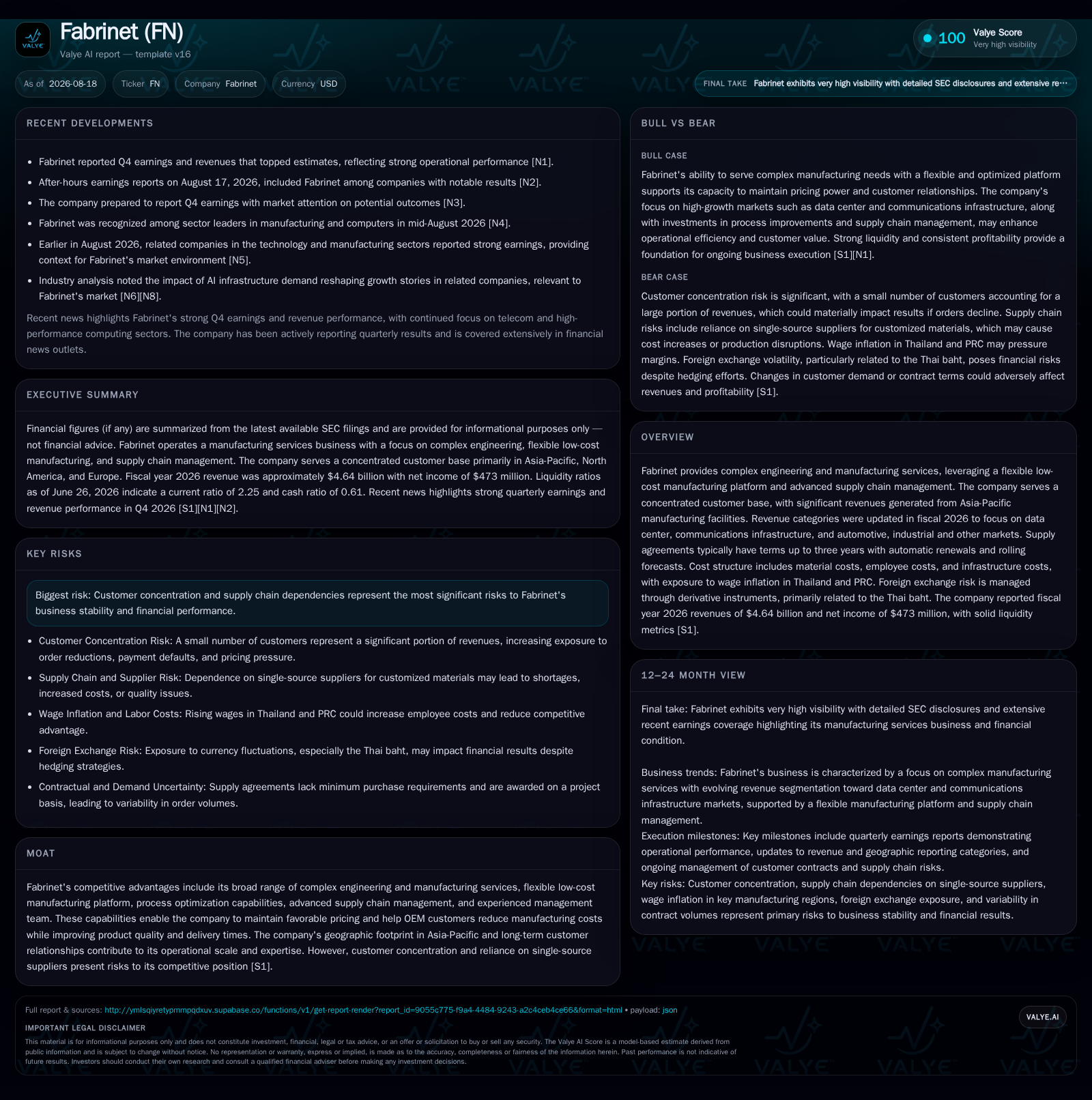
Fabrinet reported strong fiscal 2026 results with revenues rising to $4.64 billion and net income growth of over 40%, driven by expansion in communications infrastructure and targeted industry segments. The company’s business model capitalizes on complex engineering services and a flexible, low-cost manufacturing platform mainly in Asia-Pacific, but remains vulnerable to customer concentration and supply chain complexities. Recent contract amendments extending debt facilities enhance capital flexibility as Fabrinet continues investing in China despite geopolitical and labor-market challenges. Long-term growth hinges on securing diversified OEM partnerships, managing currency risks, and sustaining process optimization advantages.
Recent Operating Update
Fabrinet’s latest quarterly filing ending March 27, 2026 provides crucial insights into ongoing operational priorities and risks entering fiscal year 2027. The company continues investing heavily in its Asian manufacturing hubs — notably China — exposing itself to geopolitical and economic uncertainties endemic to that region, alongside political disturbances in Thailand where its principal factories reside [S2]. These factors underscore the operational complexity of maintaining an Asia-focused contract manufacturing footprint during diverse economic policies and labor conditions.
Additionally, Fabrinet recently amended its credit arrangements with Bank of Ayudhya Public Company Limited expanding the aggregate credit facility by Thai baht 2.61 billion (~$78 million) plus an additional $100 million USD tranche while extending the drawdown period [S3]. This enhancement to financial flexibility suggests preparation for sustained capital deployment towards operational expansion or buffer against localized disruptions.
Business Model Analysis
Fabrinet operates as a specialized contract engineering and manufacturing service provider primarily serving OEMs in technology-driven markets such as data centers, communication infrastructure, automotive electronics, and industrial applications [S1,S4]. The company's revenue derives from executing engineering-heavy manufacturing contracts that combine precision assembly with rigorous supply chain logistics across multi-year master supply agreements typically lasting up to three years with automatic annual renewals [S5,S16]. Despite lacking minimum purchase guarantees under these contracts, Fabrinet secures rolling forecasts from customers guiding inventory procurement and production volumes.
Revenue mechanics hinge on pricing based on product complexity, volume ordered project-by-project under overarching agreements. Cost structures involve direct materials procurement—often long lead-time or non-cancelable—and significant wage expenses within Thailand and China facilities as well as fixed infrastructure costs. Fabrinet's ability to maintain pricing power rests on demonstrated efficiencies in cycle time reduction, yield improvements, quality assurance protocols, and process optimization expertise that OEMs find difficult or uneconomical to replicate in-house. This positions Fabrinet as a valuable outsourcing partner helping customers reduce total cost of ownership while maintaining high product standards.
However, this model also imposes working capital demands due to pre-purchasing materials against uncertain final orders. The company mitigates cash conversion risk through close collaboration with clients’ rolling forecasts but remains sensitive to order volatility.
Industry Structure and Competitive Position
Within the industrial hardware contract manufacturing domain—including overlapping peers like Flex Ltd., Jabil Inc., TTM Technologies, Benchmark Electronics, and Celestica—Fabrinet distinguishes itself with a niche focus on high-complexity optical components alongside broader electronic systems integration primarily centered in Asia-Pacific production hubs.
Unlike more broadly diversified EMS providers like Flex or Jabil which operate globally across consumer electronics sectors with vast scale economies, Fabrinet leverages specialization as its moat: tailoring offerings for telecom optics (historically) now repositioned towards data center interconnects and communication infrastructure needs while expanding automotive-electronics engagement as evidenced by revised segment disclosures starting Q4 FY26 [S4]
This strategic focus enables pricing favorable relative to commoditized contract manufacturers but also concentrates risk due to fewer large OEM customers accountable for the majority of revenue (four customers represented >57% revenue in FY26) [S1,S8]
Supply chain management sophistication acts as another competitive barrier: Fabrinet's depth in securing critical single-source components through disciplined forecasting cycles contrasts with less integrated competitors who may face material shortages more acutely. However, reliance on limited suppliers can still periodically disrupt production yielding order delays—a structural vulnerability shared across the sector.
Growth Drivers
Key tailwinds include accelerating OEM outsourcing trends motivated by capex reduction aspirations amid increasingly complex product designs requiring higher precision assembly capabilities not easily migrated offshore without quality risks.
End markets are also growing: surge demand for data center infrastructure driven by cloud services expansion supports higher volumes for optical interconnect products where Fabrinet has established expertise [S12]. Likewise, growing automotive electrification creates incremental production opportunities for electronic modules servicing safety and autonomous features differentiated by stringent manufacturing requirements.
Technological complexity fuels continuous demand renewal cycles where OEM customers seek partners able to adapt rapidly—a niche well served by Fabrinet's engineering services breadth combined with agile low-cost manufacturing platforms leveraging Asian labor cost advantages but flexible enough for mix adjustments towards higher-margin projects [S1,S5]
The company's recent shift to report revenues according to ship-to rather than bill-to customer location enhances visibility into growth geographies confirming Asia-Pacific dominance (~74% of revenues FY26) paired with gradual North America revenue share expansion (23%) reflecting diversification efforts or evolving client sourcing strategies [S6,S13]
Further growth reinforcement comes from long-term master supply agreement renewals supplemented by project-based orders enabling measurable backlog metrics giving advance production visibility—a valuable KPI for managing capacity utilization efficiently.
Risks and Watchpoints
Customer concentration looms largest: losing even one major OEM client or sustaining order cutbacks could materially erode revenue given roughly four clients contributing over half of total sales last fiscal year—an exposure intensified by their own financial downturns or market consolidations which compress bargaining leverage against Fabrinet [S1,S8,S16]. Equity investors should monitor customer health indicators carefully.
Supply chain fragility driven by dependency on single-source components heightens vulnerability not only to supplier yield deterioration or capacity constraints but also geopolitical disruptions affecting material flows often linked to semiconductor shortages impacting electronic assembly schedules industry-wide [S21]
Labor market challenges including wage inflation pressure rising operational costs especially within Thailand where strikes or social unrest have periodically surfaced threaten margin stability demanding vigilant HR management alongside automation investments where feasible [S2]
Currency exchange fluctuations remain a significant risk vector given substantial costs incurred locally denominated mostly in Thai baht; although hedging strategies employing derivatives have moderated volatility effects recently evidenced by a return to modest FX gains after prior losses fiscal year-over-year—ongoing monitoring of effectiveness against market shifts is prudent [S2,S23].
Consolidation among customers constrains total addressable business further reducing the number of accessible OEMs while simultaneously magnifying buyer power leading potentially to downward unit pricing pressure—a secular headwind common across contract manufacturers facing oligopolistic client dynamics [S8,S16]
Lastly, regulatory compliance overhead including international export controls complicates serving certain high-tech customers implicating indirect business restrictions that could reduce sales opportunities or necessitate costly procedural changes.
What To Watch Next
Upcoming fiscal quarters will test Fabrinet’s ability to sustain double-digit sales growth amid ongoing macroeconomic tightening affecting tech spending globally. Key performance indicators include new contract wins beyond existing core customers that would diversify concentration risk; margin resilience especially gross margin trends reflecting material cost pass-through efficiency; order backlog consistency supporting output planning; foreign currency hedge performance amid fluctuating baht/USD rates; employee turnover rates signaling workforce stability; and capital expenditure deployments aligned with stated China expansion plans revealing operational agility.
Monitoring any shifts in master agreement terms during renewals offers early insight into pricing trajectory and future volume commitments. Equally important will be tracking legal developments related to ongoing PRC litigation matters that could affect subsidiary operations though current impact appears unquantified at early stages [S1 LEGAL PROCEEDINGS excerpt not detailed here beyond risk mention].
Financial Profile Discussion
As of June 26, 2026, Fabrinet held $347 million in cash and equivalents with current assets totaling approximately $3.16 billion against current liabilities near $1.40 billion, yielding a current ratio of about 2.25, indicating solid short-term liquidity and working capital management [F1]
The company’s credit facility was recently expanded by approximately $178 million USD equivalent, enhancing financial flexibility for capital expenditures or operational needs [S3]
Disclaimer: This analysis is for informational purposes only based on publicly available filings as of August 18, 2026. It does not constitute investment advice or a research view regarding Fabrinet's securities.
Disclaimer: This is research-only, informational analysis and not investment advice. It may include AI-generated interpretation and general industry context. Always verify important details using primary sources.

Comments