
Securitize Corp. Accelerates Tokenization Amid Platform Transparency Gaps
The company’s first post-merger quarterly report reveals operational opacity despite its core role in the evolving digital securities ecosystem.
Securitize Corp.’s latest 10-Q filing following its July 2026 business combination discloses minimal financial or operational metrics, limiting insight into platform adoption or monetization progression. Operating as a key player in digital securities tokenization, the company’s business model centers on facilitating security token offerings, compliance services, and secondary market activities. However, absent transparency on critical KPIs such as STO volume, investor accounts, or transaction liquidity, assessing competitive positioning versus peers like tZERO or Polymath remains challenging. Industry growth drivers including regulatory clarity and institutional interest create opportunity, but execution risks tied to compliance complexity and market liquidity persist.
Post-Combination Operating Snapshot Exposes Deep Visibility Gaps
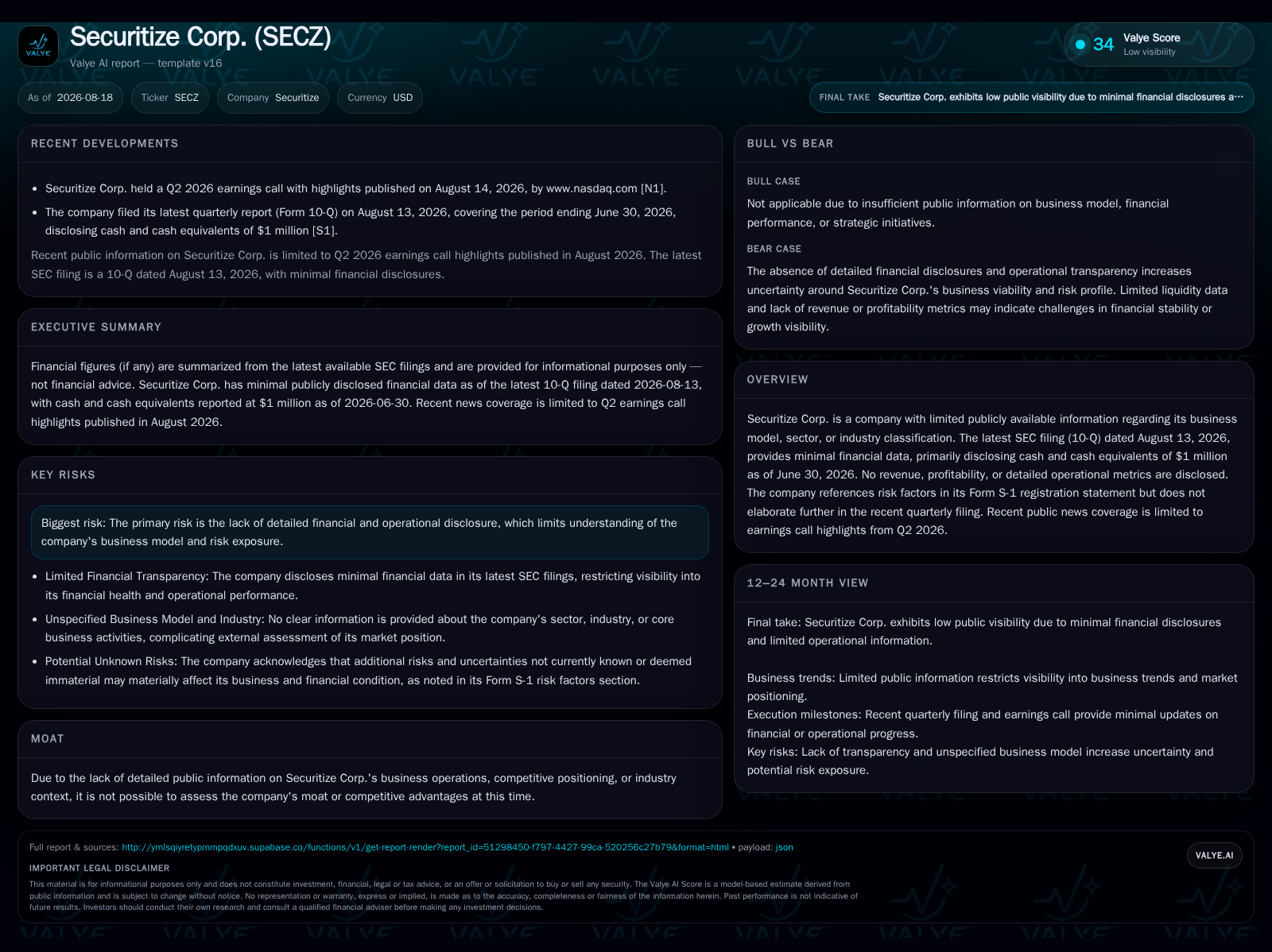
Securitize Corp.'s maiden quarterly report post its July 1, 2026 business combination offers scant operational clarity. The August 13 filing reveals a cash balance of only $1 million as of June 30, signaling limited disclosed liquidity [F1]. Beyond this narrow balance sheet snapshot, no revenue figures or other performance indicators appear in the filing [S2]. The lack of disclosed key performance metrics—such as transaction volume or active client counts—means investors face significant opacity regarding commercial traction. Moreover, an earnings call summary released contemporaneously highlighted ongoing operational efforts but fell short of quantifying growth rates or customer acquisition dynamics [N1]. This deficiency complicates understanding whether monetization pipelines are advancing as expected or if unit economics remain unproven.
Confirming either scenario hinges on forthcoming disclosures that directly address platform usage intensity and monetization dynamics. Without such data points in near-term reports, external evaluation of Securitize's scale and competitive progress remains guesswork.
Platform Dynamics: Tokenization Services Without Transparent Metrics
Securitize operates within the digital asset services space primarily as a platform enabling security tokens issuance and associated compliance functions. Typically, companies in this domain earn fees from multiple sources: transactional charges related to security token offerings (STOs), subscription fees for platform access, compliance-related service revenues including KYC/AML onboarding and regulatory reporting automation, and commissions from secondary market trades facilitated via blockchain ledger infrastructure.
Industry-standard KPIs critical to assessing operational health include number of STOs facilitated—a direct proxy for deal flow—and active investor accounts reflecting user engagement. Transaction volume on the platform indicates liquidity depth vital to sustaining marketplace dynamism. Retention rates of issuers and investors serve as defensive moat proxies by revealing customer loyalty and network effects maturity.
Regrettably, Securitize’s recent filings abstain from disclosing any of these KPIs [S2], nor did public remarks during the Q2 earnings call augment transparency on these fronts [N1]. This absence obscures validation of product-market fit or potential leverage deriving from scalable compliance automation modules embedded in smart contract frameworks. Given these elements underpin operating leverage and margin expansion potential in tokenization platforms, their omission leaves open questions about Securitize's trajectory.
Future filings incorporating even aggregate STO counts or monthly active investor statistics would materially improve visibility into growth momentum.
Competitive Context: Benchmarking Against Evolving Digital Securities Peers
While direct peer comparisons are constrained by Securitize's limited disclosure, industry knowledge positions competitors like tZERO as notable benchmarks illustrating ecosystem-oriented models where secondary trading venue liquidity heavily influences valuation prospects through network effects amplification. Polymath focuses on compliance automation via integrated KYC/AML workflows enhancing issuer onboarding efficiencies and reducing regulatory friction—a defensive moat that any rival must match to compete effectively.
Additionally, custody specialists such as Coinbase Custody complement issuance platforms by providing secure digital asset storage solutions integral to investor confidence.
Given these differentiated roles within the digital asset value chain, Securitize’s strategic positioning depends on how effectively it meshes issuer servicing with end-investor trading execution and custody orchestration. Persistent regulatory complexity demands substantial technology investments in compliance automation—where peer capabilities set high bars.
Absent disclosed customer metrics or detailed operational updates from Securitize, it remains unclear if the company matches peer-level integration depth or enjoys unique partnerships that might buffer competition from both crypto-native firms and traditional financial institutions entering tokenization.
Growth Catalysts in an Unfolding Regulatory Milieu
The industry backdrop supporting companies like Securitize involves several robust growth vectors rooted in improving regulatory clarity around digital securities offerings. Enhanced legal recognition facilitates broader institutional adoption by reducing compliance ambiguities—a primary impediment cited in risk disclosures [S2].
Demand for fractional ownership expands addressable markets by enabling private market assets to be subdivided into tradable units via tokenization—a feature particularly attractive for real estate or venture capital exposure among smaller investors. Blockchain-enabled smart contracts automate settlement processes streamlining operations and lowering costs versus conventional securities issuance architectures.
Collaborations with established financial institutions can accelerate scaling by leveraging existing distribution channels and embedding tokenized products within traditional investment workflows.
Collectively these factors point to sustainable tailwinds that could unlock latent demand if platforms demonstrate credible track records supported by transparently reported operating metrics.
Underappreciated Obstacles: Market Liquidity and Compliance Complexity
Despite favorable macro trends, considerable headwinds persist for players like Securitize. Low liquidity suppresses price discovery efficiency and hinders investor engagement—a vicious cycle dampening network effects critical to platform viability.
Cybersecurity risks inherent in distributed ledger technology platforms pose continuous operational threats requiring ongoing investment in defense capabilities.
Additionally, precarious regulatory environments expose firms to legal actions over securities law enforcement impacting innovation pace.
Integration complexity with legacy financial systems also constrains issuer appetite who expect seamless onboarding compatible with existing back-office workflows.
Securitize references risk factors consistent with these common industry challenges but offers no new mitigation evidence in the latest report [S2]. Absent forward progress updates here may leave the firm vulnerable relative to more transparent peers gaining trust through demonstrated execution.
Forward Signals to Watch: Adoption KPI Disclosure and Secondary Trading Stats
Looking ahead, increasing disclosure quality around key adoption markers will be crucial. Specific metrics such as cumulative STO facilitated count alongside sequential growth rates can signal deal flow health. Similarly rising transaction volumes on platform point toward improving marketplace liquidity essential for sustained issuer/investor engagement.
Issuer retention rates provide early evidence of stickiness while average fee per transaction helps infer revenue mix stability and unit economics robustness. Secondary market liquidity expansion milestones—whether driven by new trading venues or partnerships—would be particularly valuable given their outsized impact on valuation multiples observed among peers like tZERO.
Equally important will be public affirmations around scaling compliance automation capabilities addressing evolving regulatory demands which function as barriers protecting intellectual property moats.
Transparent communication of these data points could help re-rate market perceptions transforming current opacity into differentiated competitive advantage.
This analysis highlights how Securitize Corp., despite occupying a strategically valuable niche in digital asset tokenization infrastructure post-business combination, currently suffers from limited publicly available operational data undermining comprehensive evaluation. The coming quarters' disclosures regarding core KPIs will be pivotal in discerning whether the firm can capitalize on promising industry tailwinds while navigating formidable execution risks inherent in this emergent sector.
Disclaimer: This document is an analytical briefing based solely on publicly filed documents and industry context without any investment research views.
Disclaimer: This is research-only, informational analysis and not investment advice. It may include AI-generated interpretation and general industry context. Always verify important details using primary sources.

Comments