
Aeon Acquisition’s Strategic Moves Highlighted by Recent Promissory Note and Arbitration Settlement
Aeon Acquisition I Corp. strengthens its path toward an inaugural business combination by securing sponsor funding and resolving key legal risks.
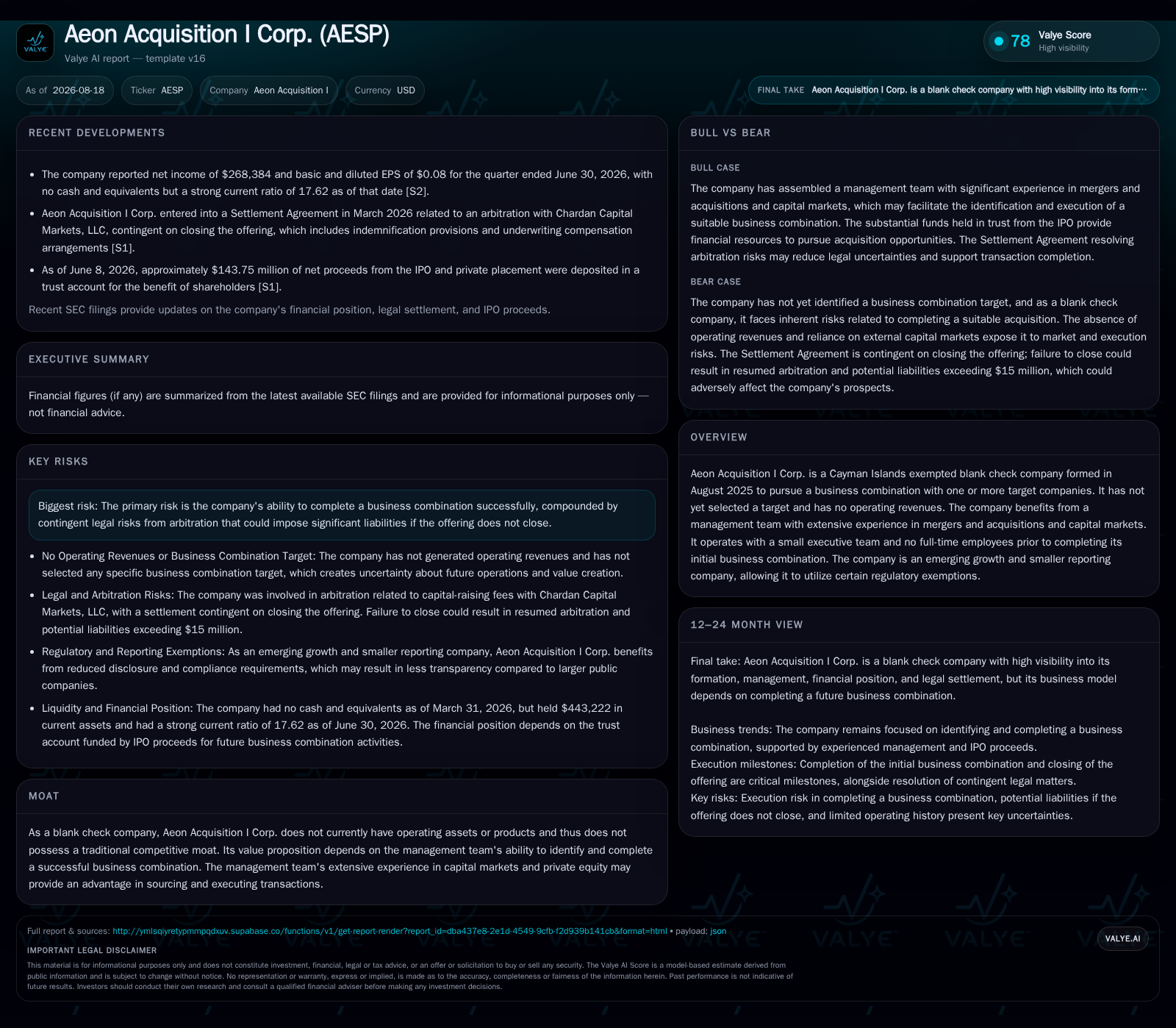
Aeon Acquisition I Corp., a Cayman Islands exempted blank check company formed in August 2025, remains focused on consummating its initial business combination. A recent unsecured promissory note of up to $250,000 from its sponsor enhances liquidity for transaction-related expenses, addressing a critical operational need in the absence of revenues. Concurrently, settlement of a prior $15 million arbitration claim reduces legal uncertainty and bolsters shareholder confidence ahead of a potential de-SPAC transaction. The company's experienced management team anchors its ability to source and complete a deal amid competitive pressures and evolving market conditions typical for SPACs.
Recent Sponsor Financing Underscores Commitment Toward Business Combination
Aeon Acquisition I Corp.'s July 2026 issuance of an unsecured promissory note from the Sponsor up to $250,000 marks a significant operational development supporting its pursuit of an initial business combination [S3]. Given the company's status as a blank check vehicle with no operating revenues or assets pre-merger, liquidity for costs such as due diligence, underwriting fees, legal expenses, and regulatory compliance is essential. This non-interest bearing loan payable upon closing enhances Aeon's financial runway without increasing ongoing cash flow burdens or diluting stakeholders prematurely. The prepayment option without penalty further aligns incentives between Sponsor and public shareholders by preserving flexibility.
This financing move is emblematic of proactive cost management typical among SPACs at this stage. Compared to peers who either rely extensively on PIPE financing or sponsor capital infusions for interim expenses, Aeon's approach reflects focused preparation to avoid disruption ahead of its projected merger timeline.
Resolving Legal Risks Enhances Transaction Confidence
Aeon recently settled a significant arbitration dispute originating from prior capital-raising activities linked to predecessor engagements predating its formation [S1]. The claim by Chardan Capital Markets sought at least $15 million relating to fee disputes connected with potential SPAC transactions. The resolution included indemnification provisions where CEO Demetrios Mallios and affiliated entities jointly shield the company and shareholders from direct liability.
Settlement terms designate Chardan as lead book-running manager for Aeon's offering and promise dismissal of arbitration proceedings post-closing. This effectively removes a material legal overhang that could have introduced regulatory scrutiny or caused investor hesitation during shareholder votes – a known friction point in SPAC deals historically.
By mitigating legal risk through structured indemnification and settling longstanding claims before targeting a business combination, Aeon positions itself more favorably relative to peer SPACs that may be encumbered by unresolved disputes. This clarity on liabilities is likely to enhance market credibility ahead of transaction execution.
SPAC Business Model Refresher: How Aeon Creates Value Through De-SPAC Mechanics
Aeon Acquisition I Corp., incorporated in August 2025 as a Cayman Islands exempted company, exemplifies the blank check company archetype designed solely to raise capital through an initial public offering (IPO) without commercial operations or revenue generation until completing a business combination [S1]. Its IPO units bundle Class A ordinary shares alongside redeemable warrants and rights—standard instruments granting investors both equity upside potential upon acquisition completion and protective features such as redemption rights that allow cash exit before de-SPAC closure.
The proceeds from Aeon's IPO are held primarily in a trust account insulated from operational expenditures pending merger approval. This trust preserves investor capital subject to reduction only by permitted transaction-related expenses like underwriting fees or costs financed through the newly issued promissory note. Public shareholders maintain voting power over proposed targets with redemption rights acting as both negotiation leverage and risk mitigation.
The value creation pathway depends heavily on management's capacity to source attractive private targets capable of benefiting from public equity access faster or more flexibly than via traditional IPO processes. Retail investors rely on confidence in the Sponsor's reputation and execution capability — non-traditional KPIs compared to operating companies — making management expertise paramount.
Competitive Positioning Within the SPAC Landscape Robust but Execution-Dependent
Aeon's executive team brings deep experience across mergers & acquisitions, capital markets, private equity investing, technology platforms, and strategic leadership dating back decades [S1]. CEO Demetrios Mallios has an extensive background involving global fund management roles across major financial institutions such as Bank of America and UBS alongside principal investing via The Aeon Group. CFO Alan Lewis similarly carries entrepreneurial credentials entwined with private equity fund growth.
When benchmarked against prominent SPAC sponsors like Pershing Square Tontine Holdings or Churchill Capital Corp—who leverage brand recognition plus historical deal flow—Aeon's management pedigree is competitive but yet unproven in closing complex transactions under evolving market conditions. This introduces typical execution risk shared across new blank check entrants competing for quality targets amid near-term market volatility.
Aeon's relatively small current asset base supplemented by Sponsor loans evidences operational prudence but also highlights dependency on flawless deal sourcing pipelines. Redemption dynamics during shareholder votes will serve as critical barometers for investor sentiment reflecting peer experience where high redemptions often dilute available merger consideration adversely.
Key Growth Drivers: Management Expertise, Market Conditions, and Pipeline Quality
Several sector-wide macro factors support Aeon's growth prospects toward completing its inaugural business combination. Private companies increasingly prefer alternative listing avenues such as de-SPAC transactions due to generally shorter timelines compared with traditional IPOs as well as more flexible valuation negotiations under less volatile conditions including current capital market uncertainties encountered broadly across sectors.
Aeon's management team's extensive networks offer access into proprietary deal flows impossible for less-connected competitors; this sourcing advantage is critical given few announced targets currently reported by similar-sized blank check firms around its vintage date [S1]. Additionally, recent sponsor-backed financing mitigates cash burn risks maintaining readiness for transaction execution costs absent recurring operational income [S3].
Furthermore, regulatory frameworks remain broadly supportive though evolving scrutiny emphasizes transparent governance practices—a factor eased now that prior legal disputes have been formally settled [S1]. Public shareholder appetite remains vital; thus careful handling of redemption features combined with credible target announcements will underpin momentum heading into official merger votes.
Risks Ahead: Redemption Risk, Deal Completion Timelines, and Regulatory Environment
Despite supportive elements there are inherent risks characteristic of SPACs generally which pertain acutely here given Aeon's nascent status without announced business combinations yet executed [S2]. Primary among these is failure to secure or close an attractive transaction before mandated statutory deadlines leading inevitably to liquidation or return of capital excluding potential warrants upside.
High redemption rates represent another material threat whereby public shareholders elect cash out upon announcement diminishing available merger proceeds requiring renegotiations or downscaling deal valuations—a scenario observable with several peers over recent quarters owing partly to changing market sentiments. Regulatory considerations could intensify post-arbitration given amplified oversight attention commonly faced by vehicles previously entangled in disputes even after settlement agreements render those disputes closed formally.
Sponsor alignment alleviates some risks since management's incentives align toward effective deal closure; however complexities around PIPE financing commitments remain uncertain until formal transaction terms emerge publicly. Persistent reputational risks subsist if delays mount jeopardizing investor confidence—a comparative weakness versus track record-rich rivals boasting multiple completed combinations within standard timeframes.
Monitoring Milestones: Target Identification, Shareholder Votes, and Transaction Closing
Investors should carefully monitor Aeon's timeline progress starting with public disclosures regarding target identification—the absence thereof currently limits broader fundamental assessment ([S2],[S3]). Subsequent steps hinge on securing shareholder approval through votes often conducted months after announcement characterized by variable redemption behavior necessitating transparent communication.
Other critical checkpoints include confirming underwriting fee arrangements integrated into offering structures per industry norms affecting net proceeds available for transaction funding alongside warrant exercise rates which impact future share count dilution dynamics post-business combination. Lastly, closure execution dates will validate whether promoter-led initiatives translate beyond preparatory phases into durable operational enterprises accessing public markets successfully.[S2]
This analysis is based entirely on publicly filed SEC documents dated through August 2026 combined with sector-specific frameworks relevant to Special Purpose Acquisition Companies (SPACs). It excludes any speculative assumptions regarding undisclosed negotiations or financial forecasts.
Disclaimer: This is research-only, informational analysis and not investment advice. It may include AI-generated interpretation and general industry context. Always verify important details using primary sources.

Comments