
Richmond Mutual Bancorporation’s Latest Quarter Reveals Evolving Credit Risk Dynamics and Brokered Leasing Strategy
The August 2026 Q2 filings highlight RMBI's credit provisioning shifts under CECL and the strategic role of broker networks in its leasing business.
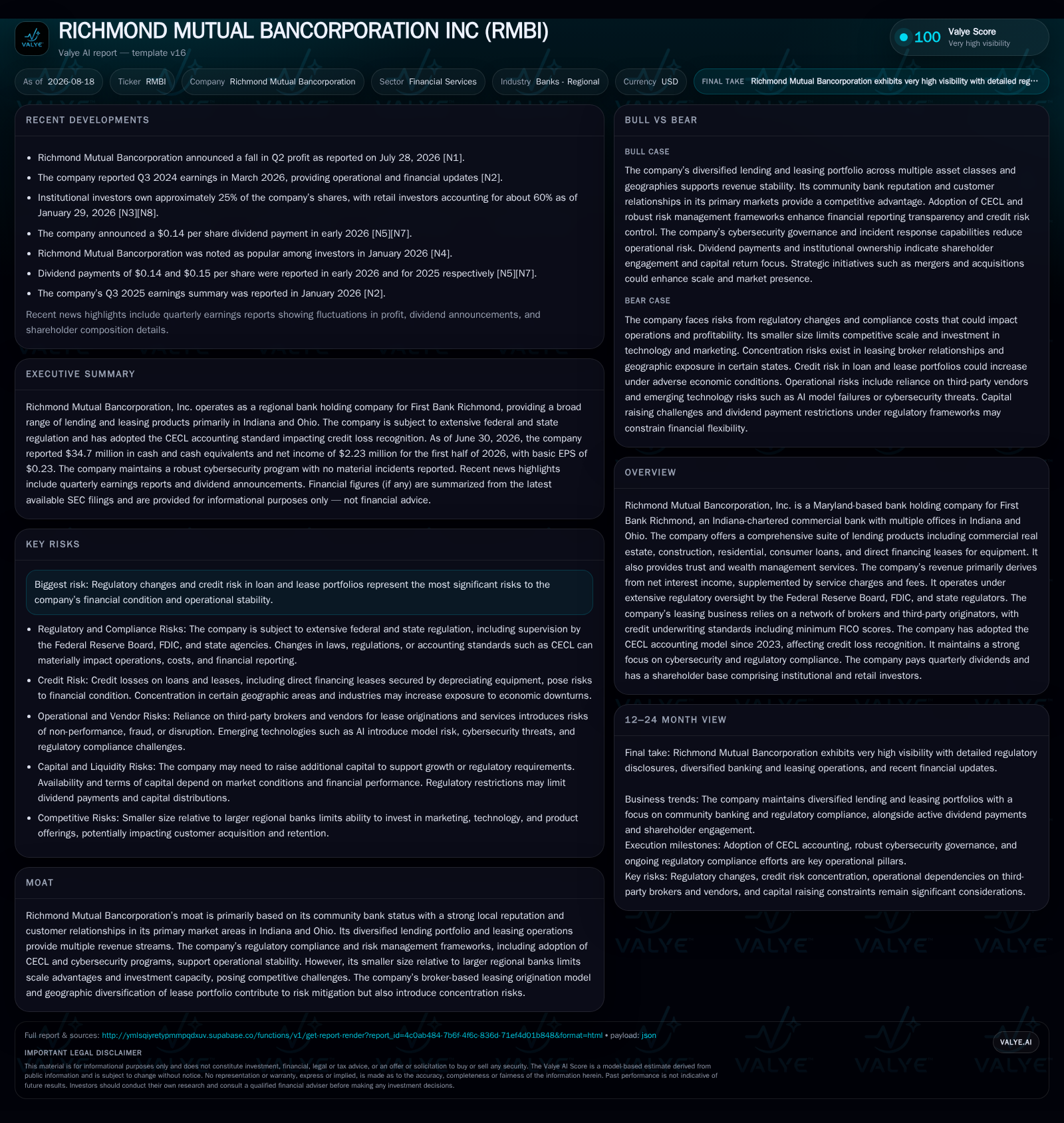
Richmond Mutual Bancorporation reported nuanced credit loss provision increases in Q2 2026, reflecting ongoing impacts from its CECL accounting model adoption. The bank’s diversified lending, including commercial real estate, consumer loans, and equipment leases originating via an external broker network, underscores a multi-channel revenue approach. Benchmarking against regional peers suggests RMBI experiences typical CECL-induced earnings volatility but offsets this with strong local market relationships in Indiana and Ohio. Deposit base stability and regulatory capital position remain adequate, though regulatory and concentration risks merit monitoring in upcoming quarters.
Quarterly Operating Highlights: Credit Loss Volatility under CECL Accounting
Richmond Mutual Bancorporation’s latest quarterly disclosure for Q2 2026 reveals heightened provisioning for expected credit losses attributable to the ongoing influence of the Current Expected Credit Losses (CECL) accounting standard adopted at the start of 2023 [S2]. This forward-looking methodology compels management to estimate lifetime credit losses upon loan origination using macroeconomic forecasts rather than waiting for incurred defaults. Consequently, RMBI recognized an increase in its allowance for credit losses during Q2 that outpaced traditional incurred loss models used prior to CECL [S2].
This accounting asymmetry introduces notable earnings volatility by accelerating credit loss recognition upfront while spreading interest income over time. For a regional bank like RMBI with concentrated commercial real estate exposures sensitive to local economic cycles, fluctuations in employment rates or property valuations feed directly into quarterly credit provisions [S1]. These developments underline why observed net income declines reported in July 2026 are partially temporary reflections of forward-looking models rather than definitive credit deterioration [N1]. Confirmatory markers will include stabilization or moderation of the loan loss provision ratio alongside improving non-performing assets (NPA) metrics.
Diverse Lending Streams Anchored by Local Market Expertise and Broker Origination Channels
RMBI operates a geographically focused bank holding company anchored by First Bank Richmond with branches mainly across Indiana and Ohio [S1]. Its lending platform is diversified across multiple segments: multi-family and commercial real estate loans; construction and land development financing; consumer loans including home equity lines; commercial & industrial loans; and notably direct financing leases primarily for equipment [S1],[S25].
Equipment leasing volume is distinctly sourced via an extensive network of third-party brokers and originators who identify prospective lessees outside RMBI's traditional branch footprint [S1]. This broker channel enables the bank to access more diverse lessee pools without significantly expanding direct sales cost bases—a relative competitive advantage compared to peers of similar size such as Fifth Third Bancorp or KeyCorp who maintain more traditional origination systems. Underwriting protocols require minimum FICO scores which help mitigate credit risk from these indirect originations.
The value chain position as both a traditional community lender and an indirect lessor allows RMBI to generate stable net interest income while also collecting fee income on leases, diversifying revenue amid evolving market demands. The ability to leverage dual channels—local relationship banking alongside broker-partnered leasing—provides flexibility but also adds complexity in risk monitoring.
Competitive Implications of Peer Benchmarking on Asset Quality and NIM Performance
When viewed relative to other Midwestern regional banks such as Fifth Third Bancorp or KeyCorp, RMBI exhibits comparable pressure from CECL-derived earnings swings, especially regarding net interest margin (NIM) compression due to rising provisions [S2],[S1]. However, its smaller asset base limits scale economies that might otherwise smooth operating leverage.
RMBI’s non-performing assets ratio remains within typical thresholds for community banks focused on geographic clusters with relatively stable economic activity [S2]. Efficiency ratios reflect disciplined cost controls but are likely challenged by regulatory compliance burdens which disproportionately weigh on smaller institutions [S1]. Deposit bases blend organically sourced accounts with brokered deposits facilitating liquidity management in competitive Midwestern deposit markets—a balancing act for many peers grappling with funding costs [S1],[S2].
Competitive pressure manifests not only from larger regional banks with broader product suites but also fintech lenders eroding certain segments like consumer loans or equipment finance. RMBI’s broker leasing model attempts to offset some disadvantage through external origination reach.
Growth Tailwinds: Local Economic Conditions & Lease Portfolio Expansion via Broker Channels
Underlying loan demand reflects steady industrial activity in Indiana-Ohio corridor markets supported by employers across manufacturing, healthcare services, retail distribution centers, and education institutions including Ohio State University vicinity [S26]. The region's unemployment rates near historical lows contribute positively to borrower payment capacity enhancing asset quality trends [S26].
Equipment leasing growth through brokers has been buoyed by favorable business investment spending as firms seek capital-efficient ways to upgrade machinery without outright purchase. This originations pipeline offers revenues less directly correlated with local deposit volumes or traditional loan demand cycles allowing some diversification benefits for RMBI [N1],[S1],[S2].
Deposit growth tracks modestly along population expansions within core cities while brokered deposits fill liquidity gaps efficiently without requiring costly branch expansions. Such dynamics help contain funding expense alongside supporting conservative loan-to-deposit ratios consistent with regulatory expectations.
Rising Risks: Regulatory Pressures, Concentration Pitfalls, and Deposit Base Stability
RMBI operates under stringent supervision from multiple regulators—the Federal Reserve Board as parent holding company regulator plus FDIC and Indiana Department of Financial Institutions at subsidiary levels—imposing capital adequacy requirements that govern dividend policies and operational flexibility [S1],[S24]. The increased operational cost associated with regulatory compliance constrains smaller regional banks’ ability to invest heavily in technology or expand product lines rapidly.
Loan portfolio concentration remains focused on commercial real estate and construction development loans comprising a significant portion of total assets (~64%) posing inherent cyclical risk given sensitivity to local real estate markets [S29]. Although geographic dispersion across parts of Ohio mitigates pure single-market exposure somewhat, stresses such as rising vacancies or refinancing challenges could trigger sharper loan loss trends. Credit underwriting practices incorporating adjusted FICO thresholds post-CECL appear designed to temper accumulation of higher-risk loans but will require vigilant portfolio monitoring.
Deposit base stability is another watchpoint amid macroeconomic uncertainty affecting depositor confidence regionally. While brokered deposits supplement funding needs effectively, reliance on these may increase liquidity risk should capital markets tighten abruptly or altered regulations impact brokered funding availability.
Monitoring Milestones: Ahead for Loan Growth Metrics, NPA Trends, and Liquidity Signals
Key performance indicators warranting close observation include quarterly net interest margin stability reflecting pricing power amid competitive lending; loan growth rate especially within equipment leasing segments evidencing commercial client confidence; allowance for credit losses adjustments signaling evolving macro forecasts embedded within CECL methodologies; non-performing assets ratio movements indicative of true asset quality shifts beyond abstract provisioning changes; and deposit growth rates which directly influence liquidity risk profiles.
Additional milestones involve regulatory updates potentially altering capital buffers or reporting norms post-pandemic recovery phases. Pending supervisory stress-test feedback or Federal Reserve commentary on community bank resilience could inform execution risks.
Financial Profile Discussion: Capital Resilience Amid Earnings Volatility
As of June 30, 2026, Richmond Mutual Bancorporation held approximately $34.7 million in cash and cash equivalents [F1]. The balance sheet reflects measured growth oriented towards maintaining conservative loan-to-deposit ratios aligned with risk appetite parameters set forth internally. Dividend payout policies remain subject to both internal earnings realizations influenced by CECL effects and external regulator approvals restricting distributions contingent on capital conservation buffer maintenance [S15]. This prudent stance supports longevity through cyclical credit environments.
Though earnings have exhibited increased quarter-to-quarter variance due primarily to CECL’s forward-looking provision model usage rather than abrupt business deterioration signals, the institution retains fundamental soundness rooted in diversified asset composition and local market franchise strength.
Richmond Mutual Bancorporation illustrates how a midsize regional bank contends with modern accounting standards reshaping earnings visibility while leveraging a hybridized lending origination approach combining community banking intimacy with broker-enabled equipment lease sourcing. Future operating quarters should clarify sustainability of these emerging dynamics amidst shifting local economic conditions and evolving regulatory landscapes.
This analysis incorporates only publicly disclosed financials and operating data without offering investment advice or projections.
Disclaimer: This is research-only, informational analysis and not investment advice. It may include AI-generated interpretation and general industry context. Always verify important details using primary sources.

Comments