
Alliance Laundry's Installed Base Strength Fuels Resilient Revenue Amid Margin Pressures
Q2 2026 results underscore Alliance Laundry's reliance on its vast installed base for stable growth while contending with input cost inflation that compresses margins.
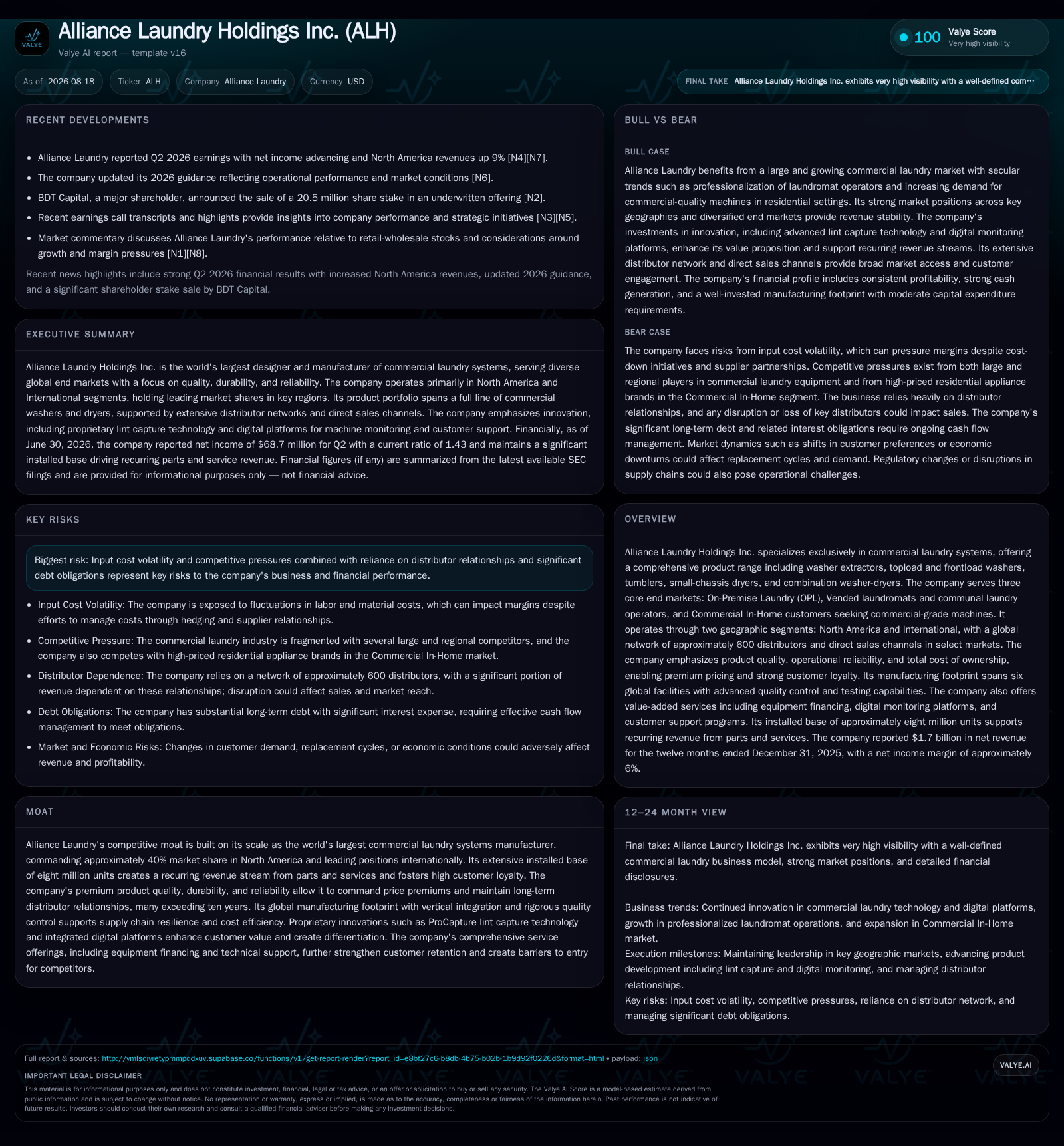
Alliance Laundry Holdings Inc. reported solid revenue growth in North America for Q2 2026, driven primarily by replacement demand from an estimated eight million unit installed base. This dependable replacement cycle supports stable sales despite uneven macroeconomic conditions impacting different end markets. However, rising input costs have pressured gross margins, challenging the company's ability to fully pass through price increases. Alliance's premium product quality and broad distributor network help sustain pricing power and customer loyalty, creating a recurring revenue stream in aftermarket parts and services. Going forward, expansion in emerging markets and increasing commercial-grade residential demand offer growth potential, but risks from commodity volatility, competitive pricing, and debt levels remain prominent.
Q2 Summary: Growth Momentum Supported by Installed Base Replacement Demand
In its latest quarter ending June 30, 2026, Alliance Laundry Holdings Inc. reported North American revenue growth of roughly 9%, reflecting solid demand tied closely to its sizeable installed base estimated at eight million commercial laundry units [S2][N2]. This extensive installed base drives predictable replacement cycles typically spanning about ten years due to equipment durability and mission-critical functionality across healthcare, hospitality, laundromats, and other commercial end-markets [S1]. The cyclical yet stable pattern of replacement buying underpins the company’s revenue consistency even as broader economic conditions fluctuate. This structural underpinning reduces sensitivity to macroeconomic noise by spreading investment timing across diverse customers.
End-Market Diversification Underpins Resiliency during Uneven Macro Trends
Alliance Laundry addresses three core markets: On-Premise Laundry (OPL), Vended laundromats/communal facilities, and Commercial In-Home customers seeking commercial-grade machines [S1]. Each segment exhibits distinct investment timing and demand drivers—for instance, healthcare OPL investments depend heavily on institutional budgets with stringent uptime requirements, while vended laundromats are influenced by demographic trends and investor activity in mature versus emerging regions. The blended exposure tempers overall business cyclicality as different end-markets rarely contract simultaneously. Moreover, emerging markets present opportunities particularly for vended systems adoption where communal laundry gains traction [S1]. This strategic diversification provides a resilient revenue foundation.
Premium Product Quality Sustains Pricing Power Despite Input Cost Hurdles
Alliance Laundry's engineering focus emphasizes durability and reliability along with optimized total cost of ownership that resonates strongly with commercial customers facing operational downtime risks [S1]. This premium positioning enables the company to command price premiums relative to peers such as Electrolux Professional or Miele Professional who target similar quality-conscious buyers. However, the recent quarterly disclosure highlights rising input cost pressures—particularly steel and component inflation—that have compressed gross margins despite ongoing price adjustments [S2]. The inability to fully pass through price increases immediately is typical in capital goods industries where contractual cycles limit rapid repricing. Alliance’s investment in manufacturing efficiency and vertical integration partially mitigates these pressures but sustaining margin expansion remains challenging.
Distributor Network Durability and Market Share Foster Ongoing Customer Loyalty
With approximately 600 distributors worldwide and direct sales channels in select regions, Alliance Laundry enjoys broad geographic coverage supporting penetration into diverse customer bases [S1]. These distributors often cultivate long-term partnerships exceeding a decade that entrench switching costs for end-users due to familiarity with servicing regimes and financing options. This dealer loyalty reinforces recurring aftermarket parts sales and service contract renewals key to stable margins beyond initial equipment revenue [S1]. Compared to smaller players or OEMs lacking scale like Continental Girbau, the extensive network supports market share maintenance estimated near 40% in North America [S1]. The embeddedness of Alliance’s equipment within customer operations further reinforces this moat.
Innovation in Digital Platforms Adds Recurring Revenue Layers
Beyond hardware sales, Alliance continues developing integrated digital laundry platforms that offer operational monitoring, predictive maintenance alerts, and usage analytics [S1]. Though currently a modest portion of revenues relative to capital equipment sales, these software services enhance customer value by improving machine uptime and reducing operational costs. Subscription fees linked to these platforms add sticky recurring revenue streams gradually increasing margin predictability. Peer companies like Electrolux Professional also invest in such digital offerings signaling an industry-wide shift towards service-enriched product ecosystems with deeper customer engagement.
Growth Catalysts: Emerging Markets Expansion and New Residential Demand Segments
Geographic expansion into emerging economies where demand for commercial-grade laundry systems is nascent represents a key growth vector [S1]. These markets offer room for penetration as hygiene standards rise alongside infrastructure investments in healthcare facilities, hotels, and new communal laundry setups. Parallelly, an upswing in residential consumers seeking durability of commercial laundry machines is another growth opportunity given evolving preferences for premium home appliances offering higher throughput than traditional consumer washers/dryers [S1]. Capturing this hybrid segment could broaden Alliance’s addressable market though it requires tailored channel approaches.
Risks at the Intersection of Commodity Inflation, Competitive Pricing, and Distributor Dependence
The company faces headwinds from volatile raw material costs which pressure gross margins; steel price fluctuations remain a notable concern given the weight-intensive nature of washers and dryers [S2][S1]. While Alliance holds premium pricing power due to quality differentiation, competitive pressures from incumbents or new entrants may limit pricing elasticity, especially amidst tightening capital expenditure budgets in certain regions. Furthermore, distributor relationships are critical but inherently pose concentration risks if any major partner shifts strategy or consolidates with competitors. Lastly, substantial indebtedness totaling over $1.3 billion long-term plus asset-backed borrowings require continued free cash flow generation to manage debt service without constraining growth investments [F1][S5][S6][S7].
Looking Forward: Execution Milestones and Market Signals to Monitor
Investors should track Q3 2026 sales momentum across geographies to assess whether installed base-driven replacement demand sustains pace amid evolving macro conditions [N4]. Gross margin trends will reveal how effectively inflationary pressures get absorbed or offset through mix improvements or pricing actions. Distributor retention rates will provide early signs on relationship stability affecting recurring aftermarket revenues. The adoption rate of digital platform subscriptions can gauge progress toward higher-margin recurring revenue streams complementing hardware sales. Market penetration progress in emerging countries alongside residential-commercial hybrid product adoption offers further evidence of growth trajectory validation.
Financial Profile Discussion: Liquidity Cushion Supports Investment in Capacity and Innovation
Alliance Laundry held cash and equivalents of approximately $159 million as of June 30, 2026 with current assets surpassing current liabilities resulting in a healthy current ratio around 1.43 [F1]. These liquidity levels support working capital needs alongside ongoing capital expenditures expected near $60 million annually aimed at capacity expansion and modernization [S1][S7]. The company previously refinanced portions of its long-term debt following an IPO transaction that enabled a $525 million reduction in term loan principal during late 2025 [S5][S7]. Interest rates on outstanding borrowings currently range between SOFR plus 2.25%–2.75%, modestly improved through recent amendments [S7][S11][S22]. Maintaining leverage discipline will be important given cyclicality inherent in capital goods end-markets as well as inflation-driven input cost variability impacting operating margins.
This analysis synthesizes SEC filings together with known industry context to elucidate Alliance Laundry Holdings’ operating momentum powered by its entrenched installed base balanced against margin pressures from inflationary inputs. The company’s premium quality positioning coupled with durable distributor relationships creates a competitive moat underscored by growing recurring aftermarket revenues. Vigilance over commodity cost trends, competitive dynamics affecting pricing power, distributor health metrics, plus disciplined financial management remain key watchpoints for maintaining performance consistency going forward.
Disclaimer: This is research-only, informational analysis and not investment advice. It may include AI-generated interpretation and general industry context. Always verify important details using primary sources.

Comments