
Archimedes Tech SPAC Partners III’s Governance Update Highlights Board Composition Ahead of Deal Timelines
Latest quarterly filing showcases strong liquidity and governance enhancements, shaping outlook on ARCI’s readiness for its pending business combination.
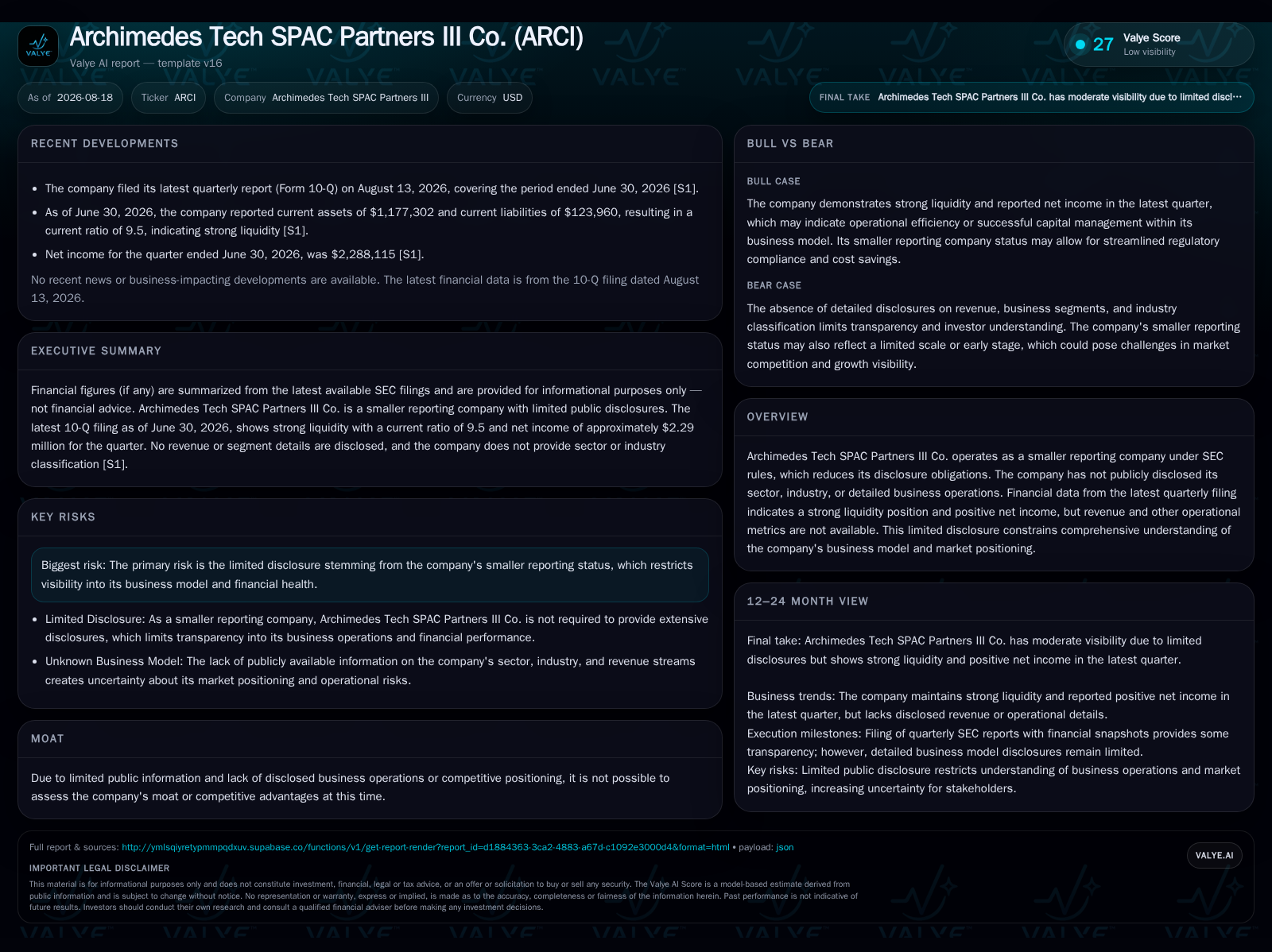
Archimedes Tech SPAC Partners III Co. reported a solid liquidity position with a current ratio of approximately 9.5 as of June 2026, reflecting substantial cash held in trust typical of a pre-merger SPAC [S2][F1]. The company appointed Stephen N. Cannon as an independent director to key governance committees, bolstering board oversight ahead of anticipated deal execution [S3]. Despite these positives, limited disclosure consistent with its smaller reporting status constrains assessment of pipeline visibility or operational traction. These elements underscore the typical challenges SPACs face balancing liquidity management, redemption risk, and sponsor incentives in a competitive transaction environment.
Latest Quarterly Filing Reveals Robust Liquidity Amid Limited Operational Disclosure
Archimedes Tech SPAC Partners III Co.'s latest 10-Q filing dated August 13, 2026, underscores a financially sound baseline typically expected from an active Special Purpose Acquisition Company (SPAC) entering the critical phase of seeking a business combination [S2][F1]. The reported current assets stand at approximately $1.18 million versus current liabilities near $124 thousand as of June 30, 2026, delivering an enviable current ratio around 9.5 that signals ample short-term liquidity to support overhead expenses and transactional costs [F1]. This level of cash buffer is nearly entirely held within the trust account established at IPO, which contains proceeds raised from public investors earmarked for eventual acquisition financing.
Despite the operating loss of $200k observed during the quarter—a reflection of minimal operational activity consistent with the blank-check nature—the company recorded net income roughly $2.3 million due to non-operating sources such as mark-to-market gains or interest income from trust assets [F1]. This positive net income is not reflective of sustainable operating performance but aligns with financial dynamics common across pre-de-SPAC firms that rely on capital preservation rather than revenue generation.
Disclosure remains notably sparse as Archimedes Tech operates as a smaller reporting company under SEC rules, exempting it from extensive itemized risk factor or pipeline updates typically found in larger counterparts’ filings [S2]. Consequently, analysts and investors face opacity regarding target identification efforts or deal progression timelines.
Board Composition Shift Enhances Oversight Ahead of Potential Deals
In an important governance development disclosed in an event filing dated July 17, 2026, Archimedes Tech SPAC Partners III Co. appointed Stephen N. Cannon as a Class II independent director effective immediately [S3]. Mr. Cannon's placement on critical committees—the audit committee along with compensation and nominating/governance committees—affords the board enhanced rigor and independence in oversight functions crucial before entering binding merger agreements.
This strategic board strengthening mirrors industry best practices where robust independent governance reduces conflicts of interest between sponsors and public shareholders, improves compliance monitoring during complex de-SPAC processes, and signals management’s commitment to transparency—factors increasingly scrutinized given past SPAC controversies.
SPAC Business Model Mechanics: Sponsor Promote, Units, and Redemption Risks
Archimedes Tech’s funding structure typifies standard SPAC economics primarily anchored around its initial public offering units composed of one ordinary share plus one-fourth of a redeemable warrant exercisable post-deal closure [S3]. The trust account holds IPO proceeds net of underwriting fees and expenses until a qualifying business combination is consummated or liquidation occurs.
After completing a merger (the de-SPAC transaction), sponsor promote shares—typically about 20% of equity issued—vest sponsors with significant ownership stakes designed to incentivize sourcing profitable deals but also dilute public shareholders’ interests. Warrants add another layer where holders may exercise rights to purchase shares at preset prices after consummation, influencing dilution dynamics.
Crucially, public shareholders retain redemption rights allowing them to opt out from the combined entity by redeeming shares for their pro-rata share of trust assets prior to closing. High redemption rates diminish deal capital availability and can pressure sponsors to renegotiate deal terms or scramble for PIPE financing commitments.
Though ARCI does not disclose specific redemption metrics or announced deals publicly due to smaller-reporting exemptions [S2], this structural risk remains central when evaluating potential transaction viability.
Navigating Industry Structures: Comparisons to Peer SPAC Vehicles and IPO Alternatives
Within the broader SPAC ecosystem, Archimedes Tech operates among numerous smaller-scale vehicles whose mandate aligns closely yet differ principally in scale and transparency compared to giants such as Pershing Square Tontine Holdings (PSTH). PSTH exemplifies how size and sponsor reputation can enhance access to marquee target companies while instilling investor confidence through more frequent disclosure updates.
Similarly, Churchill Capital Corp series illustrate sector- or target-focused vehicles that occasionally outperform generalist competitors by leveraging vertical expertise. As a cohort underpinning alternative finance options beyond traditional IPOs handled by bulge-bracket underwriters, SPACs provide expedited access to public capital markets but face cyclical fluctuations driven by investor sentiment shifts and tightening regulatory scrutiny.
Against this landscape, ARCI’s smaller footprint implies longer timelines or greater uncertainty on deal announcement pacing amid intensified competition for quality private companies seeking liquidity.
Growth Enablers: Market Environment, Regulatory Landscape, and Sponsor Experience
The ongoing evolution in market appetite for alternative public listing mechanisms has partially revived SPAC activity after regulatory clampdowns previously dampened issuance volumes nationwide. Favorable equity capital markets combined with innovations in PIPE financing arrangements empower sponsors to structure competitive deals inclusive of committed private placements aiding capital certainty post-merger.
ARCI’s recent governance refresh through Mr. Cannon’s appointment signals responsiveness toward improving institutional credibility—a factor likely valued when negotiating merger terms with sophisticated counterparties.
Moreover, sponsors equipped with seasoned deal-making experience boost probability outcomes as they leverage networks for target sourcing while managing complex regulatory filings required for SEC review and shareholder votes.
Risks Centered on Visibility Gaps, Redemption Uncertainty, and Timing Constraints
The chief investment risk stemming from ARCI’s profile is limited public visibility into its business combination pipeline or strategic direction given smaller reporting requirements that reduce mandatory disclosures [S2]. This opacity complicates external evaluation of tangible progress compared to larger peers who publish detailed updates on negotiated deals or letter-of-intent status.
Additionally, redemption rights exercised at elevated levels represent another fundamental hazard diminishing trust account proceeds available for closing acquisitions potentially forcing lower-quality deals or liquidation outcomes if no acceptable target emerges timely.
Regulatory frameworks impose finite windows—generally two years from the IPO date—for completing a business combination; failure triggers forced liquidation distributing residual trust funds back to shareholders sans earnings opportunities. Such pressure intensifies urgency potentially conflicting with thorough diligence demands impacting long-term value creation potential.
Key Milestones Ahead: Deal Announcement Windows and Shareholder Votes
Investors should monitor critical calendar events revolving around ARCI’s statutory deadline to announce or consummate its business combination. This timeline dictates necessity for pre-merger shareholder approval votes which often generate heightened market volatility due to redemption pricing uncertainties influencing share valuations.
Successful announcements typically catalyze warrant exercises providing incremental post-merger capital while failed attempts culminate in liquidations returning principal minus expenses without upside participation —a scenario detrimental especially when opportunity costs arise from prolonged holding periods without revenue generation.
Thus anticipation centers on discreet communications regarding signed merger agreements or decisive PIPE commitments which serve as tangible signals advancing de-SPAC progress beyond speculative posture currently persistent due to disclosure limitations.
Flagship Financial Metrics: Liquidity Strength Despite Operating Losses
Summarizing ARCI’s financial posture as per the latest quarter-end balance sheet delineates classic pre-business-combination characteristics—significant liquidity held predominantly as cash or equivalents within the trust account contrasted against modest operating expenses resulting in minimal operational losses but net positive intraperiod gains primarily arising outside core operations [F1]
The sizeable current ratio nearing 9.5 further validates ample cash buffers preserving runway necessary for administrative continuity pending deal closure decisions or liquidation procedures if required under mandate constraints.
While net income appearing materially positive might superficially suggest profitability this derives chiefly from accounting treatments related to trust asset valuations rather than operational efficiencies thus aligning ARCI’s financial metrics squarely within industry norms seen across similar blank-check enterprises awaiting de-SPAC activity completion.
Disclaimer: This analysis provides an informed perspective based on publicly available SEC filings without endorsing any investment decision. It aims to clarify Archimedes Tech SPAC Partners III Co.’s operating context within the specialized SPAC framework alongside relevant sector nuances.
Disclaimer: This is research-only, informational analysis and not investment advice. It may include AI-generated interpretation and general industry context. Always verify important details using primary sources.

Comments