
Midera Food Processing Establishes Operational Independence with Solid Quarterly Performance
Midera's inaugural standalone quarter post-spin-off showcases positive net income and operational continuity supported by transitional agreements and a strong liquidity position.
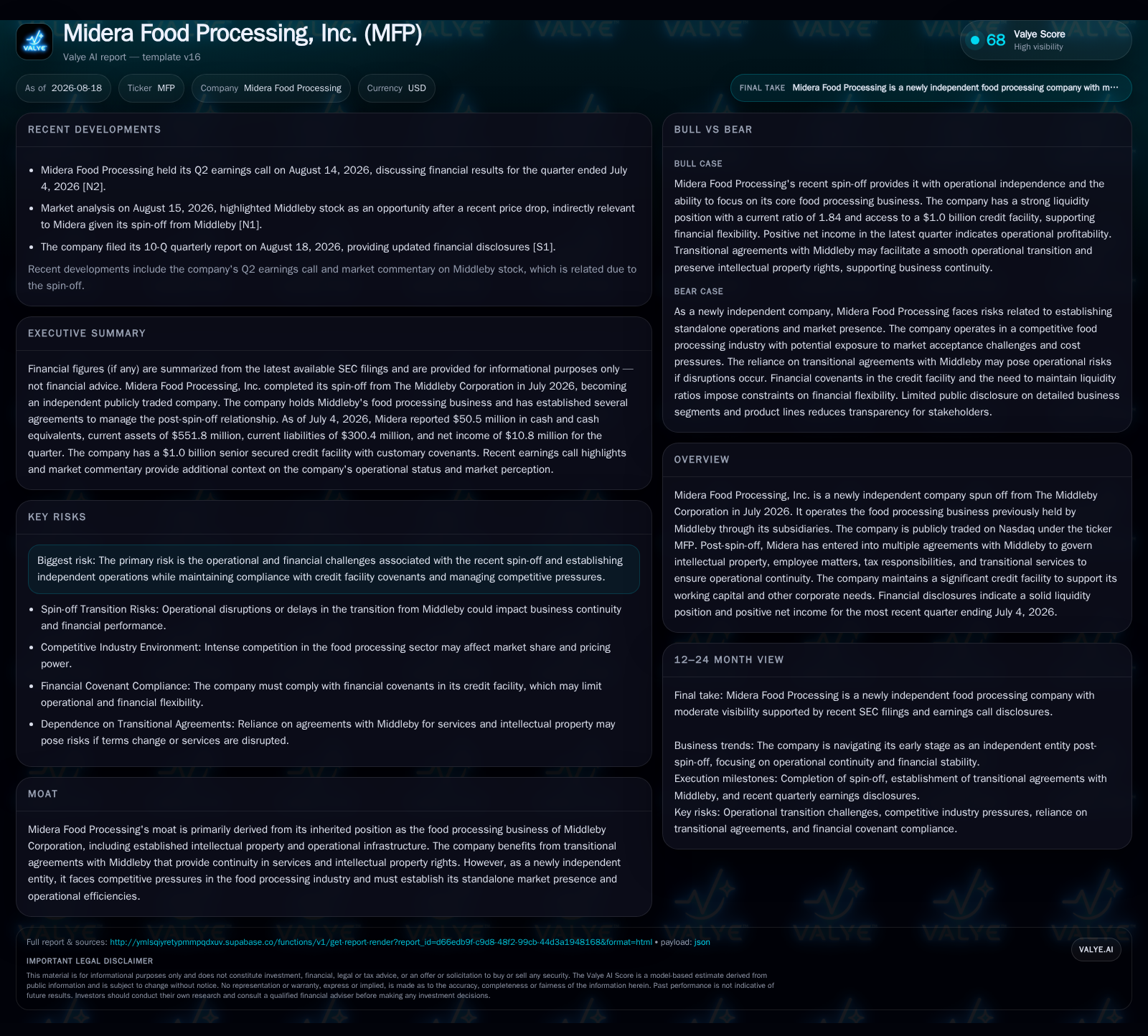
Midera Food Processing, Inc. reported its first quarterly results as an independent company ending July 4, 2026, demonstrating positive operating income and net income, underscoring a stable transition from its previous status as a Middleby subsidiary. Operational performance reflects effective management of production volumes and capacity during the spin-off, aided by transitional service agreements that secure access to intellectual property and administrative functions. The company's business model centers on converting raw materials into value-added processed foods for retail and foodservice channels, leveraging inherited IP rights and packaging technologies. Midera faces typical spin-off integration challenges, credit covenant scrutiny, and supply chain risks amid competitive industry dynamics. Near-term focus will revolve around achieving operational independence, optimizing capacity utilization, and sustaining working capital efficiency to confirm growth momentum. The financial profile shows robust liquidity with a current ratio near 1.84 and manageable net leverage backed by a $1 billion revolving credit facility.
Quarter One as an Independent Company: Operating Highlights and Transitional Dependencies
Midera Food Processing’s initial quarterly filing as an independent entity marks a critical inflection point following its July 2026 spin-off from The Middleby Corporation. For the quarter ended July 4, 2026, Midera delivered $23.7 million in operating income alongside net income of $10.8 million [F1][S2]. This financial performance evidences an effective transition from subsidiary status to standalone operations without immediate profitability disruption—a noteworthy achievement given typical spin-off complexities. The company maintains operational continuity through a comprehensive Transition Services Agreement (TSA) with Middleby covering IT systems support, payroll administration, accounting functions, compliance oversight, and other vital administrative services [S18]. This arrangement mitigates near-term disruption risks while also granting access to intangible assets via an Intellectual Property Matters Agreement that preserves critical IP rights necessary for manufacturing processes and packaging technology utilization [S18]. Production volume metrics have not been explicitly disclosed yet maintaining stable operating income suggests adequate capacity utilization amid this tenuous period.
Midera's Business Model: Transforming Raw Materials Into Value-Added Food Products Post Spin-Off
Midera’s revenue derives primarily from transforming raw agricultural commodities into processed food products distributed through retail grocers, foodservice operators, and industrial customers [S3]. This midstream role in the food value chain involves capturing value through efficient processing equipment deployment, supply chain management that optimizes raw material sourcing cost-effectively, and leveraging packaging technology innovations to meet consumer demands for convenience and safety. Post spin-off, the business leverages inherited intellectual property rights from Middleby to sustain product differentiation—an essential moat in an industry where product innovation drives pricing power and customer retention.
The company’s working capital management is bolstered by access to a substantial revolving credit facility aggregating $1 billion split between a $750 million US dollar tranche and a $250 million multi-currency tranche [S6]. This facility underpins liquidity for inventory financing and operational outlays amidst industry volatility in raw material availability or demand fluctuations. Early figures such as a current ratio of approximately 1.84 alongside healthy cash reserves indicate prudent liquidity stewardship during the ramp-up phase of independence [F1].
Positioning Within the Food Processing Value Chain: Competitive Levers and Peer Benchmarks
Operating midstream in the food supply chain situates Midera between upstream agricultural suppliers and downstream channels like retail grocers or foodservice companies requiring processed foods at scale. This positioning necessitates robust supply chain lead time management to mitigate raw material price swings or defects impacting yield rates.
Peers such as Middleby (former parent), Hormel Foods Corporation, Kraft Heinz Company, and Conagra Brands illustrate varying degrees of scale-related pricing power alongside sustained investment in processing equipment innovation which strengthens operational efficiency margins over time. Compared to such peers, Midera confronts typical post-spin-off challenges including establishing standalone cost structures while nurturing proprietary technology advantages derived from its IP portfolio inherited from Middleby’s prior holdings. Capacity limitations could constrain incremental sales volumes until capital expenditure programs or optimization projects mature.
Food safety compliance remains another strategic lever; adherence to regulatory standards forms both an entry barrier for new entrants and a recurring operational risk factor that can influence defect rates or customer retention adversely if breached.
Growth Vectors Aligned With Industry Trends in Product Innovation and Market Channel Expansion
Macro-level demand drivers underpinning Midera’s growth outlook include increasing consumer preference for convenience processed foods driven by lifestyle trends favoring ready-to-eat or minimally prepared options. Innovations leveraging advanced preservation techniques (e.g., modified atmosphere packaging) reduce spoilage rates enhancing shelf life—a key selling point across retail grocery chains.
Geographic expansion especially targeting emerging markets where processed food penetration remains relatively nascent offers additional runway for volume growth aligned with rising disposable incomes.
Further growth vectors encompass strategic acquisitions or partnerships that can expand product portfolios or access specialized packaging technologies facilitating entry into new sub-segments within food processing.
Technological advancements in processing equipment also enable productivity enhancements reducing unit costs thus increasing margins following initial capital outlays.
Fueling Challenges: Spin-Off Complexities, Credit Facility Covenants, and Supply Chain Vulnerabilities
Integration risks post-spin-off encompass the dual imperative of transitioning core operations independently while continuing reliance on transitional agreements that are temporary by design [S6]. Any lapse or failure to renew these TSAs could materially disrupt manufacturing throughput or back-office functionalities.
Supply chain vulnerabilities include exposure to raw material scarcity or price inflation pressures exacerbated by geopolitical factors or fluctuating agricultural yields impacting cost bases directly. Compliance risks linked to evolving Food Safety Modernization Act regulations also warrant ongoing governance vigilance.
"What Comes Next?" Indicators of Demand Momentum and Execution Tracking to Watch Closely
Upcoming quarters will be crucial for evaluating whether Midera can solidify margin stability evidenced by the latest quarter’s results while progressing beyond dependence on transitional services agreements with Middleby via contract renewals or internal capability build-out [S2][N1]
Tracking production volumes relative to capacity limits will signal operational ramp efficiency while working capital turnover rates may indicate supply chain responsiveness improvements.
Announcements regarding product innovation milestones or cost structure optimizations will further clarify trajectory toward full operational independence.
Investor scrutiny will likely focus on evolving leverage ratios relative to EBITDA improvement supporting sustainable credit covenant compliance alongside incremental market share gains within targeted downstream channels.
Financial Profile Discussion - Leveraging Liquidity While Managing Net Debt Post Spin-Off
As of the quarter ending July 4, 2026, Midera reports approximately $50.5 million in cash plus equivalents against total debt near $258.6 million yielding net debt roughly at $208.1 million [F1]. The current ratio stands robustly at about 1.84 underlining sound short-term liquidity buffered by significant current assets versus liabilities totaling $300.4 million [F1]. This liquidity profile affords operational flexibility critical during early post-spin-off phases particularly when managing working capital demands linked with inventory cycles common in food processing.
The revolving credit facility negotiated concurrent with the spin-off offers up to $1 billion capacity accommodating potential liquidity requirements arising from acquisitions or general corporate purposes inclusive of debt repayments if needed [S6]. Positive operating cash flow generation reflected in earnings underscores an improving financial foundation although close monitoring of leverage trends remains essential given macroeconomic uncertainties affecting commodity costs.
This analysis synthesizes Midera Food Processing’s position immediately following its spin-off emphasizing both its early operating accomplishments along with structural dependencies characteristic of newly independent companies within the food processing sector. Forward execution success depends on navigating transitional service reductions sensibly while driving capacity utilization gains amid evolving competitive pressures impacting profitability sustainability.
Disclaimer: This is research-only, informational analysis and not investment advice. It may include AI-generated interpretation and general industry context. Always verify important details using primary sources.

Comments