
Tempest Therapeutics Advances Dual-Targeting CAR-T Pipeline While Facing Critical Liquidity Constraints
Clinical progress in CAR-T and small molecules underscores pipeline diversification, but funding challenges raise substantial going concern doubts.
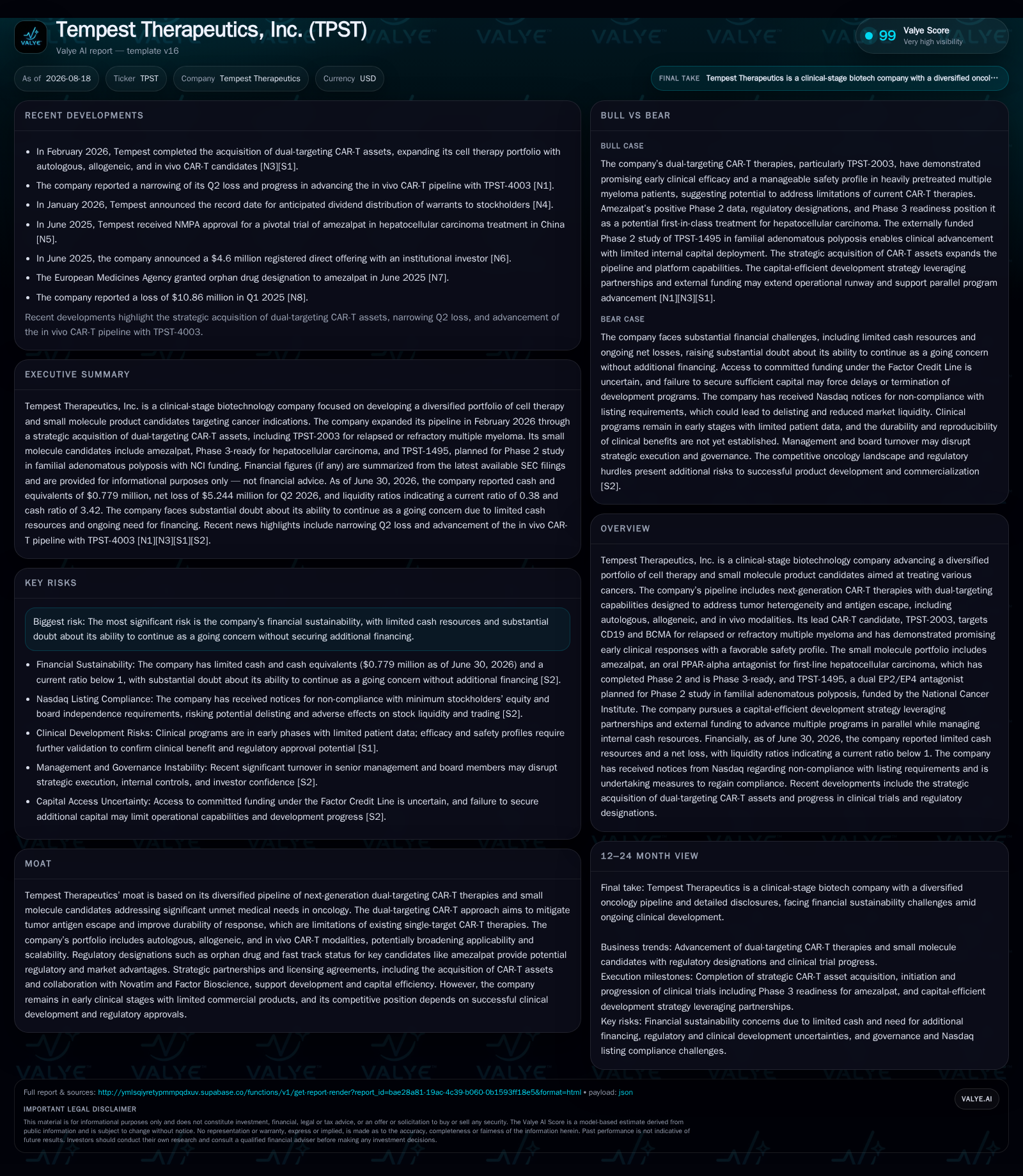
Tempest Therapeutics reported continued clinical development progress for its dual-targeting CAR-T therapies and small molecule oncology candidates in the latest quarter, notably advancing TPST-2003 for relapsed/refractory multiple myeloma and preparing to initiate a Phase 2 study with TPST-1495. The company's strategy of pursuing a diversified oncology portfolio through autologous, allogeneic, and in vivo CAR-T modalities aims to address tumor heterogeneity constraints typical of single-antigen approaches. However, with cash reserves of approximately $0.8 million at June 30, 2026 and a current ratio well below 1, Tempest faces acute financial sustainability risks. Access to capital under a $20 million facility agreement remains uncertain, posing critical near-term risks to ongoing operations and clinical programs.
Recent Operating Update: Accelerated Clinical Progress Amid Liquidity Strains
Tempest Therapeutics’ latest quarterly report filed August 13, 2026 [S2] reveals ongoing clinical advancement of its core dual-targeting CAR-T therapy candidate TPST-2003 targeting CD19 and BCMA for patients with relapsed/refractory multiple myeloma (rrMM). This program is a centerpiece of Tempest’s strategy to overcome tumor antigen escape—a common resistance mechanism encountered in existing single-target CAR-T therapies—by simultaneously engaging two key antigens [S1]. Additionally, the company is progressing plans for a Phase 2 trial with small molecule TPST-1495 in familial adenomatous polyposis (FAP), which benefits from National Cancer Institute funding that reduces internal capital demands [S1].
While these developments demonstrate pipeline momentum across both cell therapy and small molecule domains, Tempest’s financial disclosures underscore a precarious liquidity position. As of June 30, 2026, Tempest held roughly $0.8 million in cash and equivalents against current liabilities exceeding $4.4 million, yielding a low current ratio of approximately 0.38 [F1]. The company explicitly states substantial doubt about its ability to continue as a going concern without securing additional financing within the next year [S2]. A secured flexible credit line (FCL) providing up to $20 million of funding from Factor Bioscience offers some runway cushion but access is contingent on meeting specific conditions that add uncertainty around timing and amount [S2]. This financial fragility presents significant risk that development programs could be delayed or curtailed absent urgent capital raises.
Business Model: Dual-Modality Oncology Portfolio Focused on Clinical-Stage Innovation
Tempest Therapeutics operates as a clinical-stage biotechnology company developing diversified therapeutic candidates primarily targeting oncology indications through two modalities: cell therapy—especially next-generation CAR-T—and small molecule drugs [S1]. Revenue generation is currently non-existent; instead, value creation hinges on successful progression through clinical development phases (Phase 1/2/3), securing regulatory approvals enhanced by orphan drug/faster pathways, and ultimately monetization through milestone payments from partnerships or licensing arrangements prior to commercialization.
The strategic acquisition completed February 2026 significantly expanded Tempest’s CAR-T pipeline to include autologous CD19/BCMA TPST-2003 alongside other dual-targeting autologous (CD70/CD70) and gene-edited allogeneic products (e.g., TPST-3003) designed to reduce graft-versus-host disease risks via T cell receptor editing [S1]. Autologous approaches involve patient-specific cell collection, engineering, and reinfusion—complex processes often limited by manufacturing capacity—while allogeneic "off-the-shelf" products aim for scalability but face immunological hurdles. Moreover, Tempest is exploring in vivo CAR-T modalities where gene delivery occurs directly inside patients to simplify manufacturing logistics [N1]. This suite of candidates highlights an innovative approach addressing tumor heterogeneity—a central challenge driving relapse after single-antigen targeting—by tackling antigen escape via dual-target engagement.
Complementing cell therapies is a focused small molecule portfolio featuring amezalpat for first-line hepatocellular carcinoma (HCC), which is Phase 3-ready after completing Phase 2 studies showing tolerability and efficacy signals [S1]. This candidate benefits from fast track regulatory designations that may accelerate approval timelines. TPST-1495 targets prostaglandin receptors EP2/EP4 implicated in polyp formation for FAP treatment; this trial is supported by external NCI funding [S1], limiting Tempest’s internal cash consumption.
Monetization mechanics revolve around successful clinical transitions unlocking milestone payments or licensing revenues; direct product sales remain distant given pre-commercial status. Customer bases include healthcare providers administering advanced therapies requiring complex logistics for CAR-T infusion as well as oncologists prescribing oral small molecules once approved. Pricing power will depend on demonstrated efficacy benefits over existing treatments given competitive market dynamics.
Industry Structure and Competitive Position
The biotechnology sector landscape for oncology-focused companies developing CAR-T therapies is intensely innovative yet capital-intensive. Firms such as Kite Pharma (Gilead), Juno Therapeutics (Bristol Myers Squibb), Legend Biotech (for BCMA indications), Adaptimmune, and Allogene Therapeutics exemplify competition centered on single vs multi-antigen targeting strategies alongside efforts to broaden patient eligibility through allogeneic "off-the-shelf" options.
Tempest distinguishes itself by focusing on dual-targeting CAR-T platforms designed to mitigate tumor antigen escape—a limitation noted for approved single-antigen CAR-T therapies used primarily in hematologic malignancies. Its portfolio spans autologous personalized products balanced by allogeneic platforms incorporating gene-editing technology targeting the TRAC locus to abrogate TCR activity thereby potentially reducing graft-versus-host complications [S1]. Furthermore, the development of an in vivo CAR-T modality could provide novel manufacturing scalability if technical hurdles are overcome [N1].
Nonetheless, Tempest remains early stage compared with established peers possessing marketed products generating revenues funding extensive clinical pipelines. Its small molecule oncology candidates complement the cellular therapy approach but also place it within competitive classes containing more advanced developers like Exelixis or Clovis Oncology deploying targeted therapeutics. Orphan drug status secured for lead assets provides regulatory advantages such as marketing exclusivity post approval but does not shield from operational execution risks or financing constraints.
Growth Drivers: Clinical Progression & Pipeline Expansion Supported by Strategic Collaborations
Clinical development milestones are primary catalysts underpinning Tempest’s growth outlook. Ongoing enrollment progression and forthcoming readouts from Phase 1/2a trials with TPST-2003 will be closely monitored as go/no-go inflection points indicating candidate viability against rrMM—a population with significant unmet medical need due to resistance to conventional therapies [S1], [N1]. Confirmation of safety profiles alongside durability data that reflect mitigation of antigen escape would validate the dual-target approach critical to differentiation.
Pivotal development readiness of amezalpat positions it well for partnership discussions or out-licensing leveraging its Phase 2 data package coupled with fast-track regulatory designations that could expedite alignment on approval pathways in HCC patients [S1]. Initiation of the NCI-funded Phase 2 trial for TPST-1495 reduces reliance on internal capital while expanding indications beyond hematologic cancers into hereditary colorectal cancer syndromes.
Pipeline breadth rooted in acquisition-driven expansion from February 2026 adds multiple complementary cell therapy assets quintupling candidate diversity encompassing solid tumors alongside blood cancers plus immunology indications beyond oncology under early research collaborations [S1]. Such diversity aids risk mitigation typical for biotech firms highly vulnerable to binary trial outcomes.
Strategic collaborations such as supply agreements with Roche further facilitate combination trial opportunities pairing amezalpat with immune checkpoint inhibitors enhancing potential efficacy synergies without onerous upfront costs reported previously [S1]. External funding sources like NIH/NCI grants supporting studies also bolster capital efficiency.
Risks and Watchpoints: Acute Financial Constraints Cloud Development Outlook
The foremost risk confronting Tempest is financial sustainability amid intense cash burn driven by broad clinical programs requiring investment in manufacturing scale-up—particularly acute in cell therapy—and regulatory compliance activities accompanied by administrative overheads [S2]. Despite asset portfolio expansion increasing prospects for future milestone inflows or partnership revenue streams, no such income has materialized yet.
With available cash totaling approximately $779,000 at quarter end June 30, 2026 versus liabilities over $4.4 million producing a current ratio under one-third (0.38), the firm faces severe near-term liquidity pressure raising "substantial doubt" about going concern status per management disclosures [F1],[S2]. Reliance on the flexible credit line facility negotiated during the asset acquisition offers potential relief capped at $20 million total; however access remains conditional subject to covenant maintenance or equity raise triggers introducing execution risk regarding timing or quantum availability [S2]. Should these funds not materialize promptly or fully, ongoing costly Phase trials may need curtailment delaying progress if not outright operational wind down.
Regulatory uncertainties remain given evolving frameworks surrounding cellular immunotherapies although orphan drug designations smooth certain pathways; competitive advances by larger firms offering similar targets increase innovation pressure challenging durability if competitors develop effective alternatives sooner.
Finally, governance vigilance over cybersecurity is notable given sensitive proprietary platform data imperative for sustained R&D productivity; lapses here could cause reputational damage disrupting collaborations vital for co-development or supply arrangements detailed previously [S1].
What To Watch Next: Clinical Milestones & Financing Execution Critical
Key upcoming corporate milestones include interim safety/efficacy updates from ongoing Phase 1/2a trials evaluating TPST-2003 within rrMM cohorts—positive announcements validating durable responses would materially de-risk pipeline elements facilitating fundraising or partnering conversations [N1],[S2]. Initiation timing and enrollment rates into the planned Phase 2 study of TPST-1495 backed by NCI grant support will also serve as markers regarding internal capability management amidst tight resource constraints.
Further strategic business development activity concerning amezalpat could unlock licensing deals accelerating Path-to-Revenue horizon; observers should monitor announcements detailing negotiation status.
Financially, transparency around drawdowns against Factor Bioscience's credit line including updates reflecting compliance with covenants will be essential gauges regarding survival probability beyond one-year windows mentioned in filings [S2],[S3]. Quarterly burn rate trends relative to cash inflows conditioned through equity issuance plans will similarly inform solvency prospects.
Additionally, any disclosures addressing manufacturing capacity expansions necessary for scaling autologous/allogeneic product output will indicate operational preparedness layering onto developmental accomplishments imperative before commercialization can commence sustainably.
Financial Profile Discussion
Recent balance sheet data emphasize critical financial stress points characteristic of early-stage biotech firms aggressively investing ahead of revenue realization. As of June 30, 2026,[F1] Tempest Therapeutics reported:
- Cash & cash equivalents of $779,000;
- Current assets totaling approximately $1.7 million against current liabilities of about $4.45 million;
- A current ratio of approximately 0.38, indicating liquidity constraints;
- Total debt and net debt figures from prior fiscal snapshots are not confirmed as current and thus are not presented here;
- No product revenues recorded historically underscoring complete reliance on external funding sources;
- Significant operating losses persist consistent with expanding R&D scope, typical prior to commercialization steps.
These factors combined underscore the imminent necessity for successful capital raises—whether equity placements or milestone/partner-triggered proceeds—complemented by careful expenditure prioritization if ongoing operations are to remain viable absent transformative data signals justifying higher valuation access channels.
Disclaimer: This is research-only, informational analysis and not investment advice. It may include AI-generated interpretation and general industry context. Always verify important details using primary sources.

Comments