
CapsoVision Advances AI-Driven Capsule Endoscopy Amid Regulatory and Financing Challenges
Q2 filings reveal a regulatory pivot on the colon capsule pathway and ongoing AI platform progress amid liquidity concerns.
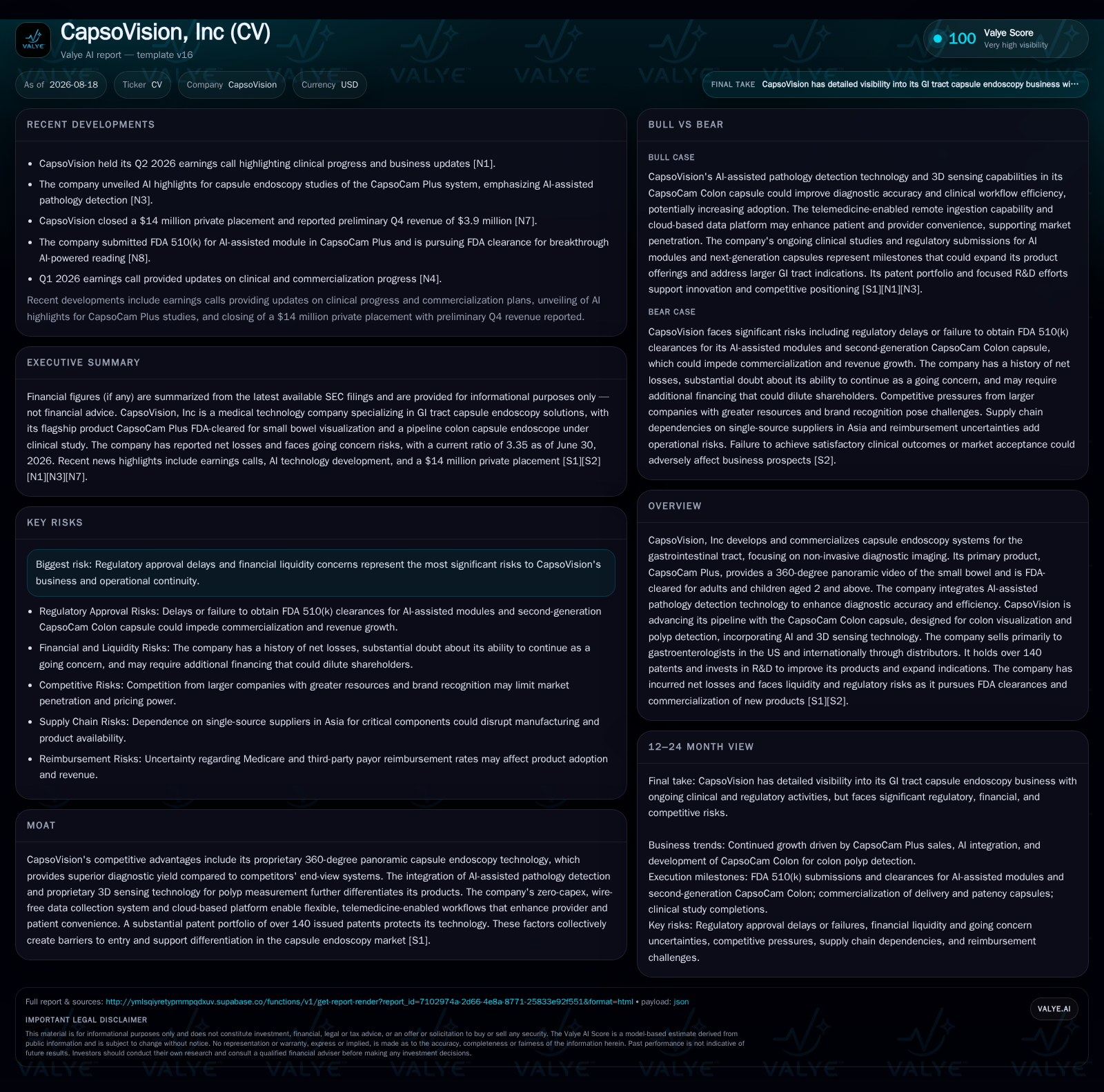
CapsoVision’s Q2 2026 disclosures highlight a strategic shift after FDA feedback led to abandoning the first-generation CapsoCam Colon submission in favor of an enhanced second-generation device with expanded pivotal enrollment. Concurrently, its AI-assisted pathology detection system for the existing CapsoCam Plus small bowel capsule is advancing toward anticipated FDA clearance, promising workflow efficiencies that could boost clinical adoption. These innovation-driven milestones underpin growth potential within a highly regulated medical device market, but persistent net losses and financing needs underscore execution risks as the company prepares equity raises to sustain development and commercialization efforts.
Latest FDA Milestones Signal Shift in CapsoCam Colon Pathway
CapsoVision’s latest Q2 10-Q filing reveals a critical regulatory setback altering the commercial timeline of its next-generation GI diagnostics pipeline. The company initially submitted a first-generation CapsoCam Colon capsule under the FDA 510(k) pathway in June 2025 but received negative feedback including concerns on panoramic imaging processing and clinical study design during FDA discussions through late 2025 [S1]. As a result, CapsoVision discontinued pursuit of that submission and redirected resources to develop a second-generation colon capsule featuring improved imaging quality, an expanded field of view, integrated AI polyp detection, and novel 3D sensing tech for polyp size measurement — an important clinical parameter correlating with malignancy risk [S1]. This pivot necessitated enlarging the pivotal trial to approximately 800 patients across up to 20 U.S. sites; by mid-2026 over 500 patients had been enrolled with a planned Q3 submission timeline [S1], [S2]. These developments effectively push anticipated commercial availability into mid-2027 or later, underscoring regulatory hurdles as a principal constraint. Successful clearance would validate the company’s execution and unlock significant new revenue streams beyond its current small bowel franchise. The FDA interaction thus reflects both an operational inflection point and an elevated regulatory risk factor inherent in high-complexity medical device innovation.
AI-Embedded Platform Elevates Clinical Utility and Workflow Efficiency
Parallel to the colon capsule program, CapsoVision is advancing its existing flagship product, CapsoCam Plus, through incorporation of proprietary AI-assisted pathology detection algorithms designed to reduce clinician review time for video data from single-use capsules [S1]. The firm filed a supplemental FDA 510(k) application in December 2025 covering this enhancement with anticipated clearance around mid-2026 [S1]. Clinical studies completed prior to filing demonstrated statistically meaningful reductions in clinician reading times without compromising diagnostic accuracy [N2]. This feature addresses a key bottleneck limiting capsule endoscopy adoption — namely time-consuming manual video review — thereby improving utilization rates within gastroenterology practices. Productizing such AI capabilities enhances competitive differentiation vis-à-vis legacy capsule systems relying purely on human review, including Medtronic’s PillCam which lacks panoramic AI integration [S1]. Moreover, cloud-based storage and retrieval (CapsoCloud platform) complement these advances by supporting telemedicine-enabled workflows offering convenience gains for providers and patients alike.
Panoramic Imaging Differentiates Amid Competitive Medical Device Landscape
CapsoVision’s core technology advantage arises from its patented 360-degree panoramic imaging capsule design contrasted against conventional forward-view-only scopes such as Medtronic’s PillCam [S1]. Panoramic imaging increases diagnostic yield by capturing circumferential visualization of small-bowel mucosa in a single pass, potentially identifying abnormalities missed by limited-angle systems. This is materially supported by CapsoVision’s extensive patent portfolio exceeding 140 issued patents protecting capsule optics, image processing algorithms, AI technologies, and cloud-platform functionalities [S1]. The absence of onboard wiring for data transmission enables an unattended patient experience enhancing safety and optimizing clinic throughput. In combination with proprietary AI-assisted detection trained on a growing annotated clinical dataset internally developed by CapsoVision’s specialized team [S1], their platform uniquely positions the company at the intersection of hardware innovation and digital health trends within GI diagnostics.
Growth Drivers Centered on Indication Expansion & Telemedicine Integration
The strategic progression into colon capsule endoscopy marks a clear growth inflection opportunity beyond small bowel applications where CapsoCam Plus currently generates all near-term revenue with steady annual growth (~15% year-over-year reported through December 2025) linked principally to unit volume expansion among gastroenterologists across U.S. direct sales channels and selected international distributor partnerships concentrated in Europe and South America [S1], [N1]. Regulatory clearance of the second-generation colon capsule—coupled with confirmed clinical benefits from integrated AI polyp detection—would open access to colorectal cancer screening markets with substantially larger patient volumes. Meanwhile, continued investment in the company’s cloud-based video management software enables scalable telemedicine workflows increasingly preferred by providers aiming to optimize efficiency post-pandemic [S1]. Expanding geographic reach beyond core European countries into underserved emerging markets further supports revenue diversification albeit subject to reimbursement complexities. Key KPIs such as clinical study enrollment rates, incremental customer adoption figures among gastroenterology clinics, software usage frequency metrics including remote video reviews, and ongoing R&D expenditure levels serve as near-term telegraphs of progress against these drivers.
Liquidity Profile Frames Execution Risks Despite R&D Commitment
e of sufficient working capital coverage absent unexpected cash demands [F1]. However, publicly disclosed audit notes signal “substantial doubt” regarding going-concern status absent additional funding events [S2]. To mitigate this risk, management executed an August 13, 2026 controlled equity offering agreement permitting sales of up to $100 million common stock at discretion through Cantor Fitzgerald acting as sales agent—a significant backstop message regarding reliance on future capital raises for operational continuity and funding pivotal clinical trials (colon second generation plus pancreatic cancer indication) [S3]. Overall financial prudence allied with proactive fundraising efforts remain essential given capital-intensive innovation pathways intertwined with elongated regulatory approval timelines intrinsic to FDA Class II device categories.
Outlook: Upcoming Clearance Timelines & Capital Raise Watch
Looking forward into late 2026 through early 2027 timelines frame critical milestones: pending FDA review outcomes on December-submitted AI upgrade for CapsoCam Plus expected roughly mid-2026 clearance would drive initial expansion via workflow productivity gains enhancing customer retention rates [S1], [N2]. Concurrently enrollment completion of ~800 patient pivotal study arm positions second-generation CapsoCam Colon for FDA submission projected Q3/Q4 2026—with potential clearance horizon set realistically mid-2027 contingent upon no additional information requests or delays during agency review cycles [S1], [S2]. Market introduction thereafter constitutes an inflection point unlocking new large-volume indications such as colorectal cancer screening utilizing non-invasive ingestion rather than conventional invasive colonoscopy modalities. Furthermore ongoing pancreatic cancer early detection research leveraging breakthrough device designation pursuit remains at exploratory stages requiring additional data despite recent negative regulatory feedback offset by committed resubmission plans once more robust evidence accrues [S1].
On the financing front, close monitoring of capital raise execution against expenditure burn rates will be vital—with recent controlled equity offering agreement enabling flexibility but also spotlighting reliance on external funding sources amidst uncertain market conditions affecting biotechnology/device sector financing cost structures [S3]. Investors should track quarterly filings supplemented by earnings calls announcements highlighting enrollment progress updates, FDA interaction commentary, commercialization readiness metrics including distribution channel expansions or reimbursement developments alongside software platform scaling indicators evidencing increased remote usage or user base growth.
This analysis synthesizes all currently available public filings including Q2 Form 10-Q dated August 13, 2026 as primary source alongside related event filings (8-K) through August 18, 2026 complemented by latest Annual Report (Form 10-K) filed March 26, 2026 plus supplemental industry context.
The company demonstrates technological differentiation through panoramic imaging combined with embedded AI capabilities poised to improve GI tract diagnostics efficacy while addressing physician workflow bottlenecks via cloud-enabled telemedicine platforms. Yet its near-term financial profile coupled with protracted FDA regulatory pathways constitute material execution challenges that require sustained investor attention focused on milestone tracking related to pivotal trial completions, regulatory clearances timing relative to stated guidance plus capital raising success serving as key indicators validating trajectory toward scalable commercialization.
Disclaimer:
This document presents an independent industry-focused analysis based solely on publicly available data without any investment advice or research view regarding securities mentioned herein.
Disclaimer: This is research-only, informational analysis and not investment advice. It may include AI-generated interpretation and general industry context. Always verify important details using primary sources.

Comments