
Diageo's Strategic Board Refresh and Portfolio Shifts Signal Growth Ambitions
Diageo’s August 2026 filings reveal leadership renewal, North American demand headwinds, and cost-saving initiatives shaping its premium spirits growth strategy.
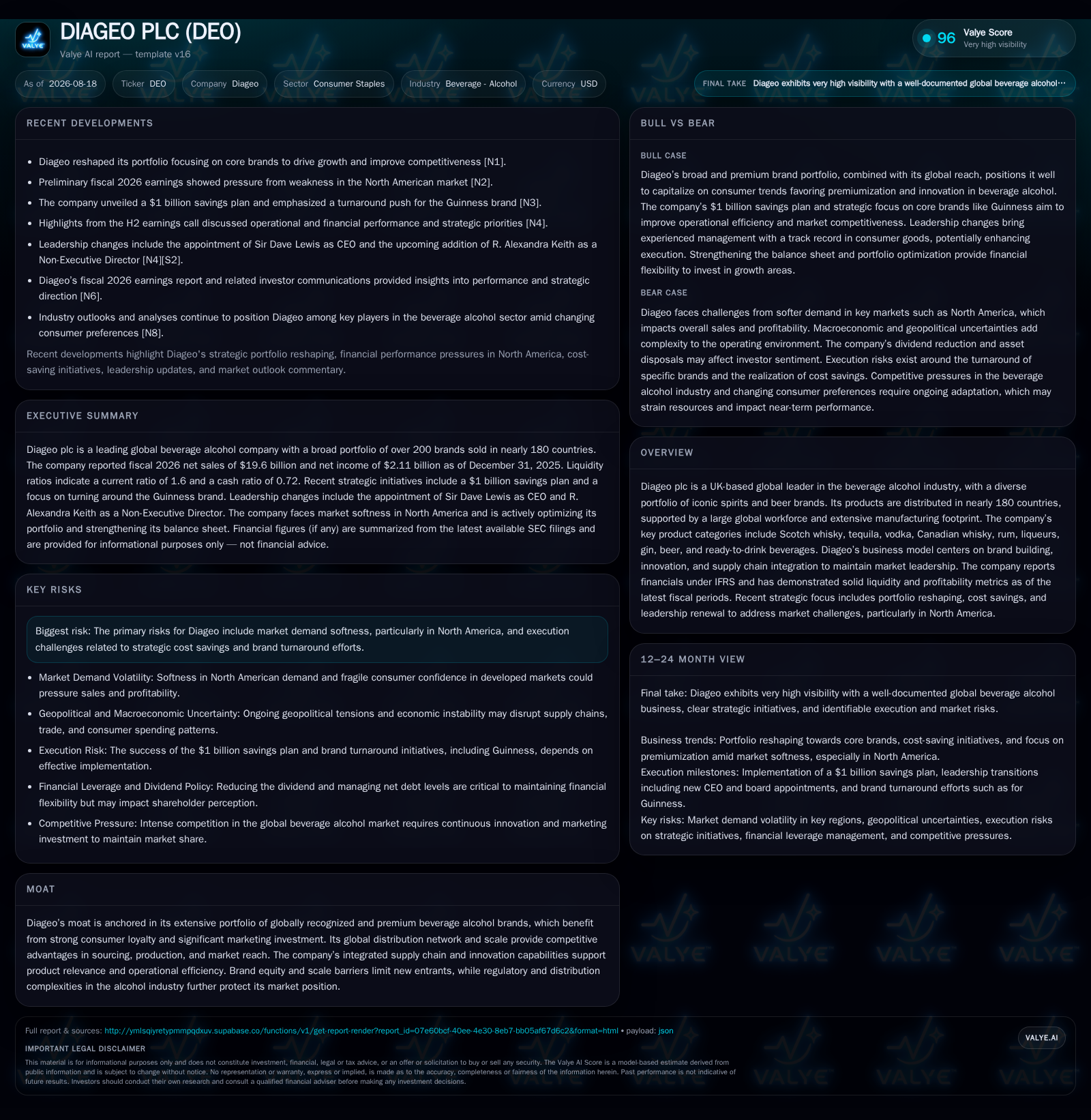
In its latest quarterly update, Diageo announced the appointment of R. Alexandra Keith to its Board, signaling a focus on innovation-driven brand development and operational scaling. The company reported ongoing softness in North American demand, a critical developed market, pressuring organic net sales growth amid competitive and macroeconomic challenges. In response, Diageo continues portfolio reshaping to prioritize core premium brands and announced a $1 billion supply chain savings program targeting margin resilience. Innovation in ready-to-drink (RTD) segments and sustained premiumization remain key growth drivers, while execution risks and regulatory uncertainties pose watchpoints. Financially, Diageo maintains solid liquidity with robust cash reserves and expects gradual profit improvement supported by cost efficiencies [S1][S2][S3][N1][N5][N6].
New Board Direction Reinforces Strategic Transformation Goals
Diageo’s August 2026 interim filing announced the planned appointment of R. Alexandra Keith to the Board effective November 5, pending shareholder approval [S2]. With over 35 years in international consumer goods, including her recent tenure as CEO of Procter & Gamble's Beauty business, Keith brings vital expertise in brand building, innovation-led growth, supply chain leadership, and portfolio strategy execution across North America, Europe, and Asia. Her inclusion signals Diageo’s commitment to strengthening governance focused on disciplined execution of its transformation priorities—namely accelerating innovation-driven premiumization and optimizing global brand portfolios. Given her proven track record in scaling complex businesses with a consumer-centric lens, Keith is well-positioned to influence Diageo’s shareholder value creation agenda amid challenging market dynamics.
North American Market Weakness Challenges Top-Line Momentum
The latest reports highlight Diageo’s ongoing difficulty in North America—a key developed liquor market—with organic net sales expected to decline mid-single-digits in fiscal 27 compared to an approximate 3% market contraction [N1][S6][S1]. This softness reflects economic headwinds dampening discretionary spending on alcohol alongside rising competition from both incumbent global players and local craft brands targeting shifting consumer tastes toward lower-alcohol or experiential offerings. Despite improving share performance relative to the broader category downtrend, the region remains a drag on overall revenue growth stability and underscores geographic risk concentration intrinsic to global beverage alcohol leaders. The pressure adversely impacts volume metrics while complicating premiumization efforts given price sensitivity from economically constrained consumers.
Leveraging Brand Equity Through Focused Portfolio Reshaping
Amid these headwinds, Diageo continues aggressive portfolio reshaping aimed at concentrating capital allocation behind fewer core brands exhibiting robust consumer loyalty and growth potential [N5][S1]. This strategic prioritization supports raising average selling prices (ASP) via premiumization—focusing on Scotch whiskies such as Johnnie Walker, tequila like Don Julio, vodka options including Ketel One, alongside RTD innovations that capture evolving occasion-based drinking trends. By pruning non-core assets and underperforming labels, management seeks to improve sales mix quality while streamlining marketing spend intensity for higher return on investment. Such targeted brand-building investments aim to strengthen category competitiveness globally and exploit distribution network advantages intertwined with retail partnerships spanning wholesale channels.
Supply Chain Integration Drives Cost Savings Amid Margin Pressure
To underpin margin resilience despite excise duty inflation—a prevalent cost factor in many jurisdictions—Diageo has unveiled a $1 billion savings program centered largely on supply chain efficiencies [N6][S7][S1]. These initiatives include scaling manufacturing economies of scale through integrated logistics optimization and reducing complexity across production sites worldwide. The plan projects approximately $850 million from operating framework redesign plus $150 million from supply chain improvements spread over three years with phased implementation targeting near-term fiscal savings commencement in fiscal 27. Such structural cost management is critical given fixed excise duties remain only partly pass-throughable to customers due to competitive pricing constraints. Execution discipline here will be essential; failure risks operating margin erosion amid adverse pricing environments.
Innovation And Premiumization Fuel Growth Opportunities
Product innovation remains central to Diageo’s medium-term growth ambitions particularly within the expanding ready-to-drink (RTD) segment favored by younger demographics seeking convenient yet premium experiences [S1]. While specific pipeline product launches are not detailed publicly—which avoids speculative claims—the company stresses alignment with consumer trends including health-consciousness and lower-alcohol alternatives without compromising luxury positioning. Continued investment in marketing spend supports brand resonance while digital channels create new pathways for customer engagement enhancing penetration rates across multiple markets. Overall, innovation complements premiumization efforts by enabling diversified occasion-based consumption occasions expanding volume potential beyond traditional spirits use cases.
Risks: Regulatory Headwinds, Demand Uncertainty, And Execution Challenges
Diageo faces multiple industry-specific risks typical for leading beverage alcohol producers [S1]. Regulatory challenges include excise duty volatility which directly impacts pricing power given many countries impose production taxes irrespective of end-user price structures or economic shifts. Demand uncertainty remains acute particularly in North America where discretionary spending fluctuations can severely curtail net sales volumes. Competitive intensity from established and emerging local/global brands adds pricing pressure requiring continuous brand relevance renewal. Execution risk around large-scale cost-saving initiatives—both operating framework redesign and supply chain streamlining—is nontrivial; delays or inefficiencies could undermine margin targets while restructuring charges elevate near-term costs.
Next Steps: Monitoring Operational Execution And Market Signals
Key upcoming milestones will involve evaluating the initial efficacy of the $1 billion savings program through quarterly results updates alongside tracking recovery signs within North American markets vis-à-vis organic net sales momentum improvements [S2][S3]. Additionally, observers should watch for innovation rollouts within RTDs for evidence that product extensions gain traction supporting ASP uplift strategies. The impact of new board member Alexandra Keith's contributions may emerge gradually through enhanced strategic decision-making about portfolio shape and capital deployment focusing on durability under evolving global consumption patterns.
This analysis synthesizes disclosed information from Diageo plc's August 2026 filings combined with sector knowledge applicable to global beverage alcohol producers. It aims to elucidate recent developments’ strategic implications without projecting unsupported forecasts or investment advice.
Disclaimer: This is research-only, informational analysis and not investment advice. It may include AI-generated interpretation and general industry context. Always verify important details using primary sources.

Comments