
Axe Compute Shifts from Asset-Light to Capital-Intensive GPU Compute Operations Tied to Volatile Digital Asset Strategy
Recent filings reveal Axe Compute’s expansion into owning GPU infrastructure paired with a Treasury Strategy centered on the Aethir token, creating unique operational and financial dynamics.
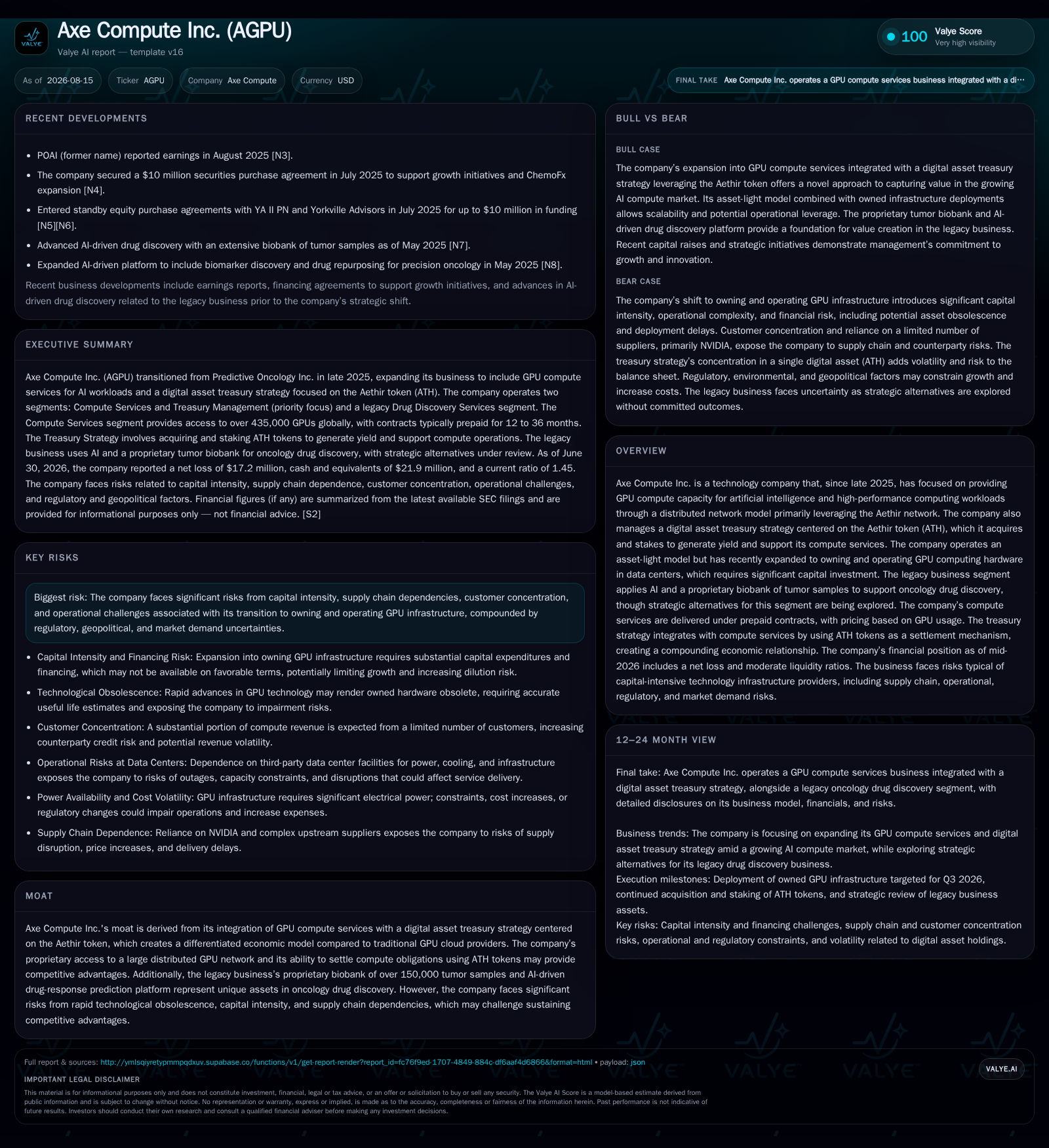
Axe Compute Inc. announced in its latest quarter progress transitioning from a primarily asset-light distributed GPU network operator to an asset-heavy model owning and operating GPU hardware in data centers. This move heightens capital expenditure and technological obsolescence risks. Concurrently, its Treasury Strategy centered on holding and staking Aethir tokens (ATH) exposes it to crypto market volatility and regulatory uncertainty. While the global AI-focused GPU compute market is expanding rapidly with severe supply constraints, Axe’s dual business of compute services and legacy oncology drug discovery presents both strategic opportunities and operational complexities. The company maintains a healthy current ratio with no debt but faces dilution risk if further capital needs arise.
Recent Operating Update
In its Q2 2026 filing dated August 14, 2026 ([S2]), Axe Compute Inc. disclosed significant shifts in its operating approach. Whereas since late 2025 the company had predominantly provided GPU compute capacity through access to the decentralized Aethir network's distributed infrastructure, it has now begun owning and operating physical GPU hardware within data centers. This shift marks a transition from an asset-light model towards capital-intensive infrastructure ownership. The company expects this move to demand substantial capital expenditures for procurement, deployment, maintenance, upgrading, and expansion of computing assets.
Alongside this operational development, Axe announced in late 2025 a focused Treasury Strategy revolving around acquiring, holding, and staking the Aethir token (ATH), the native utility token of the decentralized GPU network it leverages ([S1],[S3]). ATH acts as a proxy for GPU compute units within the ecosystem and is used both as payment means for compute services and as an incentive mechanism for network participants.
Management highlighted Adjusted EBITDA as a key performance measure during recent investor communications ([S3]). This non-GAAP metric excludes volatility from digital asset mark-to-market adjustments among other non-cash charges, reflecting an attempt to isolate core operating performance amid crypto price fluctuations.
Business Model
Axe Compute monetizes by selling access to high-performance GPU compute capacity tailored for artificial intelligence (AI) workloads and other high-demand compute applications like scientific simulations or gaming cloud services. The company's offerings derive from two main sources: rented capacity via the Aethir network's distributed GPUs owned by third parties, and owned hardware deployed in data centers under direct operational control.
Customers prepay for usage-based contracts denominated in terms of GPU hours consumed. Pricing incorporates factors such as compute intensity (e.g., NVIDIA architecture generation), service latency requirements, contract duration, and volume commitments ([S1]). The prepaid nature enhances revenue visibility but also puts pressure on maintaining capacity availability amid acute supply shortages.
The Treasury Strategy introduces a novel economic layer whereby AXE holds significant ATH digital assets acquired both through cash purchases and in-kind contributions via PIPE deals totaling over $340 million executed in late 2025 ([S1],[S5]). These tokens are staked within blockchain protocols linked to the Aethir network to generate yield that supports service operations while sustaining participation in decentralized finance activities tied to their compute marketplace. However, client payments for compute sold are often settled with ATH tokens themselves, adding complexity to revenue recognition and risk management.
Legacy operations related to oncology drug discovery currently operate as a distinct but lower-priority segment utilizing AI-powered analytics over a proprietary tumor biobank exceeding 150,000 samples ([S10],[S13]). The company is actively exploring strategic alternatives including divestiture or partnership options for this asset base while focusing resources on scaling the compute services business.
Industry Structure and Competitive Position
The GPU cloud computing space balances between centralized hyperscale cloud providers—such as Nvidia Cloud Services or Google Cloud GPUs—and emerging decentralized networks leveraging blockchain technologies to aggregate distributed resources. Axe occupies an intermediary niche connecting these domains via its hybrid model combining tokenized digital assets with traditional hardware ownership.
Supply constraints plague the sector broadly; data center vacancy rates have reached historic lows near 1.6% in North America with demand surging over 24% year-over-year ([S1]). Lead times for acquiring modern GPUs often exceed 36 weeks due to chip shortages and manufacturing limitations. This scarcity drives premium contract pricing but creates execution risk for firms expanding owned capacity given capital lock-up.
Axe’s hybrid approach contrasts materially with peer decentralized providers who rely solely on third-party equipment without bearing equipment depreciation or obsolescence risks. Meanwhile, hyperscalers leverage massive scale advantages but may lack flexibility or community engagement mechanisms offered by blockchain-enabled models.
Growth Drivers
Demand drivers align strongly with the explosive growth trajectory of AI workloads globally. Gartner forecasts worldwide AI spending reaching $2.5 trillion in 2026 alone ([S1]), while McKinsey estimates tripling of AI-dedicated data center capacity by 2030 fueled largely by GPUs that account for nearly two-thirds of such investments ([S1]).
Simultaneously constrained supply due to semiconductor production bottlenecks creates pricing power opportunities for capacity providers able to secure inventory or alternative sources such as distributed networks.
Furthermore, enterprise adoption trends favor scalable prepaid GPU compute contracts enabling agile consumption without heavy upfront capital investment by customers—a model well matched by Axe's offerings integrating token economies that incentivize participation among contributors across multiple layers.
The digital asset treasury strategy aims not only at yield generation but also at embedding Axe more deeply within the Aethir ecosystem’s evolving DeFi frameworks—potentially unlocking value beyond traditional cloud compute economics through proprietary tokenomics advantages ([S1],[S3]).
Risks and Watchpoints
The pivot towards owning physical infrastructure inflates capital intensity dramatically compared to prior asset-light operations ([S2]). Achieving timely ROI requires accurate forecasting of hardware lifecycle amidst rapid advancements rendering GPUs obsolete within short windows—frequently less than three years—as newer generations deliver exponentially better performance-per-watt ratios.
Liquidity management becomes more complex under token staking regimes which may impose lock-up periods restricting conversion flexibility just when operational cash needs peak ([S1],[S2]). Digital asset valuation volatility imposes additional unpredictability; ATH’s market price has fluctuated sharply—from highs near $0.067 down below $0.005 within months—exacerbating balance-sheet valuation risks ([S1]).
Regulatory scrutiny around cryptocurrency-related practices continues intensifying globally posing compliance uncertainties potentially affecting treasury operations or customer acceptance ([S1],[S2]). Cybersecurity risks multiply given custody requirements for sizable digital asset holdings along with operational dependencies on rapidly evolving protocol upgrades in the decentralized network.
Customer concentration remains undisclosed explicitly but is a common vulnerability in emerging tech infrastructure firms where few large clients can dominate revenue streams leading to renewal or credit risk concentration effects.
Finally, divestiture outcomes around legacy oncology assets remain uncertain; missteps here could divert management bandwidth or financial resources away from scaling core compute services ([S10]).
What to Watch Next
Investors should prioritize monitoring quarterly KPIs such as total GPU hours sold across owned vs distributed sources; expansion pace of owned data center infrastructure measured via capital expenditures; gross margin trends reflecting compute utilization efficiency; ATH staking yields netted against volatile mark-to-market impacts; cash flow improvements relative to surging CapEx demands; progress in legacy segment strategic alternatives; regulatory developments impacting crypto treasury legality; management commentary regarding customer acquisition diversification; and observed lead time reductions or inventory inflation risks influenced by semiconductor supply chain dynamics.
Future disclosures clarifying contract length profiles, customer commitments denominated in fiat versus token settlements will further illuminate revenue predictability under this complex hybrid model.
Financial Profile Discussion
As of June 30, 2026, Axe held approximately $21.9 million in cash and equivalents against current liabilities nearing $38.7 million resulting in a current ratio of about 1.45—an adequate liquidity buffer given ongoing operating losses but reflecting reliance on timely equity infusions or operational cash improvements ([F1]). Total debt was reported as zero based on best-effort current measures suggesting no formal borrowings currently burden balance sheet leverage figures ([F1]).
The PIPE equity raises conducted primarily through both cash contributions (~$50 million) and substantial locked/unlocked ATH worth over $170 million underscore dependency upon hybrid funding models blending conventional equity markets with cryptocurrency ecosystems ([S5]). This raises dilution risk along with exposure sensitivity tied closely to ATH price dynamics subject to volatile regulatory environments.
While adjusted EBITDA measures provide some normalized lens excluding non-cash digital asset valuation swings ([S3]), underlying cash burn trends emphasize that durable profitability depends critically on accelerating compute services volume monetization coupled with operational efficiencies scaling fleet utilization rates.
Disclaimer: This analysis is provided solely for informational purposes based on publicly available filings as of August 14, 2026. It does not constitute investment advice or research views regarding any security mentioned herein. Readers should perform their own due diligence before making any financial decisions.
Disclaimer: This is research-only, informational analysis and not investment advice. It may include AI-generated interpretation and general industry context. Always verify important details using primary sources.

Comments