
PetVivo Advances Commercial Efforts Post-License Termination with VetStem
PetVivo’s termination of its exclusive license with VetStem catalyzes a strategic pivot toward proprietary biomaterials commercialization and multi-partner distribution expansion in veterinary osteoarthritis treatment.
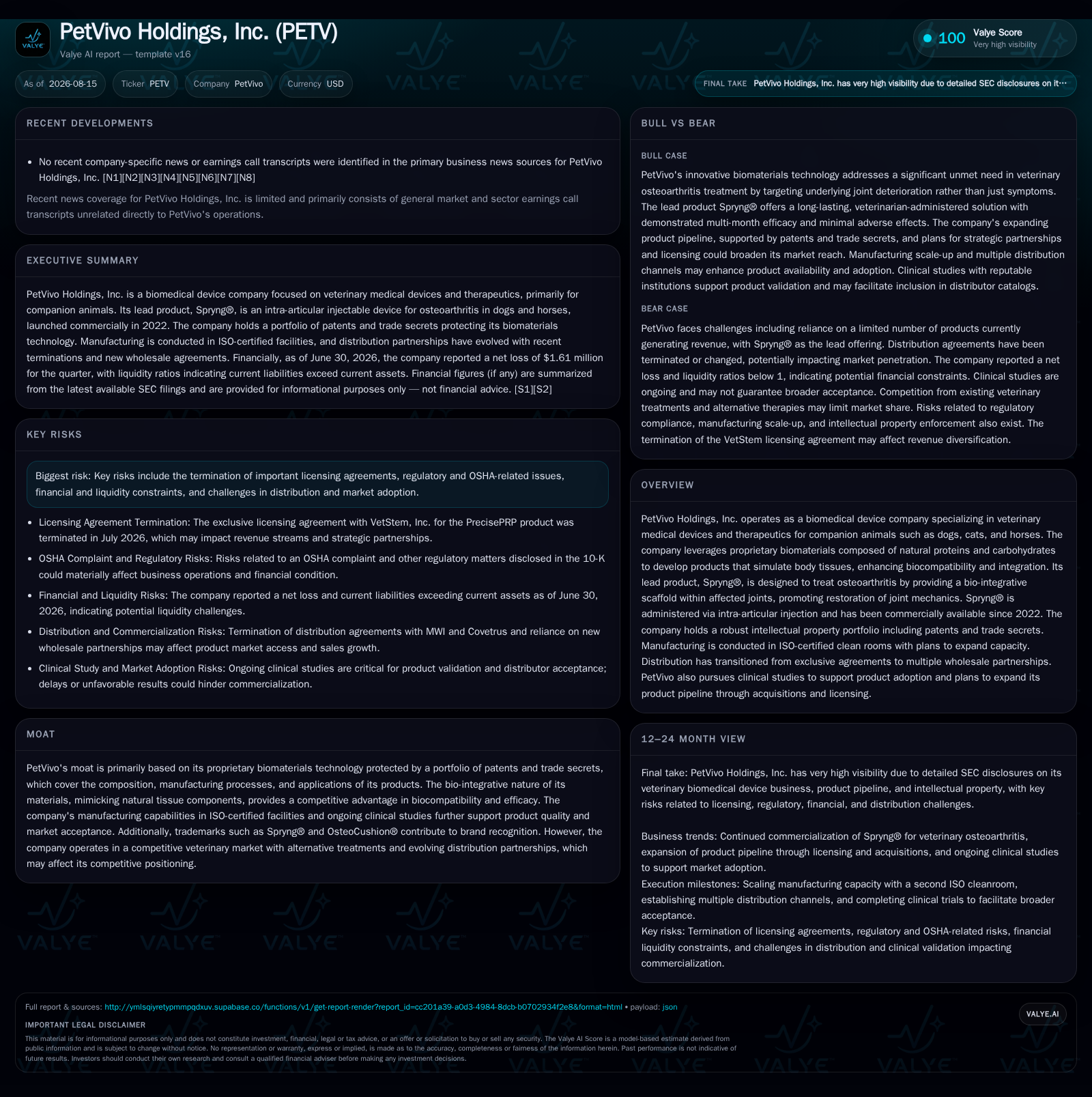
PetVivo Holdings recently ended its exclusive licensing agreement with VetStem, prompting a strategic shift to direct commercialization and expanded distribution of its Spryng® veterinary medical device. Spryng® leverages patented biomaterials technology that mimics natural cartilage to enhance joint function in companion animals. The company operates ISO-certified manufacturing facilities to ensure quality and scalability while clinical studies support veterinary adoption. Despite growth opportunities, PetVivo faces operational risks including regulatory compliance challenges, financial liquidity pressures, and the need to establish new distribution partnerships post-license termination.
License Termination Reshapes Near-Term Commercial Outlook
On July 24, 2026, PetVivo Holdings formally terminated its exclusive licensing and supply agreement with VetStem, resolving outstanding disputes but eliminating a key revenue stream tied to VetStem’s PrecisePRP product marketed for canine and equine use [S3][S2]. This development requires PetVivo to pivot toward direct commercialization or establish new distribution partnerships to maintain market presence. The transition from an exclusive licensing model to diversified channels increases execution risk as the company assumes greater responsibility for sales efforts.
This shift alters PetVivo's revenue mechanics significantly; income will increasingly depend on direct sales through expanded distributor networks targeting veterinary practices rather than royalty or licensing fees. Tracking updates on new partner engagements or early sales data will be essential to assess this strategic realignment.
Proprietary Biomaterials Technology as a Competitive Moat
PetVivo’s core product advantage centers on its proprietary biomaterials technology embodied in Spryng®, an intra-articular injectable designed for osteoarthritis management by providing a bio-integrative scaffold that restores joint biomechanics [S1][S17]. The biomaterial particles mimic natural cartilage composition—comprising collagen, elastin, and glycosaminoglycans like heparin—offering superior biocompatibility compared to synthetic alternatives common among competitors.
The company’s intellectual property portfolio includes six U.S. patents, four foreign patents, multiple patent applications, and six trade secrets covering formulations, manufacturing methods, and device applications [S20]. These protections create high barriers to entry by safeguarding both product composition and patented self-assembly manufacturing processes crucial for maintaining consistent clinical performance.
Ongoing R&D aims to extend this platform into additional indications such as navicular disease in horses. Success here would deepen PetVivo's commercial moat by expanding therapeutic applications.
Manufacturing Infrastructure Supports Quality and Scalability
PetVivo produces its products in an ISO Class 7 certified clean room facility in Minneapolis using patented scalable processes designed to ensure batch consistency while meeting volume demands [S12]. The company plans to commission a second ISO-certified clean room within the calendar year, signaling intent to scale production capacity further while mitigating risks associated with single-site dependency.
This dual-facility strategy enhances supply chain resilience and supports concurrent R&D activities focused on process improvements necessary for long-term growth.
Evolving Distribution Strategy After Exclusivity Ends
Following the termination of exclusivity with VetStem, PetVivo is shifting toward multi-partner distribution arrangements including collaborations with major wholesale distributors like MWI Veterinary Supply Co. [S1][S12]. This approach aims to broaden geographic reach across fragmented veterinary markets while reducing reliance on any single channel.
While diversification expands market access potential, it introduces complexities in logistics management and customer engagement. Balancing direct sales efforts with distributor relationships aligns with industry norms among veterinary biomedical device manufacturers competing for penetration into independent clinics nationwide.
Future developments may reveal increased distributor counts or expanded territories as indicators of successful channel diversification.
Clinical Validation Drives Veterinary Adoption
Robust clinical evidence remains critical for veterinarian acceptance of innovative devices like Spryng®. Completed clinical trials at Colorado State University evaluated safety and efficacy for canine osteoarthritis treatment through March 2024; equine tolerance studies concluded successfully earlier [S12]
Two canine studies conducted with Ethos Veterinary Health between 2022–2024 aim to demonstrate longer-term outcomes underpinning market acceptance [S5][S12]. Third-party university-backed research is often prerequisite for distributors listing new products, facilitating wider practitioner access.
Accumulating such data helps overcome adoption barriers amid existing therapies by substantiating claims of improved joint function.
Competitive Landscape: Focused Differentiation Versus Broad Animal Health Players
Within the niche of biomaterial-based intra-articular injectables for companion animal osteoarthritis treatment, PetVivo competes against larger firms like Zoetis and IDEXX Laboratories which offer broad pharmaceutical-device portfolios but less specialized biomaterials technology.
PetVivo distinguishes itself through protein-based bio-integrative formulations closely replicating extracellular matrix properties rather than synthetic polymers or small molecules common among peers. Its ISO-certified manufacturing aligns with industry best practices ensuring quality required by veterinarians.
This specialization offers premium positioning potential but entails scale disadvantages relative to established animal health conglomerates.
Market Growth Drivers Support Long-Term Demand Expansion
The U.S. companion animal health market benefits from rising pet ownership—exceeding 90 million households—and increasing owner willingness to invest in advanced treatments for chronic conditions like osteoarthritis [S24]
With approximately 69 million dogs and significant equine populations nationally, demand structurally favors efficacious joint therapeutics such as Spryng® [S1]. Concurrently, veterinary practices face margin pressure due to third-party pharmacy competition for prescriptions; devices administered by veterinarians present opportunities for higher-margin revenue streams
These dynamics create an environment conducive to biomedical device companies offering differentiated products that enhance both clinical outcomes and practice economics.
Risks: Regulatory Compliance, Operational Challenges, Liquidity Constraints
Despite FDA's limited premarket requirements for veterinary devices like Spryng®, regulatory risks persist around labeling compliance and post-market surveillance; adverse events could trigger enforcement actions impacting reputation or sales [S8]
Operationally, unresolved OSHA complaints pose potential material impacts depending on outcomes [S2][S6]. Financially, PetVivo exhibits liquidity pressures evidenced by a current ratio below 1 (0.72) as of June 30, 2026 and net debt near $289K after accounting for available cash balances—signaling constrained working capital limiting aggressive investment absent new funding sources [F1].
Transitioning away from VetStem exclusivity introduces short-term revenue uncertainty compounded by challenges securing alternative distribution partnerships.
Continued vigilance over intellectual property protection is also essential given competitive pressures from synthetic biomaterial providers or pharmacologic substitutes.
Investor Watchlist: Milestones Indicating Execution Progress
Key near-term indicators include announcements of additional distribution agreements expanding beyond MWI Veterinary Supply Co., which would indicate progress offsetting lost licensed revenues [S2][S3].
Clinical trial data readouts validating durability of therapeutic effects will be pivotal in driving repeat veterinarian usage—a critical operating KPI linked directly to sustainable unit sales volumes.
Metrics related to manufacturing capacity utilization following activation of the second ISO-certified clean room will reveal supply-side readiness aligning production capabilities with growing demand.
Quarterly financial disclosures will provide early insights into sales momentum post-license termination reflecting the effectiveness of PetVivo’s strategic realignment leveraging its proprietary biomaterial technology within an evolving veterinary biomedical device marketplace.
Financial Profile Discussion: Liquidity Challenges Amid Strategic Transition
As of June 30, 2026, PetVivo reported current assets totaling approximately $941K against current liabilities exceeding $1.31 million yielding a current ratio around 0.72—a level indicative of tight short-term liquidity under prevailing capital structures [F1]. Net debt stands near $289K after subtracting cash balances from total borrowings recorded at prior quarter-ends [F1].
Operating losses exceeding $9 million through March 31 underscore ongoing investment in R&D vital for pipeline development but contributing to cash burn absent significant commercial inflows [F1]
The recent loss of a material licensing revenue source necessitates prudent capital allocation prioritizing organic growth via expanded direct selling efforts and clinical program advancement rather than broad-scale expenditure without secured financing.
This analysis synthesizes PetVivo Holdings’ latest disclosures emphasizing operational pivots following cessation of key licensing relationships alongside continued reliance on patented biomaterials technology offering distinctiveness within the growing veterinary biomedical device sector focused on companion animal osteoarthritis management. Investors should monitor clinical progress indicators alongside shifts in distribution breadth as leading signals shaping near-term commercial trajectory within this specialized yet expanding market segment.
This report does not constitute investment advice or an offer to buy or sell securities.
Disclaimer: This is research-only, informational analysis and not investment advice. It may include AI-generated interpretation and general industry context. Always verify important details using primary sources.

Comments