
Mobiquity Technologies Advances AI-Powered Ad Platform Amid Liquidity Challenges
Mobiquity is accelerating adoption of its AI-driven GrowthOS platform targeting casino advertising while confronting severe cash constraints that cloud near-term growth visibility.
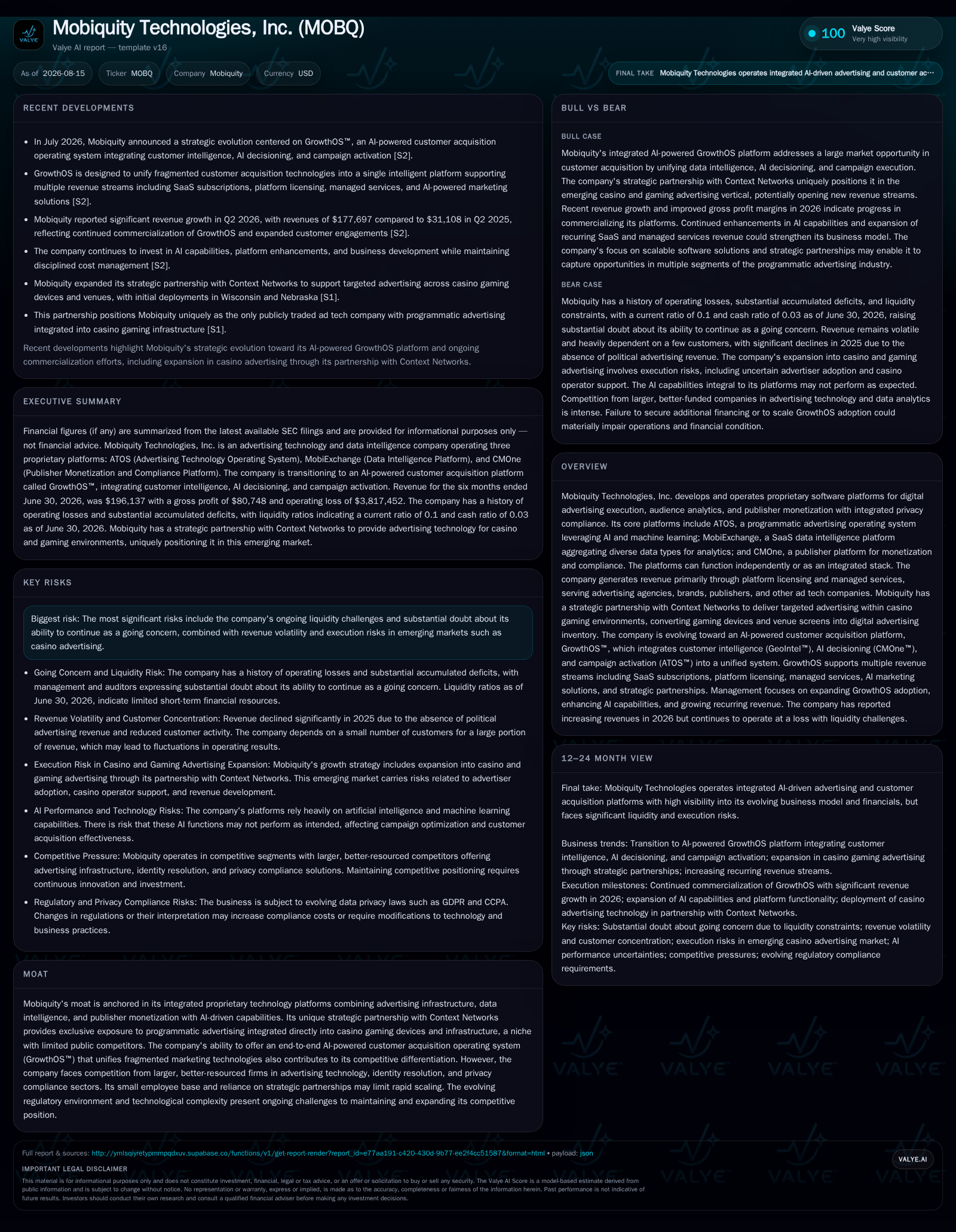
In its August 2026 quarterly filing, Mobiquity Technologies detailed a strategic pivot to expand its AI-powered GrowthOS customer acquisition platform integrating programmatic ad tech, data intelligence, and publisher monetization. This evolution aims to unlock recurring SaaS revenue streams and scale within niche verticals such as casino gaming advertising through partnerships like Context Networks. However, the company continues to face significant liquidity pressures and operating losses raising doubts about ongoing viability absent successful customer adoption and capital raises. Execution risks around complex new offerings and emerging channel expansion compound uncertainty despite increasing platform usage and improving operating leverage potential.
Latest Quarterly Filing Frames GrowthOS-Driven Strategic Shift with Revenue Scaling Uncertainty
Mobiquity’s August 2026 10-Q filing marks an inflection point by emphasizing GrowthOS™, a newly branded AI-powered customer acquisition operating system designed to unify disparate digital marketing technologies into a coherent platform. Management underscores that future revenue escalation hinges on increased GrowthOS adoption encompassing enhanced AI capabilities within the publisher-focused CMOne platform, expanded utilization of programmatic buying functions via ATOS, growth in recurring SaaS licensing combined with managed services, and further penetration of emerging specialized sectors such as casino gaming advertising [S2]. Notably, management cautions that revenue may fluctuate dramatically due to client implementation schedules, campaign timing variability, contract renewal uncertainty, and shifting purchasing behavior—signaling fragile near-term top-line predictability. This strategic evolution from simple programmatic technology provisioning toward an integrated platform reflects recognition of deep fragmentation within digital marketing stacks across advertisers and agencies [S2].
End-to-End Advertising Tech Suite: Business Model Anchored in AI-Enabled Programmatic Platforms
Mobiquity operates three foundational proprietary platforms forming the backbone of its offering: the Advertising Technology Operating System (ATOS), MobiExchange data intelligence platform, and CMOne for publisher monetization and compliance [S1,S2]. ATOS serves as an advanced programmatic advertising engine automating buying, selling, delivery, and measurement across mobile, desktop, connected TV (CTV), and other devices leveraging AI/ML models for campaign optimization and real-time bidding. This gives it a DSP-like functionality integrated with audience targeting utilizing an identity graph framework alongside fraud detection tools. Management reports ATOS processes approximately 10 billion daily advertising opportunities internally—an indicator of scale within its operational footprint though still modest relative to industry leaders [S1]
MobiExchange aggregates diverse consumer behavior signals including location, transactional data, contextual clues, and behavioral patterns into a distributed computation environment supporting audience segmentation and analytics accessible primarily via SaaS licensing. This modularity supports self-service insights critical for optimizing omnichannel campaigns. CMOne extends capabilities toward publishers allowing monetization of inventory while embedding evolving privacy compliance protocols addressing GDPR/CCPA mandates—an increasingly vital feature given regulatory pressures in ad tech ecosystems [S1,S2].
Together these platforms generate revenues predominantly from subscription or usage-based licensing fees supplemented by managed services aiding campaign execution or integration—consistent with SaaS business archetypes common among ad tech vendors. However, cost of revenues have surged notably due to increasing cloud infrastructure demands (cloud hosting, software licensing fees, engineering support) growing from negligible proportions in prior years to over 60% recently—the operational cost base reflecting ongoing investments underpinning GrowthOS scalability yet limiting short-run margins [S2,S19].
Competitive Ad Tech Landscape Highlights Scale Disadvantages and Niche Vertical Differentiation
Within the broader advertising technology software industry dominated by giants like The Trade Desk (programmatic DSP leadership) and Magnite (SSP/publisher monetization), Mobiquity remains a small-cap player facing clear scale disadvantages in distribution breadth, client penetration, and financial resources. These larger peers also boast extensive identity resolution assets combined with robust privacy compliance technologies supported by expansive data connectivity (LiveRamp exemplar). Thus competitive pressure spans pricing dynamics and innovation cycles.
Mobiquity’s key differentiation lies in its tightly integrated proprietary stack coupled with a unique strategic partnership with Context Networks targeting casino gaming environments—a specialized vertical where digital programmatic inventory is nascent but promising. This alliance enables access to inventory on gaming hardware screens and venue digital signage without requiring substantial capex from operators. Casinos thus monetize existing digital assets generating non-gaming revenue streams—a channel few public competitors actively pursue on comparable terms [S1,S2]. While this niche exposure offers some insulation from mainstream competition intensity, it simultaneously constrains rapid scale realization due to complex integration requirements and limited addressable market relative to broad DSP platforms.
Growth Opportunities Centered on Programmatic Casino Advertising and Recurring Revenue Expansion
Mobiquity’s principal growth thesis revolves around expanding programmatic advertising footprints within under-monetized casino environments leveraging Context Networks’ patented technologies. Early deployments target venues in regions like Wisconsin and Nebraska through partnerships converting gaming displays into monetizable digital ad inventory accessible programmatically across out-of-home (OOH), mobile apps, web portals, and CTV interfaces—a multichannel strategy tapping progressive connected screens [S1]. Success here depends heavily on partner integration depth and market adoption velocity.
Simultaneously the company aims to grow recurring revenues through broader deployment of GrowthOS components—particularly increasing license uptake of ATOS capabilities paired with expanding managed service contracts enhancing customer stickiness. The AI-native CMOne platform further supports cross-channel content orchestration targeting small-to-medium sized businesses seeking automated campaign activation driven by machine learning insights [S2]. These moves reflect structural industry trends favoring unified marketing platforms integrating fragmented tools into single intelligent ecosystems capable of real-time data ingestion-to-execution workflows.
Operationally Mobiquity seeks to capitalize on scaled cloud infrastructure supporting this growth vector to improve gross margins over time as fixed technology costs are leveraged against rising usage volumes. Consumer acquisition complexity amplifies demand for these integrated solutions amid tightening data/privacy laws elevating costs for standalone identity graphs or manual media planning approaches [S6,S19].
Risks from Cash Burn, Execution Complexity, Customer Concentration, and Regulatory Headwinds
Persistently negative operating cash flows have precipitated substantial doubts about Mobiquity’s ability to continue as a going concern—a red flag repeatedly flagged in recent filings including auditor disclosures extending over multiple fiscal years [S1,S7]
The firm continues burning approximately $2.6 million cash from operations for the first half of 2026 despite incremental commercial progress—underscoring the urgent need for capital infusion aligned with scaling milestones [S2]. Execution risks loom large given the technical complexity embedding AI-driven modules across multiple product lines plus integration hurdles in novel casino vertical deployments requiring bespoke solutions sustained over elongated sales cycles. Customer concentration risk may amplify revenue volatility given dependency on relatively small client bases during initial adoption phases.
Moreover stringent global regulatory frameworks mandating privacy compliance impose continual investment burdens both at product level enhancements (e.g., cookie-less targeting alternatives) as well as procedural safeguards—areas where larger rivals benefit from deeper resources investment capacity further narrowing differentiation levers available to Mobiquity [S1]
Near-Term Milestones: Customer Adoption Metrics, Revenue Beats/Misses, Platform Usage Trends to Monitor
Key performance indicators to validate management’s growth narrative predominantly revolve around measured expansion of annual recurring revenue (ARR) anchored in platform licensing contracts augmented by managed service revenues tied directly to GrowthOS adoption rates [S2]. Specific metrics include aggregate ad impressions or advertising opportunities processed daily through ATOS reflecting utilization trends; customer churn rates indicating retention quality; ramp velocity of new customer onboarding especially within casino vertical; renewal rates on expiring contracts signaling stickiness; plus emerging contribution proportions from CMOne related SaaS revenues.
Management’s commentary suggests cautious optimism tempered by contingent timing risks implying quarterly revenue could exhibit noise influenced by implementation pacing or seasonality complicating short-run forecasting accuracy [S2]. Observers should closely monitor prospect pipeline progress alongside disclosed platform usage volumes—potentially published during earnings or investor communications—to gauge traction.
Cash used in operating activities totaled approximately $2.6 million for the first half of 2026, nearly mirroring prior year consumption despite incremental improvements in gross profit margins moving from ~28% to ~41%, driven largely by enhanced infrastructure utilization efficiency accompanying GrowthOS scaling efforts [S2]
Debt levels appear moderate though exact recent figures lack granularity; historical data indicates limited indebtedness without significant refinancing options presently available [S3]. The recent independent auditor change may reflect a strategic recalibration aimed at enhancing capital market access readiness, though no explicit disclosures confirm this
Prospective developments hinge upon internal execution efficacy amid challenging market conditions typical for emerging technology-centric advertising platform providers navigating competitive landscapes amid rigorous regulatory scrutiny.
Disclaimer: This is research-only, informational analysis and not investment advice. It may include AI-generated interpretation and general industry context. Always verify important details using primary sources.

Comments