
Western Digital's Strategic Levers in an Evolving Storage Market
Western Digital’s latest quarterly update highlights shifts in product mix driven by AI storage demand and cloud infrastructure growth, underscoring both growth potential and margin challenges.
In its Q3 FY2026 filing, Western Digital reported evolving unit shipments and average selling prices reflecting increased demand for AI-optimized and cloud-centric storage solutions. The company’s portfolio balance between high-volume HDDs and higher-margin flash products underpins its strategic positioning amid intensifying competition and customer concentration risks. Growth is propelled by hyperscale data center expansions linked to AI workloads, although rapid technological changes and capital intensity remain substantial challenges. Financially, Western Digital maintains liquidity strength with a net cash position and healthy operating margins, supporting ongoing innovation investments.
Q3 Operating Update Unveils Product Mix Shift Toward AI-Optimized Storage
Western Digital’s Q3 FY2026 filing discloses a notable evolution in its unit shipments and product mix reflecting the growing influence of AI workloads on storage demand. The company reports an increase in shipments weighted toward higher-capacity hard disk drives (HDD) optimized for hyperscale cloud customers alongside solid-state drives (SSD) tailored for low-latency AI applications [S2]. This shift aligns with broader industry dynamics where cloud service providers require scalable storage with improved input/output operations per second (IOPS) and throughput to satisfy increasingly complex AI data processing needs.
Simultaneously, the average selling price (ASP) per device has trended upward as Western Digital capitalizes on higher-margin SSD adoption while continuing to leverage the cost competitiveness of HDDs for bulk capacity [S2]. This balance suggests improving pricing power enabled by differentiated offerings tuned for performance-sensitive workloads. Such an adjustment in product mix is integral to addressing the dual pressure of volume growth with margin preservation amid competitive market conditions.
Storage Portfolio Dynamics: Balancing HDD Scale With Higher-Margin Flash Memory
Western Digital operates across multiple storage technology domains: traditional magnetic HDDs renowned for high-density bulk storage at scale; NAND-based flash memory products including SSDs offering speed and energy efficiency; and embedded flash for client devices [S1]. The company derives revenue predominantly from original equipment manufacturers (OEMs), cloud infrastructure operators, and retail channel partners who embed or resell these products.
The economics differ markedly between segments. HDD sales drive scale through volume-enabled cost advantages but suffer from declining per-unit ASPs due to commoditization pressures [S1,S2]. Conversely, NAND flash products command premium pricing tied to advancements in controller technology, wear leveling algorithms, and increasing storage density measured in terabytes per package. Western Digital’s strategic focus on enhancing these flash offerings supports margin expansion potential documented in recent disclosures
Emerging advances in NAND technology allow Western Digital to compete effectively against peers such as Toshiba—also a diversified flash memory supplier—and Seagate Technology known for its strong HDD presence but growing SSD portfolio. Maintaining leading manufacturing yield rates through R&D investments remains central to outpacing rivals and managing cost efficiencies amidst complex supply chains [S1].
Customer Concentration Risk Within Expanding Cloud Infrastructure Demand
Western Digital acknowledges significant customer concentration with top clients representing a substantial portion of net revenues—a common characteristic in this sector driven by bulk contracting with major OEMs and hyperscale cloud operators [S1,S2]. While these relationships secure steady order flows aligned with capacity expansions in cloud storage infrastructure, they expose the company to negotiation leverage shifts and sensitivity to demand volatility.
Cloud customers increasingly prioritize high-capacity storage solutions that blend HDD economies with SSD performance benefits tailored for AI workloads [S2]. This nuanced customer need necessitates ongoing product innovation but also concentrates risk should a few large customers alter procurement patterns or pursue vertical integration strategies. Accordingly, the company monitors order backlog levels as an early indicator of demand sustainability
Competitive Position: Benchmarking Western Digital Against Peers’ Portfolio & Innovation
Relative to key competitors—Seagate Technology specializing in combined HDD/SSD manufacturing and Toshiba with diversified flash memory products—Western Digital sustains competitive advantage through vertical integration across magnetic and flash technologies alongside global manufacturing scale [S1]. This breadth enables responsiveness to shifting market preferences between volume-driven HDD capacity versus margin-accretive SSD deployments.
Western Digital's R&D spend as a percentage of sales supports sustained investment in next-generation storage controllers, firmware optimization for latency reduction, wear leveling improvements, and packaging technologies enhancing durability under intensive data center use [S1]. These differentiators underpin the moat fostering customer retention in demanding enterprise and hyperscale markets.
Furthermore, scale advantages bolster pricing negotiations within OEM channels relative to smaller competitors or those concentrated solely on niche segments. However, continued innovation cadence is essential given fast-paced technological shifts destabilizing legacy product relevance.
Growth Drivers Rooted in AI Data Needs and Hyperscale Capacity Expansion
Structural growth drivers illuminated by recent filings emphasize surging data generation propelled by artificial intelligence applications demanding rapid access to vast datasets stored primarily on capacious yet performant media [S1,S2]. Hyperscale cloud operators are aggressively expanding data center footprint requiring both exabyte-scale capacity via HDDs and low-latency SSD layers for compute-intensive AI training workloads.
This trend brightens prospects for Western Digital through accelerated unit shipments shifting toward advanced SSD form factors integrating improved NAND chips leveraging process-node shrinks. Concurrently, high-capacity magnetic platters optimized for reliability enable efficient scaling of petabyte-level stores critical for big data archiving.
Emerging applications such as real-time inference engines contribute additional demand vectors emphasizing latency reduction capabilities intrinsic to flash technology's attributes. These factors collectively enhance ASP trajectories observed recently [S2], signaling favorable mix impact offsetting traditional segment commoditization.
Risks from Technological Change and Capital Intensity Constraints
Despite market tailwinds, Western Digital confronts well-documented risks arising from rapid technological obsolescence cycles threatening legacy HDD relevance as SSD penetration escalates globally [S1,S2]. Sustaining dual-platform competitiveness necessitates substantial capital expenditures accompanied by ongoing R&D outlays—a financial commitment increasing operational leverage exposure.
Price competition intensifies particularly among flash suppliers driving margin compression despite incremental feature differentiation. Supply chain disruptions affecting critical semiconductor components remain perennial concerns amplified by geopolitical tensions impacting sourcing reliability.
Customer concentration compounds cyclicality risks; demand can swiftly retract if hyperscale budgets adjust or OEM inventory strategies fluctuate amid macroeconomic shifts. Legal proceedings referencing intellectual property disputes highlight complexity inherent in protecting innovation portfolios while avoiding litigation costs [S1].
What to Watch: Order Backlog Trends, ASP Movements, Guidance Updates Ahead
Investors should closely monitor developments disclosed in forthcoming earnings releases around order backlog metrics signaling demand trajectory directionality especially from major cloud infrastructure clients highlighted in recent filings [S2,S3]. Sharp changes may presage seasonal or structural shifts.
Tracking ASP evolution on high-capacity drives will illuminate pricing power sustainability amid competitive pressures noted above. Additionally, management commentary on supply chain normalizations or disruptions can provide context for near-term operating margin outlook adjustments.
Guidance revisions reflecting product launch cadences or capacity additions remain critical milestones informing execution success related to targeted growth areas such as AI-optimized SSD offerings.
Financial Profile Discussion: Liquidity Strength Supports Capital for Innovation
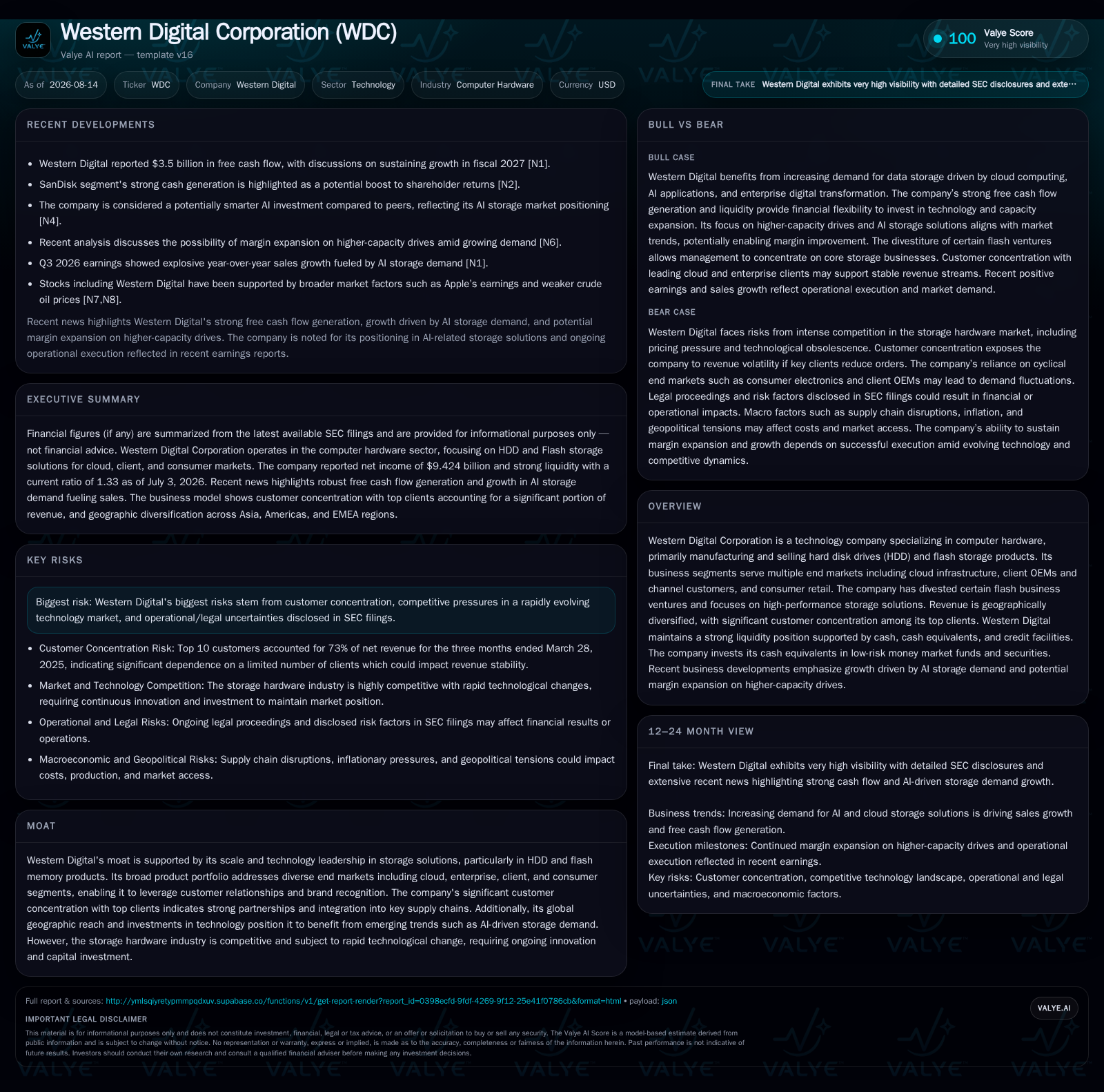
As of 2026-07-03, Western Digital held $1.58 billion in cash and equivalents against total debt of $1.06 billion, resulting in a net cash position of approximately $519 million—providing a solid liquidity buffer supporting operational agility amidst capital-intensive R&D programs [F1]. The current ratio stood at 1.33, reflecting satisfactory short-term liquidity coverage given $5.63 billion in current assets versus $4.24 billion in current liabilities [F1].
Operating income reached $4.45 billion reflective of profitability conducive to self-financing innovation investments critical within this rapidly evolving industry space [F1]. Free cash flow generation supports continued manufacturing capacity augmentation alongside technology upgrade cycles essential to retaining leadership positions.
This financial flexibility buffers against potential margin compression episodes tied to raw material volatility or temporary demand softness while enabling timely capital allocation into emergent high-growth product lines tailored for AI-driven markets.
This analysis synthesizes Western Digital’s latest quarter filings alongside annual disclosures complemented by broader computer storage industry insights. It explains how shifts toward AI-driven storage demands intersect with product portfolio strategy balancing HDD scale economics against SSD margin potential while highlighting salient risks related to customer dependence and technological evolution pressure points without dispensing any investment advice.
Disclaimer: This is research-only, informational analysis and not investment advice. It may include AI-generated interpretation and general industry context. Always verify important details using primary sources.

Comments