
Mint Inc’s Strategic Shift Challenges Profitability and Growth Momentum
Mint Inc’s recent capital raise underscores the financial strain of balancing a declining Hong Kong interior design business with early-stage AI and robotics investments.
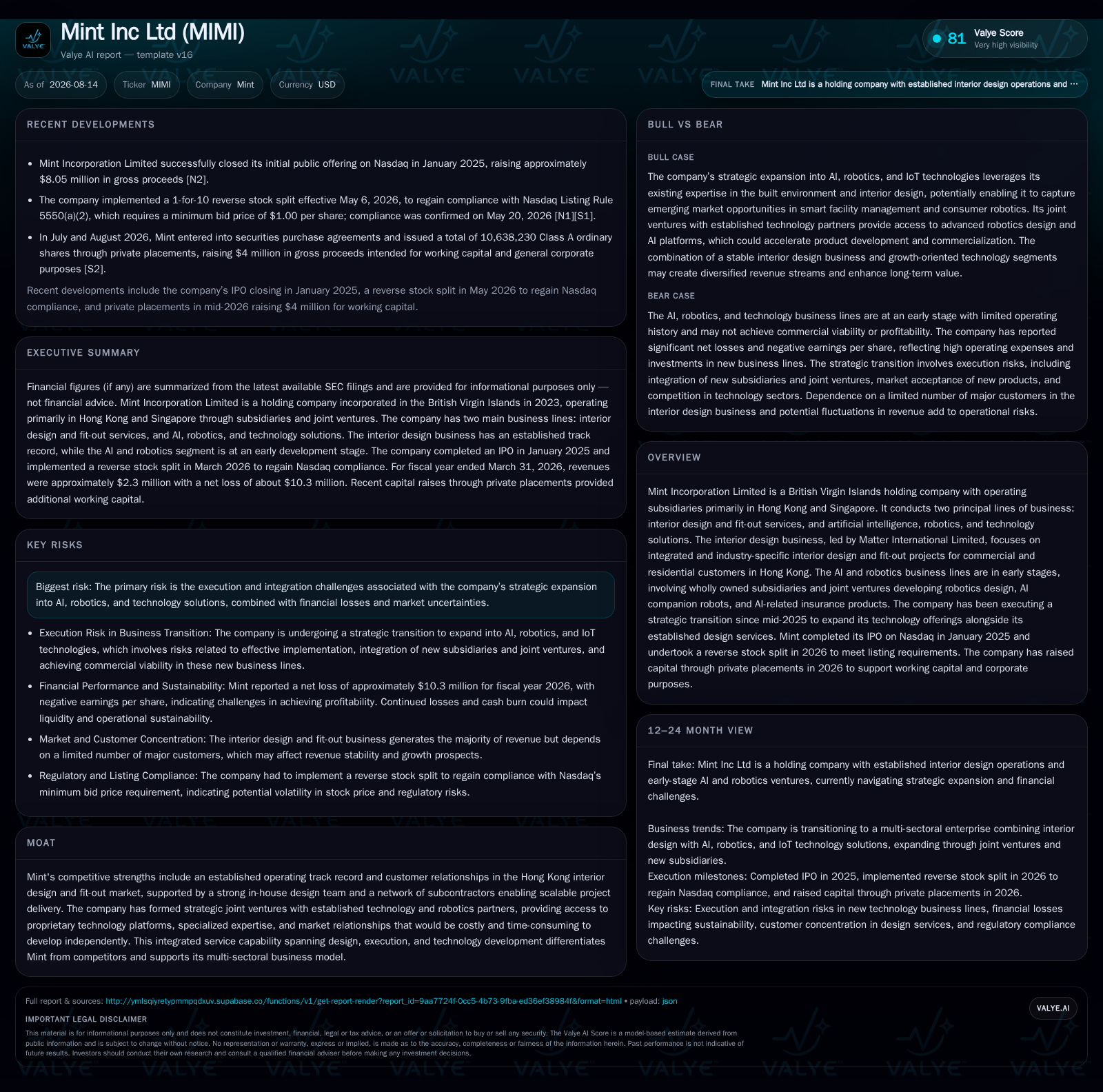
Mint Inc Ltd (MIMI) continues navigating a challenging transition from its core Hong Kong-based interior design and fit-out services towards nascent AI, robotics, and smart facility management solutions. The company's latest August 2026 PIPE equity raise at a steep discount reflects pressing liquidity needs amid widening operating losses, primarily driven by heavy R&D spend and share-based compensation linked to technology ventures. While its traditional design services face revenue and margin pressure from softness in the Hong Kong property market, the technology segment remains at an early development stage with limited commercial traction. Strategic joint ventures provide access to proprietary tech but add execution complexity and risk. Near-term growth depends on recovery in local property demand, successful JV execution, and progress toward commercialization milestones for AI and robotics products.
Capital Infusion Reflects Heightened Funding Needs Amid Margin Pressure
Mint Inc’s August 2026 private investment in public equity (PIPE) raised $2 million by issuing over six million Class A shares at roughly $0.316 each — only 20% of the prior Nasdaq closing price [S2]. This steep discount demonstrates heightened funding pressure as the company faces expanding operating losses centered around its dual business. The proceeds are earmarked for working capital amid ongoing strategic repositioning efforts that have stretched liquidity resources.
This financing event signals investor concern over Mint’s ability to sustain operations without external capital amid a deteriorating revenue base from traditional services coupled with expensive technology development initiatives. The obligation to file resale registration statements shortly adds administrative demands that may affect cash flow.
Project-Based Interior Design Revenue Under Strain from Hong Kong Property Market
Mint’s legacy interior design and fit-out services business — focused on commercial offices, retail stores, and luxury residential projects primarily in Hong Kong — saw revenues fall nearly 30%, from approximately $3.3 million in FY2025 to $2.3 million in FY2026 [S1]. This decline reflects fewer projects secured alongside reduced average contract sizes amid subdued local real estate activity.
The company operates predominantly on one-off project contracts without long-term agreements, exposing it to significant revenue variability tied directly to Hong Kong’s economic cycles and property market conditions [S1]. Reduced government land supply and cautious corporate spending have constrained commercial renovations and residential upgrades, diminishing contract flow.
Profitability pressures stem from a shift in project mix: higher-margin design-only services contracted more sharply than integrated fit-out contracts which typically yield lower gross profit margins. This dynamic contributed to overall margin compression year-over-year, revealing sensitivity of earnings to project scope negotiation and customer budget constraints.
Emerging AI & Robotics Initiatives Inject Complexity and Drive Losses
Since mid-2025, Mint has expanded into AI companion robots, robotics design, smart facility management IoT systems, and related technology solutions through subsidiaries and joint ventures [S1]. Although product sales contributed about $384K for the first time in FY2026, these segments remain early-stage with minimal revenue impact but substantial cost burdens.
R&D expenses appeared for the first time at approximately $131K related to these initiatives [S1]. Additionally, a significant $7.8 million share-based payment charge under selling and marketing expenses reflects incentives granted mainly for technology personnel tied to these ventures [S1]. Consequently, operating losses widened dramatically from $1.5 million in FY2025 to over $10 million in FY2026.
This cost profile typifies development-stage risks where upfront investments precede scalable commercial returns. Technology development milestones will be critical leading indicators of future revenue potential.
Strategic Joint Ventures: Accelerated Innovation Amid Execution Risks
Mint leverages joint ventures with robotics firms such as Axonex Robotics Limited (60% owned) to access proprietary technologies including digital twin infrastructures, drone automation platforms, and consumer AI applications deployed regionally [S1]. These partnerships accelerate innovation that would otherwise require significant time or capital if developed internally.
However, dependence on JV partners introduces operational integration challenges and shared commercial returns that dilute direct control. This complexity increases execution risk as Mint balances established interior design operations alongside distinct tech enterprises within one corporate framework.
JV performance metrics will materially influence segment profitability; delays or underperformance by partners could exacerbate losses without offsetting revenues.
Growth Drivers Anchored in Smart Space Adoption Yet Tempered by Market Cyclicality
Future growth prospects rely heavily on recovery in Hong Kong’s commercial property sector where office renovation demand might rebound following economic stabilization. Government incentives promoting smart building technologies could further stimulate adoption of AI-robotics integrated solutions in facility management.
Corporate clients’ rising focus on brand expression through innovative interior environments combined with growing acceptance of AI companion robots offer promising long-term demand drivers beyond cyclical downturns.
Expansion into other Asia Pacific markets with active real estate development is planned but entails regulatory complexities around AI data privacy requiring careful navigation.
Key Risks: Contract Variability, Market Exposure, Integration Complexity
Mint’s reliance on individually negotiated project contracts creates inherent revenue unpredictability due to fluctuating work scopes, client budgets, timing irregularities, and competitive pricing—factors intensified by sluggish property markets [S1]. Gross margin variability per project remains a critical watchpoint.
New technology segments expose the company to cybersecurity risks associated with IoT-connected systems—a concern acknowledged by management necessitating ongoing mitigation efforts [S1].
Managing mature service delivery alongside emerging technology businesses elevates organizational complexity across finance, operations, and R&D functions.
Milestones To Monitor: Registration Filings, Project Wins, JV Progress
Near term events include required resale registration filings for PIPE shares within sixty days post-August closing reflecting shareholder liquidity conditions [S2]. Operationally, quarterly updates revealing new or renewed interior design project awards will gauge recovery or stabilization trends factoring seasonality.
On the technology front, progress against product development milestones within joint ventures—such as companion robot launches or phased smart facility management rollouts—will indicate advancement toward scalable commercialization [S1].
Potential acquisitions like the proposed Ascendze transaction could validate strategic expansion if successfully completed [S18].
Financial Profile Discussion
Recent PIPE equity infusion underscores management's awareness of sustained capital needs while pursuing growth opportunities across legacy services and new technology segments; successful execution hinges on balancing organic recovery against costly innovation initiatives prudently.
This analysis synthesizes publicly filed data up to August 2026 without speculation beyond documented information; no investment research view is provided herein.
Disclaimer: This is research-only, informational analysis and not investment advice. It may include AI-generated interpretation and general industry context. Always verify important details using primary sources.

Comments