
Gulf Resources' Bromine Capacity Expansion and Regulatory Compliance Challenges Define Operating Outlook
Gulf Resources focuses on bromine production expansion amid regulatory scrutiny and Nasdaq compliance hurdles.
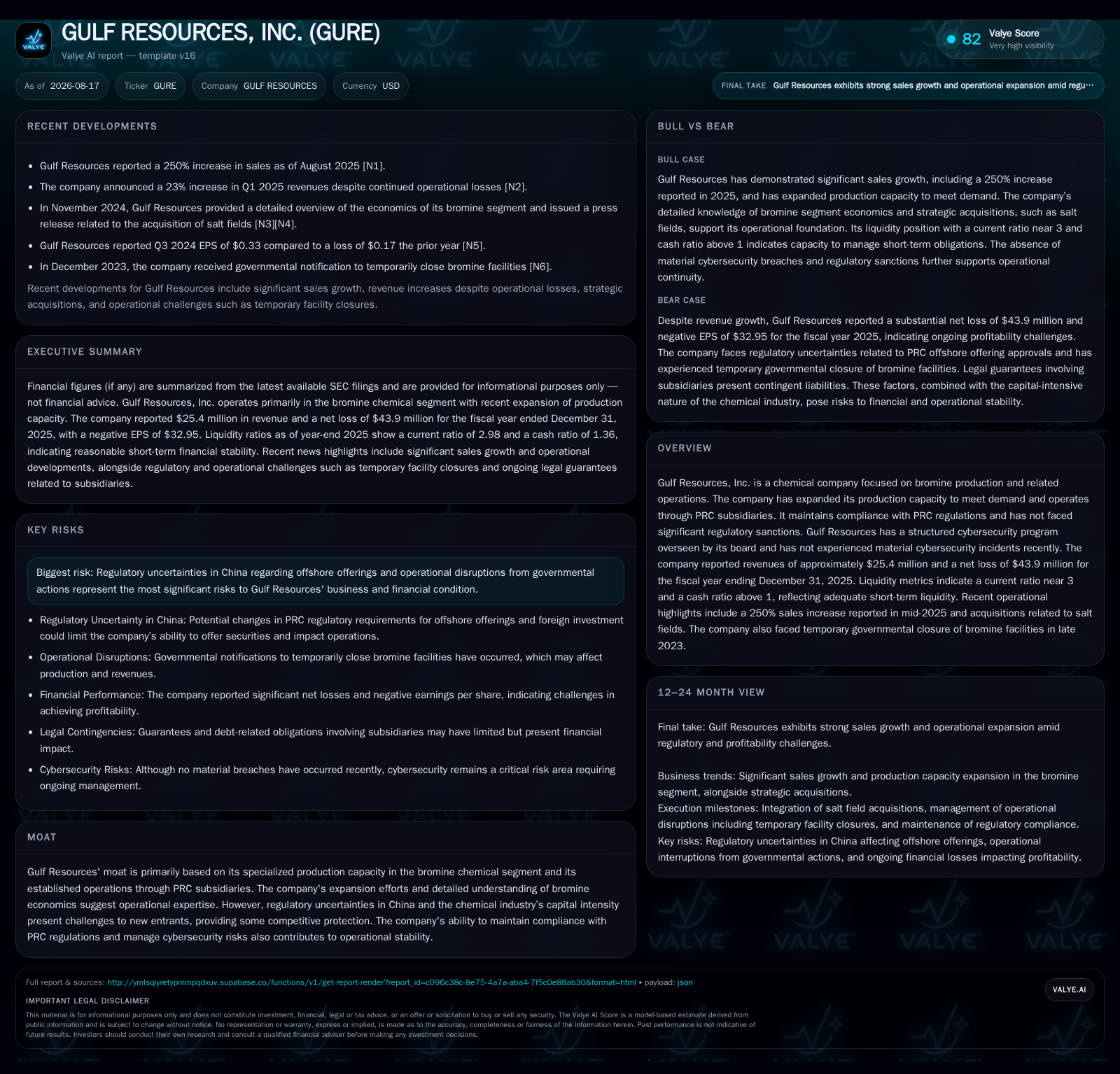
Gulf Resources, Inc. is a specialty chemical producer concentrating on bromine and related chemical intermediates through its PRC subsidiaries. The company is actively expanding production capacity to meet rising demand in industrial sectors but faces operational risks from regulatory uncertainties in China, particularly around offshore offerings and compliance with Nasdaq listing rules due to delayed SEC filings. Financially, Gulf Resources reported revenue of approximately $25.4 million with a net loss exceeding $43 million for 2025, highlighting ongoing operating challenges despite a strong liquidity position. The firm's ability to navigate regulatory approvals, complete financial reporting timely, and sustain capital investments will be pivotal for its growth trajectory.
Recent Operating Update
Gulf Resources disclosed in its latest 8-K report dated June 30, 2026, that it received an extension from Nasdaq to regain compliance with listing Rule 5250(c)(1), which mandates timely filing of periodic financial reports with the SEC [S3]. This extension follows previously issued deficiency notifications triggered by delays in their Form 10-K for the fiscal year ended December 31, 2025, and the Form 10-Q for the quarter ended March 31, 2026 [S3]. The company has submitted a compliance plan to Nasdaq, seeking until October 12, 2026, to resolve these delinquencies. However, there is no assurance that it will meet this deadline [S3].
The prolonged delay is partly due to the restatement of prior filings involving accounting adjustments linked to reclassification of certain buildings as right-of-use assets rather than fixed assets under ASC 842 lease accounting standards [S11]. This complex restatement effort spans multiple fiscal years and quarters over 2023-2025 [S11]. Additional audit processes and SEC comment responses have further complicated timely completion [S7].
Business Model
Gulf Resources operates primarily as a specialty chemical manufacturer focused on bromine production through its subsidiaries located in the People’s Republic of China (PRC) [S1]. Bromine is a vital industrial intermediate used extensively in electronics flame retardants, pharmaceuticals, and agriculture chemicals, placing Gulf upstream in the chemical value chain supplying downstream industrial manufacturers.
The firm generates revenue by processing raw materials like salt into bromine compounds that it sells directly or through industrial distributors [S1]. The specialized nature of bromine chemicals demands production facilities compliant with stringent environmental and safety standards typical of the specialty chemicals industry—a capital-intensive segment requiring significant investments in plant infrastructure
Recently, the company has emphasized expanding its production capacity to meet growing demand from target markets [S1]. This expansion includes acquiring salt fields as critical feedstock sources—an approach intended to secure raw material supply stability and improve cost control amid raw material price volatility common in chemical manufacturing.
Operationally, Gulf Resources’ PRC subsidiaries are positioned advantageously by maintaining compliance with local laws regarding foreign investment and securities listings on Nasdaq [S1]. As of their latest annual filing, the company has not been subject to PRC regulatory investigations or sanctions related to business operations or capital market actions [S1]. This regulatory standing supports operational continuity and investor confidence.
The company's monetization is contract-driven through customer agreements that reflect volume commitments aligned with production volumes; hence key volume-related KPIs such as sales volumes and capacity utilization rates directly influence revenues. Margins are sensitive to raw material costs (primarily salt), production efficiency gains from capacity expansions, and regulatory compliance expenses.
Industry Structure and Competitive Position
The specialty chemicals sector where Gulf Resources competes features differentiated producers specializing in high-value industrial intermediates. Bromine producers like Albemarle Corporation and Olin Corporation represent sizable global peers operating integrated facilities across geographies. Compared to these global players, Gulf Resources is concentrated geographically yet leverages China’s sizeable domestic industrial demand surge.
China's complex regulatory environment imposes notable barriers; chemical producers must navigate environmental permits, foreign investment regulations, and cybersecurity review processes affecting cross-border financing activities. Gulf’s established PRC subsidiary structure helps insulate against abrupt operational disruptions but does not eliminate exposure to governmental actions such as temporary facility closures—an event they have experienced historically.
In capital intensity terms, sizable upfront investments are mandatory for new capacity installations or retrofits adhering to environmental regulations. Gulf’s recent capacity expansion strategy aligns with industry growth drivers aiming at rising electronic component use and agricultural chemical enhancements that leverage brominated compounds.
Despite scale limitations relative to multinational incumbents, Gulf Resources’ localized feedstock acquisitions grant some cost advantage against imported raw materials vulnerable to logistical disruptions or tariffs.
Growth Drivers
A core growth driver lies in scaling production capacity sustainably amid increasing bromine demand linked to electronics manufacturing (flame retardants) and agriculture (pesticide intermediates) sectors prevalent in Asia-Pacific markets.
The company’s expansion includes acquisitions of salt fields—a key raw material source—which can improve feedstock cost stability while enabling steady output scaling compatible with customer contract volumes [S1]. This vertical integration reduces dependence on volatile external suppliers.
Technological improvements in chemical processing efficiency are likely incremental but vital given tight margins in commodity-linked specialty chemicals. Regulatory approvals permitting increased emissions limits or introducing higher product purity grades can unlock expanded market niches but remain contingent on PRC policy evolution.
Geographic concentration presents both opportunity—due to proximity to large downstream customers—and risk via dependency on Chinese regulatory outcomes affecting operational licensing or export capabilities.
Risks / Watchpoints / Growth Constraints
Foremost among risks are evolving PRC regulatory regimes governing offshore offerings which may limit Gulf’s access to international capital markets or require onerous filings with the China Securities Regulatory Commission (CSRC) or Cybersecurity Administration of China (CAC) [S1]. Uncertainty around whether future offerings will receive approval poses a notable threat that could restrict dividend flows abroad or trigger penalties impacting liquidity.
Nasdaq compliance pressures arising from delayed filings introduce risk of delisting if remediation efforts falter past permitted deadlines—this threatens market access for equity raising or trading liquidity [S3]
Operational disruptions from governmental facility inspections or environmental enforcement remain pertinent risks given chemical manufacturing’s inherent hazard profile.
Raw material price fluctuations tied to salt availability or logistics could compress operating margins unless offset by efficiency gains or pricing power.
Cybersecurity remains managed proactively with established board oversight and internal controls; absence of breaches over the last three years suggests effective risk mitigation [S1], although cyber threats evolve rapidly.
Legal contingencies relate mainly to prior administrative penalties involving subsidiary entities but are considered limited in impact on overall financial condition [S26].
What To Watch Next
Key upcoming milestones center on Gulf Resources’ ability to file overdue SEC reports timely during the Nasdaq grace period ending October 12, 2026 [S3]. Successful clearance would stabilize investor confidence; failure heightens delisting risk.
Progress on restated financial statements addressing building asset reclassifications will clarify financial health trends beyond reported losses thus far [S11].
Monitoring updates concerning PRC regulators’ stance on offshore listing approvals will indicate potential constraints or facilitation for future capital raisings necessary for ongoing capex investments.
Operational metrics such as sales volume growth post-capacity expansions and raw material sourcing efficiencies should emerge as positive markers supporting margin improvement if disclosed prospectively.
Lastly, adherence to cybersecurity protocols amid third-party vendor risks remains an area where disclosures might signal resilience critically needed in high-capital industries reliant on uninterrupted plant operations.
Financial Profile Discussion
Liquidity metrics offer some relief; as of year-end 2025, the company held current assets totaling about $24.6 million against current liabilities near $8.2 million yielding a strong current ratio around 2.98 indicating adequate short-term coverage [F1]. Cash on hand at September 2024 was approximately $11.2 million sustaining near-term working capital needs safely above total debt estimated at $2.85 million as of December 2025 resulting in net cash position effectively supporting ongoing investment requirements without heightened refinancing urgency [F1].
Nonetheless, sustained profitability depends heavily on successful commercialization of recently expanded production lines coupled with strict control over operating expenses including raw materials cost inflation management.
This analysis reflects data available through mid-2026 filings without investment research views. Economic conditions affecting specialty chemicals remain dynamic; stakeholders should monitor regulatory developments closely along with execution against capacity expansion plans which will ultimately drive Gulf Resources' positioning within the bromine industry supply chain.
Disclaimer: This is research-only, informational analysis and not investment advice. It may include AI-generated interpretation and general industry context. Always verify important details using primary sources.

Comments