
Lumentum Advances AI Optics Ramp as Supply Chain and IP Challenges Shape Growth
Lumentum’s latest quarter showcases robust AI-driven demand growth tempered by manufacturing constraints and intellectual property risks, shaping its near-term operational and financial outlook.
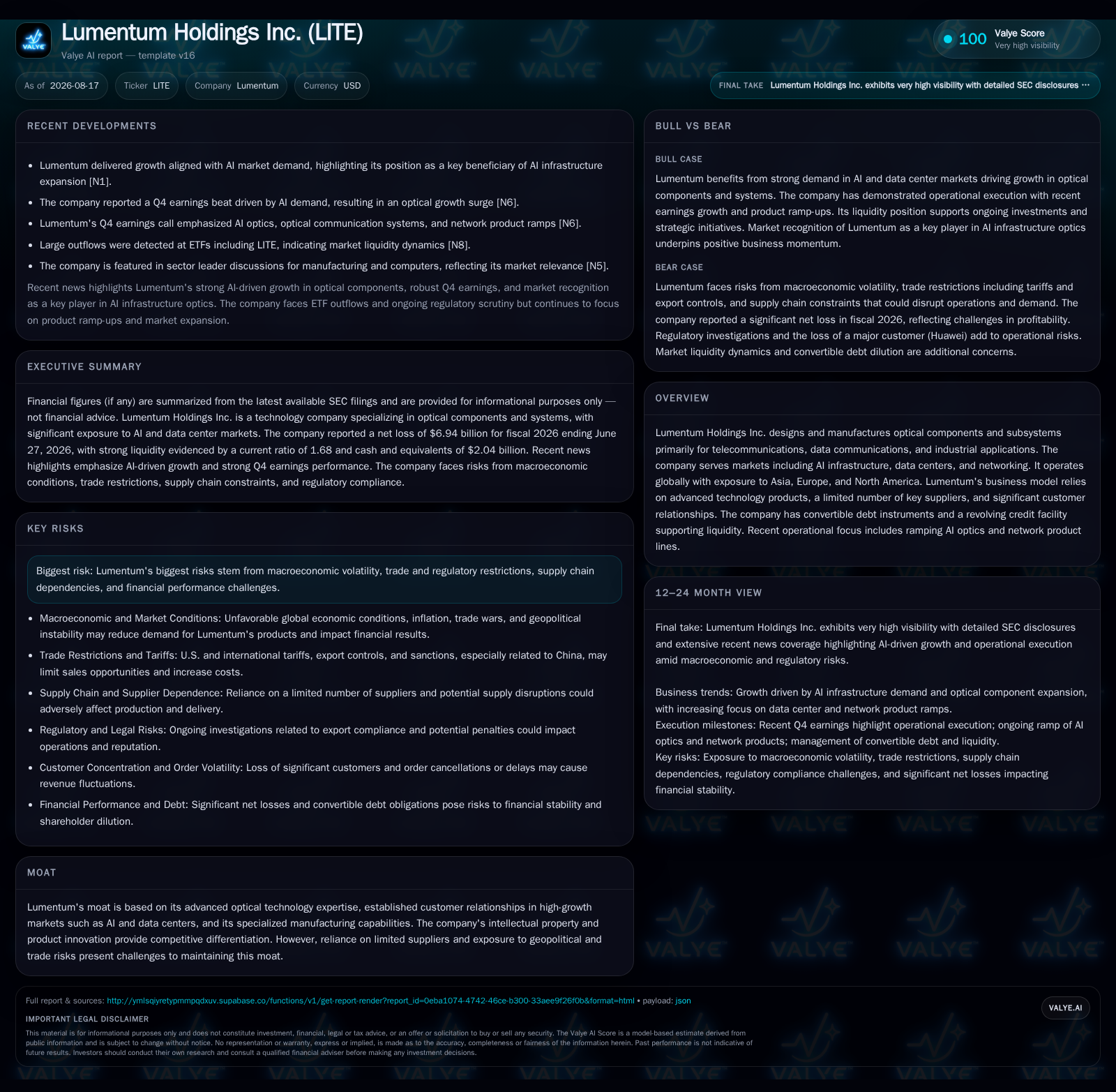
In its Q3 2026 filing, Lumentum Holdings Inc. revealed accelerating demand for AI optics and network product lines against a backdrop of constrained manufacturing capacity and supply chain challenges [S2]. The company’s business model hinges on advanced optical technology sold to a concentrated customer base in data centers and telecommunications, with innovation sustained through high R&D intensity [S1]. Industry-wide supply chain sensitivities and trade restrictions intensify operational risks, while Lumentum’s sizeable convertible debt portfolio supports its capital-intensive growth initiatives [F1]. Near-term growth depends on backlog conversion, capacity scaling, and managing intellectual property licensing obligations.
Q3 Operational Dynamics Highlight AI-Driven Demand Amid Capacity Constraints
Lumentum’s most recent quarterly filing dated May 6, 2026 (Q3 FY26) reveals a pronounced increase in shipments of AI optics products driven by hyperscale data center demand coupled with networking equipment growth [S2]. However, the company concurrently reports persistent supply chain constraints that restrict its overall capacity utilization. These constraints stem largely from reliance on a narrow base of specialized suppliers for critical components, translating into a backlog that is growing yet difficult to accelerate beyond current manufacturing throughput. This imbalance illustrates a classic tension in capital-intensive optical hardware manufacturing: surging demand outpacing the physical ability to produce complex subsystems at scale. The reconciliation of increased order volume versus limitations in yield rates and supplier lead times remains a key operational hurdle.
Moreover, delivery schedules have faced delays despite orders being firm; this is not unusual given tight supply chains affecting the entire optical sector but is an important metric linked directly to revenue recognition timing.
Core Business Model: Optical Innovation Meets Concentrated Markets
Lumentum designs and manufactures advanced optical components such as lasers for telecommunications infrastructure, photonic subsystems for data center interconnects, and increasingly specialized AI optics needed for accelerating bandwidth demands in machine learning workloads [S1]. Its revenues are generated predominantly through OEM contracts with a concentrated set of large buyers—hyperscale cloud providers and telecom equipment manufacturers—whose capital expenditure decisions heavily influence Lumentum’s volume trends. Customer concentration implies both opportunity for sizable wins but also risk related to negotiation leverage and order volatility.
Within the business model, recurring R&D investment forms the backbone for maintaining technology leadership. Lumentum dedicates a significant portion of sales to research and development aimed at sustaining product pipeline differentiation as new generations of optical hardware require finer integration and greater efficiency. This R&D spend helps mitigate competitive pressures from peers like Finisar Corporation or II-VI Incorporated which also strive for photonics innovation in overlapping markets.
Industry Structure: Managing Supply Chain Risks Amid High Entry Barriers
The broader optical components sector is characterized by high barriers to entry due to the complexity of manufacturing processes and necessity for highly specialized raw materials. Lumentum’s operations exemplify this with dependency on few suppliers for critical materials such as epitaxial wafers or precision machining services. Supply chain disruptions are thus particularly acute, influencing both short-term production yields and long-term capacity planning. Additionally, ongoing trade restrictions between the U.S., China, Thailand, and other regions inject uncertainty around tariffs, export controls, and logistics costs—each potentially increasing unit cost structures or constraining market access.
This environment necessitates proactive supplier relationship management and potential dual-sourcing strategies; however, given the technological specialization required components cannot be readily substituted without impacting quality or performance.
Leveraging Intellectual Property: Sustaining Moat Amid Competitive Pressure
Lumentum holds an extensive intellectual property portfolio that protects its technological innovations across lasers, modulators, detectors, and integrated photonic systems. This IP moat supports premium pricing power essential for margin maintenance amid competitive pressures. However, the company’s product offerings also incorporate licensed third-party technologies requiring continual renewal on commercially reasonable terms [S1]. The dependence on external technology licenses introduces exposure to potential cost increases or availability issues that could delay product development cycles or necessitate costly substitution investments.
Management has highlighted this risk explicitly as part of contractual obligations tied to technology licensing agreements. Maintaining effective disclosure controls around these agreements is critical since any lapses might adversely impact new product introductions.
Scaling Challenges in Manufacturing Capacity Utilization
Amid the surge in AI optics demand highlighted in Q3 filings, achieving optimized manufacturing yield rates remains challenging given supply shortages and equipment ramp timelines [S2; N2]. Incremental increases in production volumes require calibrated capital expenditures alongside workforce training and quality control enhancements. Any bottleneck in one segment cascades through assembly lines resulting in delivery delays or elevated defect rates.
While backlog volume serves as an important leading indicator of future revenue potential, its value depends materially on the company's success in ramping utilization ratios at constrained fabs. The margin profile is similarly sensitive since underutilized fixed costs dilute profitability during capacity-limited phases.
Growth Catalysts Defined by Data Center Expansion and AI Infrastructure Needs
The most compelling tailwind for Lumentum derives from structural growth drivers including expanding global data traffic demands fueled by cloud computing proliferation and hyperscale data centers aggressively deploying AI infrastructure requiring cutting-edge optics [S1; N1; N6; N7]. Additionally, ongoing 5G network rollouts necessitate upgraded telecommunications equipment embedding Lumentum’s laser modules.
Replacement cycles of legacy optical equipment also contribute incremental demand as existing networks modernize their interconnect technologies. These macro trends signal durable multi-year runway for photonic subsystem vendors who can navigate supply chain constraints while innovating effectively.
Risks in Supply Dependence, Trade Policy, Customer Concentration, and Technology Shifts
The company discloses multiple layers of risk likely to influence near-to-mid term results including macroeconomic volatility impacting customer spend levels particularly among large telecom operators or cloud providers [S1; S2]. Trade-related headwinds such as tariffs or export controls pose obstacles that can disrupt inbound raw materials sourcing or outbound product distribution.
Customer concentration risk remains notable given high revenue dependence on relatively few large purchasers whose procurement priorities can shift swiftly based on capital budgets or alternative technology adoption. Additionally, rapid technological change imposes relentless pressure on continuous R&D spending; failure to innovate timely may erode competitiveness.
Finally, supply chain interruptions—ranging from pandemic aftereffects to geopolitical uncertainties—threaten procurement lead times impacting manufacture schedules directly.
Monitoring Forward: Revenue Backlog Trends, R&D Pipelines, Capacity Expansion Milestones
Investors evaluating Lumentum should monitor booking trends closely including changes to order backlog volume which serve as signaling gauges of sustained demand [S2; S3]. Progress against internal milestones related to new product certifications especially in AI optics segments will validate innovation pace.
Capacity expansion initiatives require tracking both planned capital investments in fabrication upgrades along with reported manufacturing yield improvements necessary to convert backlog into revenue efficiently. Concurrently observing R&D expenditure levels relative to sales provides insight into ongoing commitment toward sustaining technological advantage.
Financial Profile Discussion: Convertible Debt Load Supports Aggressive Scaling
As of June 27, 2026, Lumentum held $2.04 billion in cash and equivalents against $40.5 million total debt excluding convertible instruments according to recent filings [F1]. However, its convertible senior notes principal sum totals approximately $1.55 billion spread across maturities through 2032 with related coupon interest obligations adding further cash flow considerations [S1]. Despite these sizable convertible obligations classified separately from traditional debt lines allowing some flexibility,
the company's current ratio stands at a healthy 1.68 reflecting ample short-term liquidity relative to current liabilities totaling $2.48 billion contrasted with $4.16 billion in current assets [F1]. This liquidity backdrop provides reasonable cushion enabling continued capital expenditure outlays critical for capacity ramp amid aggressive expansion targets.
Operating income recorded at approximately $525 million highlights solid core profitability but must be balanced against net losses influenced by non-operating charges including convertible instrument accounting effects [F1]. Overall financial health appears sufficient to support iterative investment cycles typical within industrial photonics sectors assuming stable operating cash flows going forward.
This analysis synthesizes publicly filed financial disclosures along with recent earnings commentary to evaluate Lumentum's evolving operational profile amidst dynamic industry conditions without extending investment research views.
Disclaimer: This is research-only, informational analysis and not investment advice. It may include AI-generated interpretation and general industry context. Always verify important details using primary sources.

Comments