
ADM Tronics Q2 2026: Operating Losses Amid Increased R&D and Marketing Investment
ADM Tronics reports revenue growth in Q2 2026 but records an operating loss driven by elevated expenses in marketing, production labor, and internal R&D.
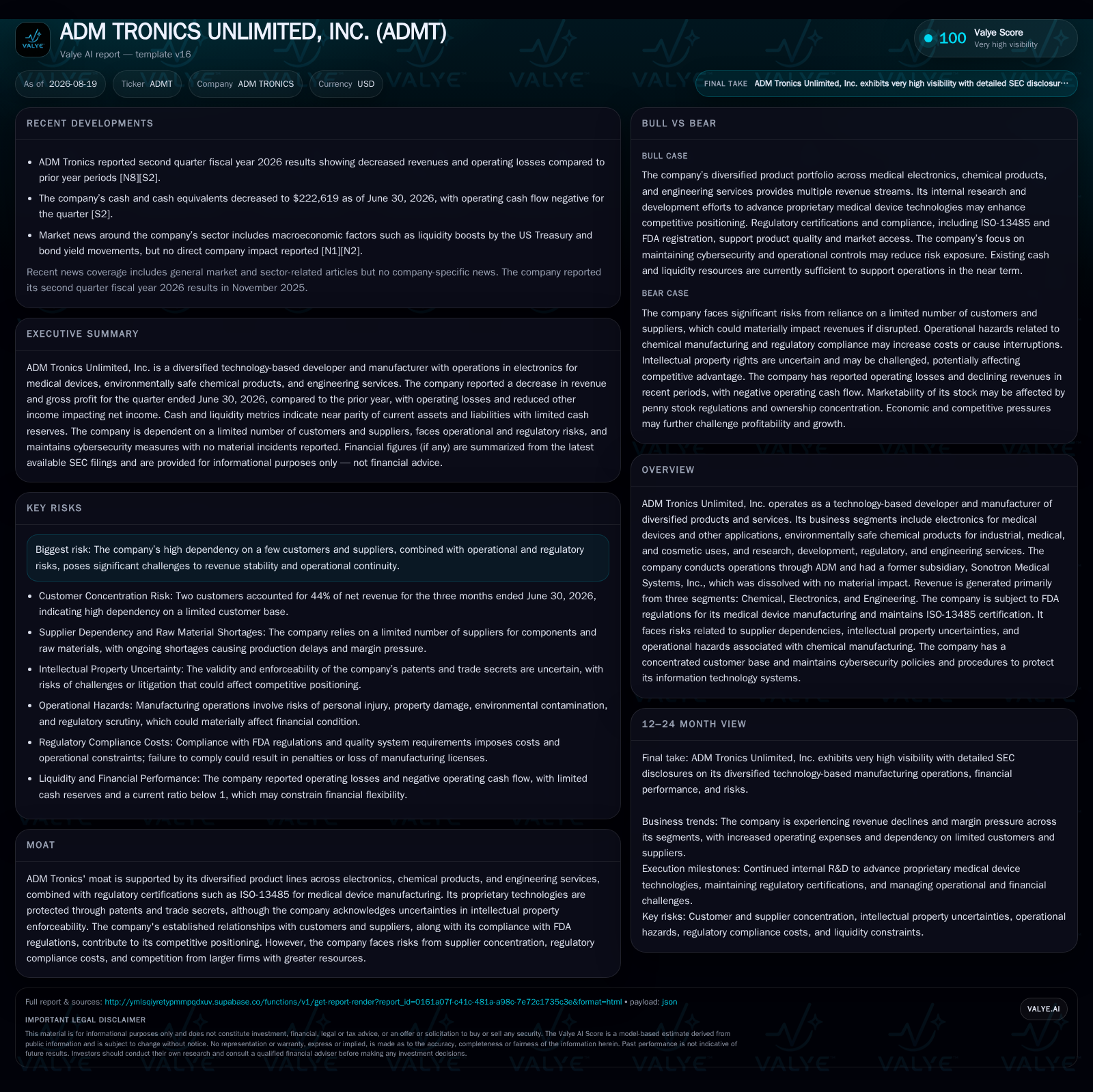
ADM Tronics Unlimited, Inc. posted Q2 2026 revenue of $866,255, reflecting growth across its Chemical, Electronics, and Engineering segments. Despite a gross profit margin of 46%, the company reported an operating loss of $20,655 due to higher operating expenses. Cash and equivalents declined by $33,111 to $222,619, with a current ratio of 0.96 indicating a slight working capital deficit. The company expects sufficient liquidity to fund operations for the next twelve months while investing strategically in innovation and market expansion.
Q2 2026 Operating Performance
ADM Tronics Unlimited, Inc. reported total revenue of $866,255 for the quarter ended June 30, 2026, driven by all three of its primary business segments: Electronics contributed the largest share, followed by Chemical products and Engineering services [S2]. The consolidated gross profit margin for the quarter was 46%, reflecting the segment mix with Electronics leading in margin [S2].
Operating expenses increased, reflecting higher spending in marketing, production labor, and internal research and development (R&D) efforts [S2]. These elevated operating costs outpaced gross profit, resulting in a net operating loss [S2].
Liquidity and Financial Position
At the end of Q2 2026, ADM Tronics held cash and cash equivalents totaling $222,619, down by $33,111 from $255,730 at March 31, 2026 [S2][F1]. The decline primarily stemmed from net cash used in operating activities amounting to $32,959, driven by increases in accounts receivable and inventory levels that outpaced growth in accounts payable [S2]. This working capital dynamic contributed to a current ratio of 0.96 as of June 30, 2026, indicating that current liabilities slightly exceeded current assets [F1].
While a current ratio below 1.0 can signal short-term liquidity constraints, ADM Tronics expects to maintain sufficient liquidity to fund its operations for the next twelve months [S2][F1]. This expectation is supported by the company’s cash position and the anticipation of net cash provided by operating activities, underpinned by its historical revenue base and ongoing customer relationships.
Business Model and Strategic Investments
ADM Tronics operates a diversified technology-based business model, generating revenue from three main sources: the production and sale of electronics for medical devices and other applications; environmentally safe chemical products for industrial, medical, and cosmetic uses; and research, development, regulatory, and engineering services [S1][S2]. Revenue recognition varies by segment. Electronics and chemical product revenues are recognized upon shipment to customers, while engineering services revenue is recognized monthly over time as performance obligations are fulfilled [S1]. The company offers limited warranty obligations on its electronics products, which historically have been minimal in cost [S1].
Margins differ by segment, with the Electronics segment generally yielding higher margins, as reflected in the 56% gross margin reported for Q2 2026 [S2]. The company’s capital allocation in the quarter prioritized increased marketing expenditures, production labor costs, and internal R&D investments over short-term profitability, reflecting a strategic emphasis on innovation and growth [S2].
Risks and Competitive Positioning
ADM Tronics’ competitive positioning is supported by regulatory certifications such as FDA and ISO-13485, proprietary medical device technologies, and a diversified product portfolio spanning electronics, chemicals, and engineering services [S1]. These factors provide some structural resilience within the industrial manufacturing and services sector.
However, the company faces operational risks including supplier concentration, regulatory compliance costs, and environmental regulations associated with chemical manufacturing. Additionally, the working capital deficit indicated by the current ratio of 0.96 introduces a liquidity watchpoint [F1]. The company’s ability to convert R&D and marketing investments into profitable revenue growth will be critical to mitigating these risks.
Scenario Analysis and Outlook
One possible positive scenario is that ADM Tronics’ increased investments in R&D and marketing successfully lead to new product development and customer acquisition. This could enable sustainable revenue growth and margin expansion in future quarters, supported by proprietary medical device innovations and effective marketing translating into higher sales [S2][S1]. Confirmation of this scenario would include accelerating quarterly revenue growth, improving gross and operating margins, and positive operating cash flow trends.
Conversely, if the increased operating expenses do not generate sufficient revenue growth, the company may face ongoing operating losses and liquidity pressures. Given the current ratio of 0.96 and the recent decline in cash by $33,111, failure to convert investment spending into profitable sales could necessitate external financing or operational restructuring [S2][F1]. The company’s revenue growth across diversified segments and solid gross margins are offset by increased operating expenses related to marketing, production labor, and internal R&D, resulting in an operating loss [S2]. The decline in cash and a current ratio of 0.96 highlight working capital management challenges, but the company has sufficient liquidity to sustain operations for the next year [F1].
Key watchpoints for assessing ADM Tronics’ trajectory include monitoring quarterly revenue growth by segment, operating income trends, cash flow from operations, working capital dynamics, and progress in proprietary medical device R&D and commercialization efforts. These indicators will provide insight into whether the company’s investments translate into sustainable financial performance and improved liquidity.
Disclaimer: This is research-only, informational analysis and not investment advice. It may include AI-generated interpretation and general industry context. Always verify important details using primary sources.

Comments