
Vivakor Q2 2026: Liquidity Challenges Amid Integrated Midstream Operations
Vivakor's Q2 2026 financials reveal a severe working capital deficit despite its diversified midstream platform and long-term contracts.
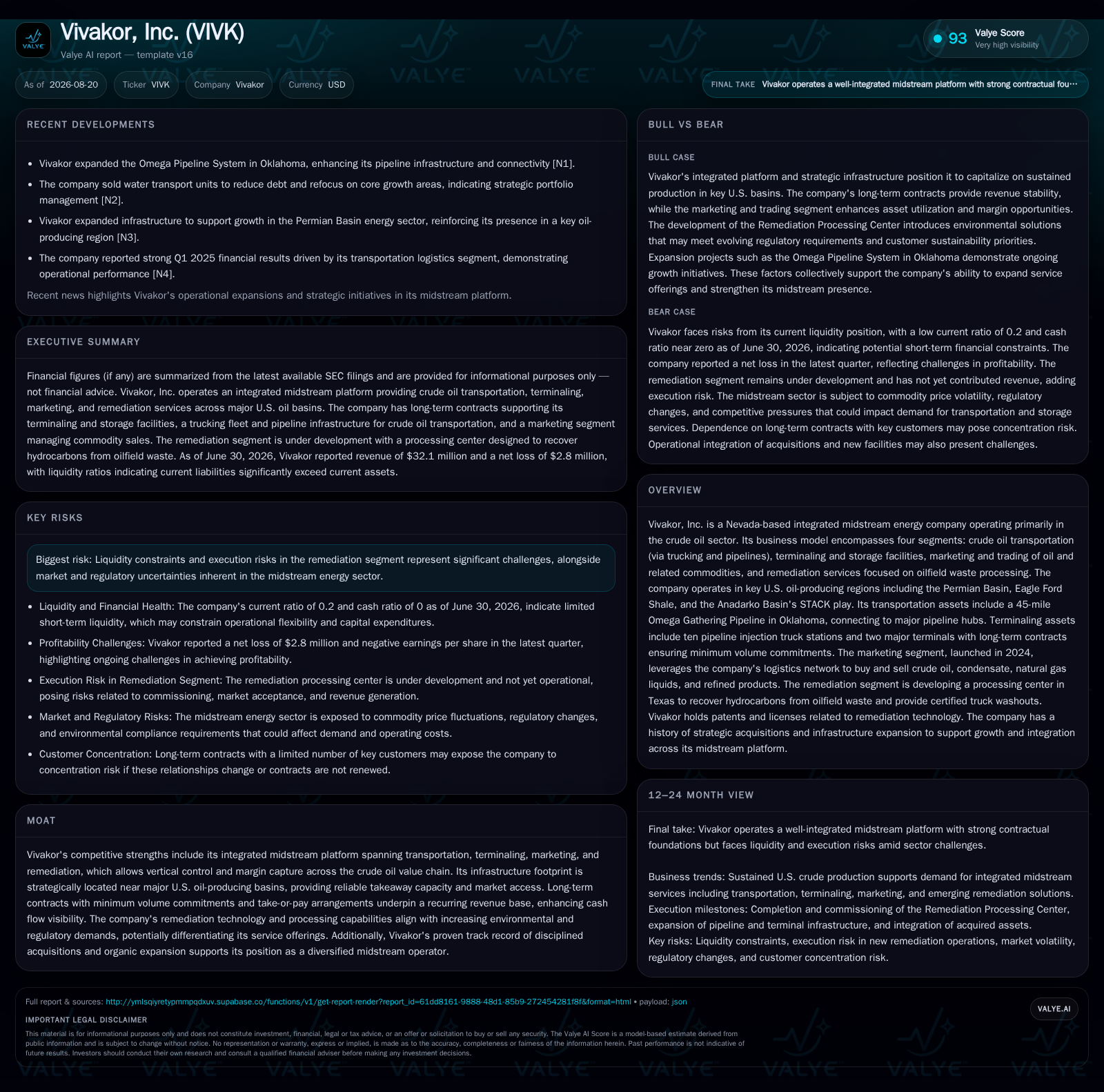
Vivakor, Inc. reported a current ratio of 0.2 as of June 30, 2026, with current liabilities of $72.5 million far exceeding current assets of $14.2 million, highlighting significant liquidity constraints. Cash and cash equivalents stood at only $257 thousand, limiting near-term operational flexibility. The company's integrated midstream platform, encompassing crude oil transportation, terminaling and storage, marketing and trading, and remediation services, provides structural revenue support through long-term contracts with minimum volume commitments. However, execution and liquidity risks in the remediation segment contribute to financial pressures. How Vivakor manages these liquidity challenges alongside its contract-backed revenue streams will be critical in the coming quarters.
Vivakor, Inc. reported liquidity constraints in its Q2 2026 financial results, with a current ratio of 0.2 as of June 30, 2026, reflecting a working capital deficit where current liabilities of $72.5 million significantly exceeded current assets of $14.2 million [F1]. This financial position highlights acute near-term stress that could limit Vivakor's ability to fund operations and meet short-term obligations without external financing, despite its integrated midstream platform and long-term contracts [S2]. The company’s minimal cash balance of $257 thousand at quarter-end further underscores the constrained liquidity environment [F1].
Q2 2026 Liquidity and Working Capital Analysis
The stark imbalance between current liabilities and assets highlights Vivakor’s liquidity pressures [F1]. This situation constrains operational flexibility and increases risk of financial distress if unexpected expenses arise or revenue inflows are delayed. The low cash balance further restricts the company’s ability to absorb shocks or invest in growth initiatives without securing additional funding [F1].
Vivakor’s working capital deficit is a critical financial metric indicating that the company’s short-term obligations exceed its readily available resources. As of June 30, 2026, the current ratio is 0.2, substantially below the generally accepted threshold of 1.0, signaling that the company may face challenges in meeting its immediate liabilities through existing current assets [F1]. This condition can lead to increased borrowing costs or the need to seek alternative financing sources, which may be dilutive or restrictive.
Cash reserves serve as a buffer to manage operational expenses, capital expenditures, and unforeseen costs [F1]. Vivakor’s minimal cash position suggests a narrow margin for error and heightens the importance of effective working capital management and contract enforcement to maintain operational continuity
Integrated Midstream Business Model and Revenue Stability
Vivakor operates an integrated midstream platform serving crude oil producers and marketers through four principal segments: crude oil transportation, terminaling and storage, marketing and trading, and remediation services [S1]. Revenue is primarily generated from contracts for transportation and storage services, commodity marketing margins, and fees from oilfield waste remediation. The company’s business model benefits from long-term contracts with minimum volume commitments, which underpin recurring revenue streams and provide a degree of cash flow visibility despite the near-term liquidity challenges [S1].
The integrated nature of Vivakor’s platform enables vertical margin capture across the crude oil value chain, leveraging its strategic asset footprint near major U.S. oil basins [S1]. This diversification across service segments can help stabilize revenue and margins by offsetting volatility in any single area. For example, transportation and storage contracts often include minimum volume commitments or take-or-pay provisions, which help secure steady revenue inflows even during periods of fluctuating commodity prices or production volumes.
Marketing and trading activities contribute additional margin opportunities by capitalizing on price differentials and market dynamics, while remediation services address environmental compliance and waste management needs for oilfield operations [S1]. However, the remediation services segment introduces execution and liquidity risks that contribute to the overall financial pressure on the company. This segment’s operational complexity and regulatory exposure can lead to variable costs and potential delays in cash collection, impacting overall cash flow stability
The company’s reliance on long-term contracts with minimum volume commitments provides structural revenue stability that partially mitigates liquidity risks. These contracts create a predictable revenue base, which is essential for managing working capital and planning capital expenditures. The company’s ability to meet short-term obligations without dilutive financing or operational disruptions is uncertain given the current liquidity profile [F1]. The remediation segment’s execution risks may exacerbate cash flow pressures, increasing the likelihood of financial strain.
Two primary scenarios illustrate the potential near-term trajectories for Vivakor:
- Bear Scenario: Vivakor’s liquidity constraints worsen, leading to operational disruptions or the need for dilutive financing. This scenario is plausible if the company continues to experience negative working capital trends, fails to secure additional financing or improve cash flow, or faces adverse market or regulatory developments impacting volumes or pricing. Long-term contracts provide revenue visibility, and the company's strategic asset footprint supports stable operations; management may optimize working capital and control costs. This scenario requires stable or improving contract volumes, effective working capital management, and no significant adverse regulatory or market shocks.
These scenarios underscore the importance of monitoring Vivakor’s liquidity metrics and operational execution closely. The remediation services segment, while strategically important, represents a key risk factor due to its complexity and potential for cash flow volatility.
Business Economics and Industry Context
In the integrated midstream energy sector, companies generate revenue primarily through fee-based contracts for transportation and storage, commodity marketing margins, and environmental remediation fees. Customers—typically upstream producers and marketers—pay for reliable logistics and waste processing services. The sector is capital intensive with significant fixed assets and long-term contracts that provide revenue visibility but also require careful working capital and liquidity management.
Vivakor’s strategic asset footprint near major oil basins and integrated service offering allow it to capture margins vertically along the crude oil value chain. Contract structures featuring minimum volume commitments and take-or-pay terms underpin revenue stability. However, the working capital intensity and execution risks, especially in remediation services, constrain liquidity and increase financial risk. Monitoring key performance indicators such as contract renewal rates, volume commitments, and cash conversion cycles will be critical to assessing Vivakor’s financial trajectory.
The company’s business economics depend heavily on maintaining high utilization of its transportation and storage assets, as well as effective marketing and trading operations that can generate incremental margin. The remediation segment, while providing diversification, introduces variability in cash flow due to regulatory compliance cycles and project execution timelines. This mix of stable contract-based revenue and variable remediation fees creates a complex cash flow profile that requires disciplined financial management.
Watchpoints
Investors and stakeholders should closely monitor Vivakor’s subsequent quarterly filings for trends in liquidity ratios and cash balances to assess whether liquidity constraints ease or worsen. Contract renewal announcements and volume commitments will provide insight into the stability of revenue streams. Any capital raising or refinancing activities will be important signals of the company’s ability to address its working capital deficit without excessive dilution. Finally, operational updates on the remediation segment will be key to understanding execution risks and their impact on cash flow.
While its integrated midstream platform and long-term contracts provide structural revenue support, the near-term financial stress and remediation segment risks pose material challenges. How the company balances these factors will shape its operational and financial outcomes in the coming quarters.
Disclaimer: This is research-only, informational analysis and not investment advice. It may include AI-generated interpretation and general industry context. Always verify important details using primary sources.

Comments