
Bridgeline Digital’s AI-Powered SaaS Platform Faces Liquidity Constraints and Intensifying Competition
Bridgeline Digital’s recent quarter highlights ongoing innovation in AI-driven marketing software amid tightening liquidity and a challenging renewal landscape.
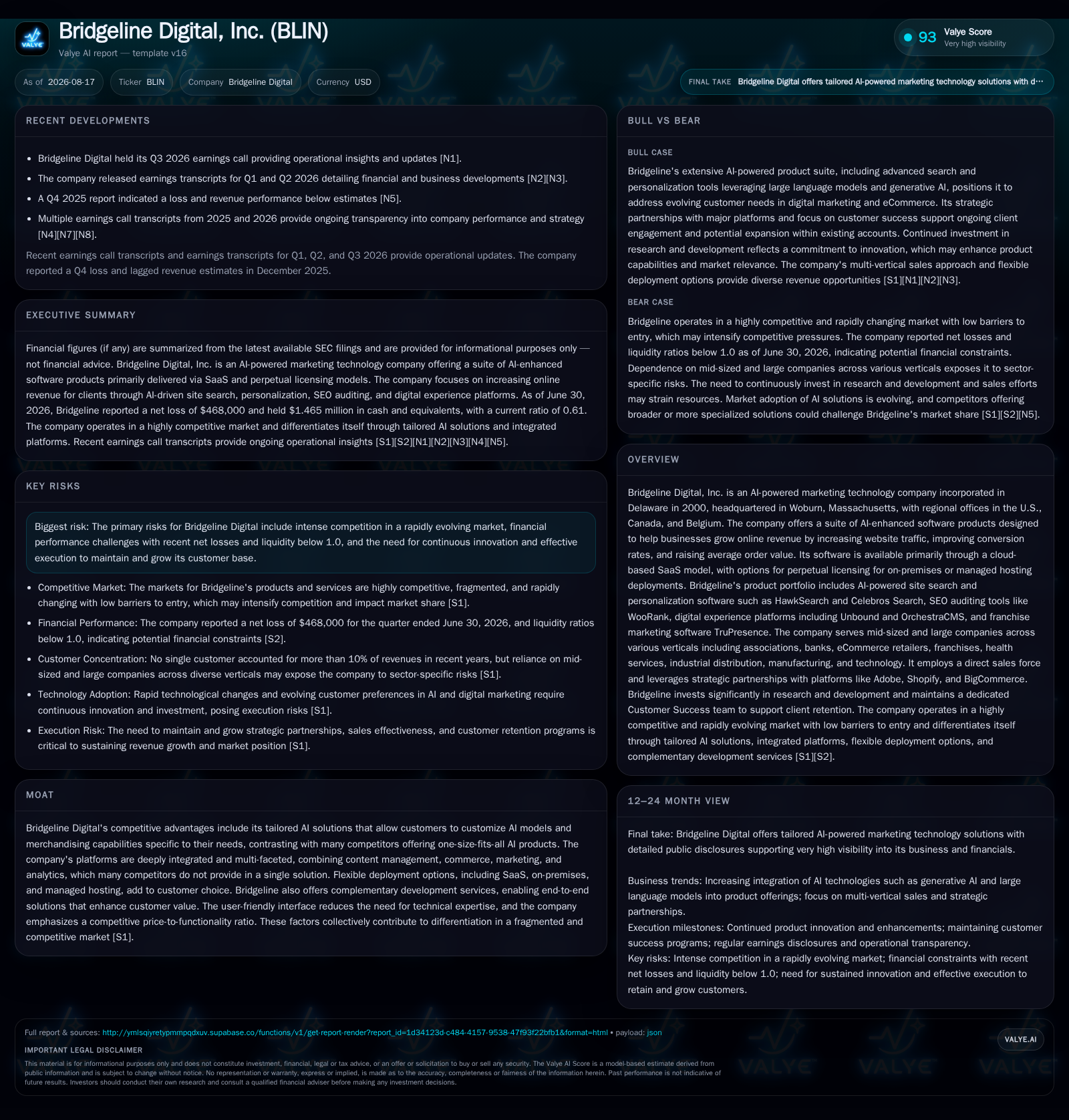
Bridgeline Digital continues to advance its AI-enhanced digital marketing platform, emphasizing customizable AI features and flexible deployment options. However, the company remains unprofitable with constrained liquidity, a low current ratio, and persistent net losses, raising concerns about financial sustainability. The competitive environment is fragmented and intensely pressured by larger players and niche specialists, underscoring the need for Bridgeline to maintain high license renewal rates and accelerate customer acquisition. Key near-term focus includes managing sales cycle variability, sustaining R&D momentum, and leveraging its AI differentiation to improve recurring revenue stability.
Recent Operating Update Highlights
While short-term financial health warrants cautious scrutiny, Bridgeline continues executing on product innovation and market competitiveness through expanded AI capabilities.
Business Model Nuances
Bridgeline operates primarily in the Software as a Service (SaaS) segment within digital marketing technology but also offers perpetual licenses for on-premises or managed hosting deployments [S21][S27]. Revenue is driven largely by subscription license fees for its core platforms — notably HawkSearch (site search & personalization) and Celebros Search — which harness cutting-edge artificial intelligence such as Generative AI (GenAI), Retrieval Augmented Generation (RAG), Large Language Models (LLMs), and others designed to increase web traffic conversion rates and average order values [S1]. These subscriptions are typically sold to mid-sized and large enterprises across diverse verticals including retail eCommerce, banking, manufacturing, franchising, and healthcare [S21].
Complementing software licenses are professional services like custom development, integration support, SEO audits via WooRank tools, digital experience platform deployments (Unbound/OrchestraCMS), and hosting arrangements partnering with AWS infrastructure providers [S21][S22]. This creates scope for upselling integrated solutions beyond stand-alone products.
Given the SaaS orientation, recurring revenue stability hinges critically on license renewal rates that have historically been subject to fluctuation due to customer satisfaction levels and shifting IT budget priorities [S1]. Sales cycles are described as lengthy and variable because implementations often involve complex enterprise workflows requiring significant mutual resource investment, leading to possible quarterly volatility in revenue recognition.
Industry Structure & Competitive Positioning
The digital marketing technology space Bridgeline inhabits is notably fragmented but highly competitive with pressures stemming from both niche innovators specializing in discrete functions such as site search (Algolia, Elastic) and large integrated platforms like Adobe Experience Cloud or Salesforce Marketing Cloud offering end-to-end commerce-personalization-suite ecosystems [S20][S25].
Bridgeline’s distinguishing factors center on its "tailored AI" approach allowing customers extensive configuration of merchandising rules powering search accuracy and user personalization — contrasting with many competitors offering more generic "one size fits all" AI solutions lacking configurability [S20]. Additionally, their multi-faceted platform approach uniquely integrates content management, commerce capabilities, analytics reporting tools with seamless professional services wrapped around cloud or on-premise deployment options enabling customer choice based on IT preferences or data sensitivity requirements [S20][S25].
This breadth strengthens customer lock-in through ecosystem adoption but requires continuous innovation given low entry barriers in cloud software markets coupled with downward pricing pressures fueled by larger competitors aggressively scaling offerings.
Growth Drivers
Central growth catalysts include accelerating adoption of AI-powered personalization technologies that improve conversion rates—a priority for eCommerce merchants particularly amid intensifying online competition—and a migration trend from legacy on-premises systems toward cloud-native SaaS platforms facilitating scalability and remote manageability.
Bridgeline’s recent rollout of nine specialized AI-powered HawkSearch modules such as Smart Search leveraging LLMs combined with image search functionalities directly responds to industry demand for omni-channel consumer engagement tools [S1]. Expansion into generative AI agents assisting backend merchandising analytics or shopper interaction automation helps reduce client operational costs while enhancing user shopping experiences.
Cross-selling capabilities among their product suite — spanning site search engines to franchise marketing software — paired with proactive Customer Success practices aimed at reducing churn underpin potential ARR acceleration. Targeting specific verticals known for technology spend such as financial services or health/life sciences also supports pipeline visibility.
Risks & Watchpoints
Despite technological strengths, Bridgeline faces amplified risks from: intense competition possibly leading to price cuts; customer churn impacting recurring revenue stability; sales cycle intermittency creating revenue unpredictability; concentration among key clients where non-renewal would disproportionately hurt top line; regulatory shifts affecting data privacy compliance obligations; cybersecurity threats requiring ongoing capital commitment; plus liquidity constraints limiting runway for R&D scaling or sales expansion investments [S1][S20]
The company has recorded consistent net losses extending years back with an accumulated deficit exceeding $90 million — highlighting structural profitability challenges [S3][S16]. Moreover, the recent balance sheet exposes cash insufficient relative to short-term obligations raising funding dependency risk despite the new ATM stock sale facility which carries dilution risk if deployed aggressively.
Furthermore, capturing sustained market share amid entrenched competitors with larger budgets necessitates effective execution in product innovation cadence maintaining differentiation especially around tailored AI capabilities where competitors also invest heavily.
What to Watch Next
Key performance indicators include license renewal rates closely linked to recurring revenues reflective of customer satisfaction; metrics around churn reduction effectiveness via customer success programs; new bookings volume as proxy for sales cycle progression; incremental ARR growth from upsell of enhanced AI modules; gross margin evolution specifically from SaaS/cloud revenue mix expansion signaling scalability improvements; alongside consistent containment or reduction of operating losses indicating path toward profitability.
Capital allocation trends merit attention given the reliance on equity capital raises for working capital needs—monitor timing/size of ATM share issuances affecting dilution pressure. Tracking adoption rates for cutting-edge solutions such as Agentic AI agents or concept/image search would signal competitive advantage sustainability.
Additionally, macroeconomic influences altering enterprise IT budgets remain relevant since pullback could exacerbate existing renewal headwinds.
Financial Profile Discussion
Bridgeline’s financial position evidences significant strain at quarter-end June 30, 2026. Cash balances stood at $1.46 million against $5.33 million in current liabilities yielding a suboptimal current ratio near 0.61 that flags potential liquidity stress should operating cash burn continue unchecked without fresh inflows or cost containment measures [F1]. Total reported debt metrics are not updated in recent filings; prior snapshots suggest leverage but no new meaningful borrowing has been disclosed post-2018.
Operating income remained negative per most recent reported annuals underscoring persistent unprofitability typical in SaaS firms balancing growth investment versus margin expansion imperatives [F1]. Continued R&D spending averaging over one-quarter of revenues demonstrates commitment to staying competitive yet constrains free cash flow generation currently. The newly executed Sales Agreement with WestPark established an ATM equity offering channel which provides flexibility for opportunistic capital raises albeit implicates shareholder dilution risks if accessed extensively. Strong management focus on cash conservation alongside R&D prioritization will be crucial for bridging towards break-even operations.
This analysis synthesizes publicly filed SEC documents through August 2026 along with sector expertise in SaaS digital marketing platforms. It aims to provide an informed overview of Bridgeline Digital’s operating environment without endorsing any investment decision.
Disclaimer: This is research-only, informational analysis and not investment advice. It may include AI-generated interpretation and general industry context. Always verify important details using primary sources.

Comments