
Harmonic’s Shift to Software-Driven Broadband Focus Post Video Business Sale
The sale of Harmonic's Video segment sharpens its focus on broadband access software amidst industry pressures and customer concentration risks.
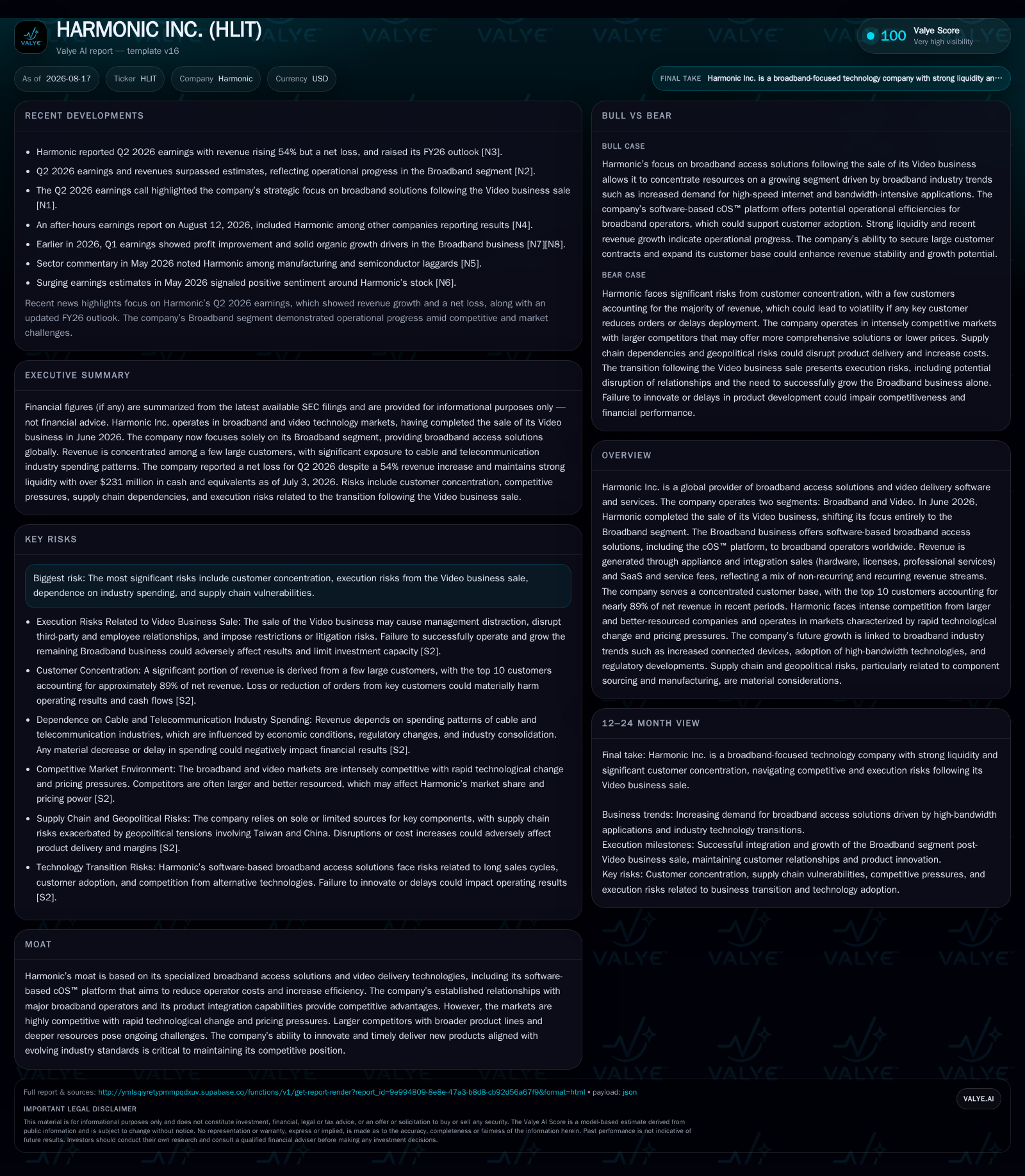
In Q2 2026, Harmonic completed the divestiture of its Video business, transitioning wholly to broadband access solutions centered on its cOS™ platform. This strategic pivot aligns with broader telecom industry trends favoring software-defined network access but raises risks regarding customer concentration and execution on technology transitions. The company's revenue model balances hardware appliance sales, licenses, and growing SaaS-based recurring fees, serving a concentrated yet global operator customer base. Financially, Harmonic maintains strong liquidity and covenant compliance post-transaction, though its future hinges on sustaining innovation and managing competitive pressures from larger vendors.
Recent Operating Update: Strategic Shift Reflected in Q2 2026
Harmonic Inc.’s latest quarterly filing dated August 17, 2026 ([S2]) confirms the completion in June 2026 of the sale of its Video business segment to Leone Media Inc., marking a clear strategic pivot to concentrate solely on its Broadband access solutions. This divestiture repositions Harmonic as a more focused player in broadband infrastructure software, shedding video delivery operations that historically contributed materially to revenues. The immediate consequence is a reshaped revenue profile now anchored exclusively by broadband-oriented products and services.
Business Model: Software-Centric Broadband Solutions with Mixed Revenue Streams
Post-sale, Harmonic's business revolves around its Broadband segment delivering software-based broadband access platforms globally. At its core is the cOS™ platform—a software-defined networking solution enabling telco operators to virtualize network functions traditionally carried out by dedicated hardware equipment ([S1]).
Harmonic monetizes through a multi-channel approach: appliance and integration sales comprising hardware units bundled with software licenses and professional services constitute a significant portion of non-recurring revenue; concurrently, SaaS subscriptions and ongoing service fees generate recurring streams contributing margin stability ([S1],[S2]). This hybrid revenue architecture echoes broader telecommunications infrastructure industry models where customers balance upfront capital expenditures against longer-term operational cost efficiencies.
The value proposition centers on enabling operators to reduce CAPEX via virtualization (NFV) while improving network agility through SDN principles. However, this model requires continuous innovation in software capabilities to keep pace with rapid technology shifts in broadband networking standards and architectures.
Industry Structure and Competitive Position
Operating within telecommunications infrastructure software, Harmonic faces stiff competition from established giants such as Cisco Systems (network infrastructure and software platforms), Arris International (broadband access hardware), and CommScope (cable network infrastructure), who benefit from broader product portfolios and deeper R&D budgets. Additionally, specialized SDN/NFV-focused software vendors—though smaller scale—pose technology innovation threats ().
Harmonic’s moat derives primarily from specialized broadband access solutions tailored to cable and telco operators alongside longstanding relationships with major clients. Its ability to integrate multiple network functions into centralized software management offers efficiency gains attractive amid global demand growth for high-speed broadband connectivity.
However, sustained pricing pressures from commodity-like hardware components combined with aggressive software pricing by large vendors compress margins. Moreover, technology transitions towards cloud-native edge computing require accelerated time-to-market capabilities—which remain vital operating KPIs for securing competitive footholds ().
Growth Drivers
Global trends underpinning potential growth include increasing fiber rollouts by telecom operators modernizing legacy infrastructure necessitating advanced broadband access platforms ([S1]). The shift away from legacy hardware towards virtualized networks boosts demand for platforms like cOS™, especially as operators seek SaaS-based managed services models for flexibility.
Further catalysts come from regulatory-led broadband expansions in emerging markets and rising backhaul infrastructure needs associated with widespread 5G deployments. Increasing video streaming consumption also indirectly supports underlying broadband capacity upgrades despite Harmonic’s exit from direct video delivery solutions.
Repeated emphasis on R&D spending—approximately 21-23% of revenues ([S25])—reflects investment into technology development aligned with evolving industry standards including SDN/NFV enhancements.
Risks and Watchpoints
Customer concentration remains a critical risk vector; top 10 customers represented about 89% of net revenue recently ([S28],[S2]), making Harmonic vulnerable to order timing fluctuations or contract renewals by few large telecom operators. Further consolidation among these customers could exacerbate this exposure.
Execution uncertainties loom large around the Video segment divestiture impact—both from diverted managerial bandwidth during transition phases and the risk of under-delivering on post-sale growth plans focused solely on Broadband. Any delays or shortcomings in rolling out new product generations could impair competitive positioning amid rapidly shifting technology paradigms ([S2]).
Supply chain vulnerabilities remain pertinent given reliance on select suppliers for key components integrated into appliance products ([S2]), while geopolitical exposure stemming from operations in Israel and outsourced development resources in Ukraine introduces additional operational risk layers ([S2]).
Pricing pressure threatens gross margins especially against larger diversified competitors capable of underwriting aggressive pricing or bundling. Maintaining recurring SaaS revenue growth is therefore key to margin improvement.
What to Watch Next
Investors should monitor several near-term operational markers:
- Execution progress on scaling SaaS-based broadband platform adoption vs traditional appliance sales,
- Customer spending patterns in cable/telecom sectors given economic cyclicality,
- New product release cadence aligned with SDN/NFV standards transitions,
- Retention rates among top customers amidst consolidation,
- Operating cash flow trends post-divestiture indicating effective capital allocation,
- Adjustments in operating margins reflecting mix shifts toward higher-margin SaaS offerings ([N1],[N2],[N3],[S2]).
Continued quarterly disclosures will reveal how well Harmonic balances these factors alongside maintaining robust financial health.
Financial Profile Discussion
As of July 3, 2026, Harmonic reported a robust liquidity position highlighted by cash and equivalents totaling approximately $231.9 million against current liabilities around $136.9 million resulting in a healthy current ratio near 3.05 ([F1]). Such liquidity affords flexibility to fund ongoing R&D efforts critical for sustaining competitiveness without immediate refinancing concerns.
Total debt remains relatively modest at about $10.5 million based on latest available data ([F1]), keeping leverage low amid a capital-intensive industry where significant engineering investment is required.
The company’s focus on balancing CAPEX spending with operational expenses ties directly to cash flow sustainability as it invests heavily in broadband software innovation while executing the post-divestiture transition plan under tight cost controls.
Continued vigilance over operating earnings volatility typical in this sector will be necessary as cyclical telecom spending intersects transformational technology shifts impacting topline consistency.
This analysis synthesizes publicly filed documents up to August 2026 without recommending any investment action. It emphasizes factual details combined with contextual industry insights relevant for understanding Harmonic’s repositioned business trajectory within telecommunications infrastructure software.
Disclaimer: This is research-only, informational analysis and not investment advice. It may include AI-generated interpretation and general industry context. Always verify important details using primary sources.

Comments