
ENvue Medical Faces Nasdaq Listing Pressure While Advancing Navigation-Enabled Feeding Tube Commercialization
The latest quarterly filing highlights ENvue Medical’s Nasdaq compliance challenges amid early-stage commercialization of its FDA-cleared navigation-enabled enteral feeding system, underscoring critical operational and financial dynamics shaping near-term prospects.
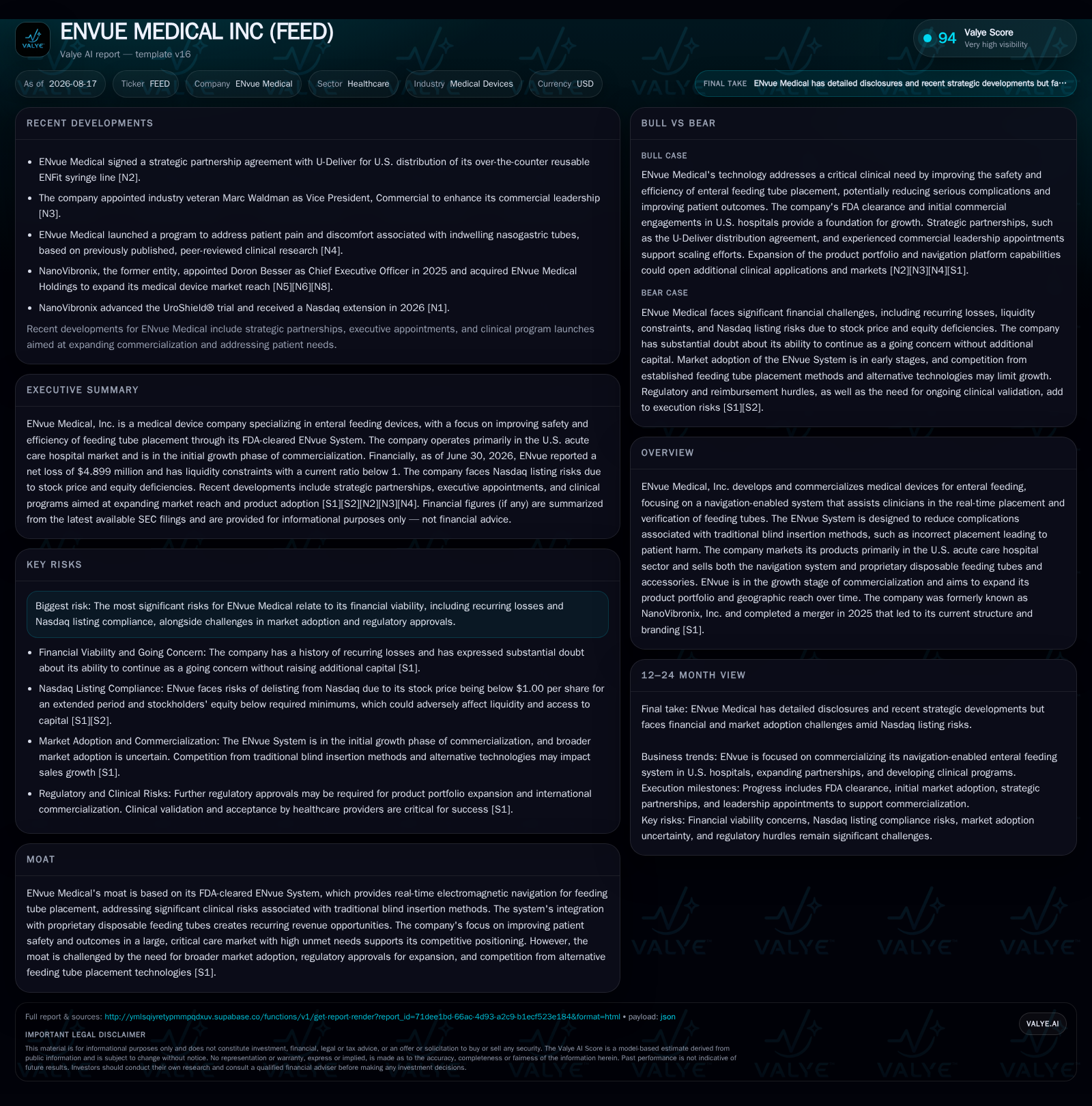
ENvue Medical’s August 2026 update reveals significant risk of Nasdaq delisting due to sustained stock price non-compliance following recent reverse stock splits, threatening capital access. Concurrently, the company progresses in commercializing its FDA-cleared navigation system for enteral feeding tube placement, engaging multiple U.S. hospitals and initiating proprietary disposable consumable sales. The dual revenue model combining capital equipment with recurring disposables underpins growth potential, though adoption hurdles, regulatory complexities, and liquidity constraints temper outlook. Key focus areas include hospital adoption metrics, regulatory approvals, and financial runway management.
Nasdaq Listing Risk Amplifies Financial Uncertainty
ENvue Medical’s August 2026 quarterly filing reveals a significant threat to its Nasdaq listing due to failure to maintain the minimum bid price of $1.00 per share over a continuous 30-business-day period from May through July 2026 [S2]. Unlike typical cases where companies receive a 180-day cure period to regain compliance, ENvue is disqualified from this relief because it executed reverse stock splits within the prior year—specifically a 1-for-11 split in March 2025 followed by a 1-for-10 split in August 2025—that reduced share count but did not elevate share price above the threshold sustainably [S1,S2].
This situation constrains market liquidity and investor confidence while complicating access to equity capital needed to fund ongoing operations. The company has appealed for continued listing before the Nasdaq Listing Qualifications Panel but acknowledges uncertainty regarding the outcome [S2]. The looming delisting risk exacerbates perceived investment risk and could impair business development opportunities dependent on public market visibility.
Commercialization Advances Amid Early Adoption
Post-merger rebranding in late 2025 positioned ENvue as a specialized medical device company focused on commercializing an FDA-cleared navigation-enabled system for enteral feeding tube placement targeted at adult patients in acute care hospitals [S1]. This system addresses critical patient safety issues inherent in traditional blind insertion techniques by employing real-time electromagnetic guidance during tube placement procedures—a key differentiator aligned with clinical priorities in intensive care units.
The company has established commercial engagements with several U.S. hospitals conducting multi-site evaluations aimed at validating clinical efficacy and fostering adoption [S1,S2]. These deployments serve as leading indicators for hospital penetration rates—a crucial KPI given that installed base growth directly correlates with consumable disposable feeding tube usage driving recurring revenues.
While specific unit sales or procedure volumes are undisclosed, incremental growth in installed systems alongside proprietary disposable sales aligns with typical medtech commercialization trajectories involving prolonged sales cycles due to hospital procurement complexity and clinical validation requirements. ENvue supports adoption via targeted clinical education programs directed at intensivists and nursing staff to accelerate integration.
Dual Revenue Model: Capital Equipment Paired with Proprietary Consumables
ENvue’s business model follows industry norms where initial revenue derives from selling capital equipment—the navigation system cleared by the FDA—while sustainable margins depend on ongoing sales of proprietary single-use disposable feeding tubes used per procedure [S1]. This creates embedded switching costs through device integration and clinician training investments that encourage repeat consumable purchases tied to patient volume.
This model leverages recurring consumable sales as a predictable revenue stream once sufficient hospital penetration is achieved; however, margin sustainability depends on pricing power vis-à-vis hospital group purchasing organizations which often exert downward pressure on disposable pricing. Additionally, product reliability affecting failure or complication rates influences customer retention critical for long-term profitability.
Regulatory Foundations and Market Access Challenges
Obtaining FDA 510(k) clearance for the ENvue System established foundational market legitimacy within the United States as a class II medical device intended for aiding qualified operators in adult enteral feeding tube placements [S1]. This clearance facilitates provider acceptance and supports reimbursement eligibility under relevant Medicare coding.
Nonetheless, promotional claims are currently limited by clearance indications; expansion into pediatric populations or novel applications requires further regulatory submissions involving uncertain timelines and expenses. International market expansion faces delays due to fragmented foreign regulatory frameworks compounded by notified body capacity constraints under updated EU MDR regulations—factors that may impede timely European commercialization [S8]
Reimbursement complexities remain pivotal; although CMS coding supports Medicare coverage, negotiated payor rates may limit commercial upside if providers find rates insufficient relative to competing alternatives or internal cost structures [S25].
Competitive Landscape: Navigating Established Players and Alternative Technologies
ENvue seeks differentiation through enhanced patient safety via real-time electromagnetic tracking addressing complications like inadvertent lung placement associated with blind insertion methods—a clinical advantage that could justify premium pricing supported by improved outcomes [S1]. However, entrenched hospital practices favoring legacy methods due to familiarity or cost concerns pose adoption barriers.
Price competition from commoditized disposable suppliers further challenges margin prospects while technological innovations by new entrants leveraging software or imaging adjuncts necessitate ongoing R&D investment by ENvue.
Growth Drivers: Hospital Demand Trends and Product Line Expansion
Demand is propelled by increasing prevalence of critically ill patients requiring enteral nutrition support—especially among aging populations with chronic conditions—and heightened institutional focus on patient safety improvements driving interest in advanced placement technologies.
Growth opportunities exist through expanding the disposable product portfolio beyond feeding tubes into complementary accessories enhancing procedural convenience or efficacy—offering cross-selling potential within existing hospital accounts.
Geographic expansion depends on securing additional regulatory clearances internationally coupled with localized commercialization strategies addressing reimbursement nuances. Ongoing clinical education initiatives aim to shorten traditionally lengthy hospital sales cycles driven by multi-stakeholder evaluation processes inherent to capital equipment procurement.
Risks: Clinical Adoption Hurdles, Regulatory Complexity, Financial Constraints
Persistent operating losses highlight urgency for achieving scalable commercial traction before capital depletion threatens viability. Slow clinical adoption driven by entrenched procedural habits and skepticism over novel technology benefits without extensive longitudinal data presents execution risk [S4,S5].
Regulatory uncertainties encompass potential delays or denials beyond initial FDA clearance plus evolving post-market surveillance obligations increasing compliance costs or triggering recalls detrimental financially and reputationally [S7,S9].
Reimbursement environment volatility amid healthcare reform efforts may restrict accessible market size at target pricing levels.
Liquidity constraints intensified by Nasdaq listing risks impair financial flexibility necessary for marketing expansion or defensive innovation investments requiring careful cash management.
Key Milestones: Adoption Metrics, Regulatory Progress, Capital Raising Efforts
Critical near-term indicators include announcements evidencing increased hospital installations or rising consumable usage validating adoption progress [S2,S3]. Resolution of Nasdaq listing appeals will materially affect capital raising capabilities supporting operational continuity.
Additional regulatory clearances enabling label expansions or new market entries would enhance commercial outlook while successful international approvals represent major growth inflection points.
Capital raises remain essential lifelines pending internal cash flow stabilization; timing and terms will influence investor sentiment affecting secondary market dynamics.
Financial Profile Discussion: Tight Liquidity Amid Operating Losses Necessitates Funding Solutions
As of June 30, 2026, ENvue held approximately $1.08 million in cash and equivalents against current liabilities exceeding $7 million, resulting in a current ratio near 0.66—indicating constrained short-term liquidity [F1]. Total debt stood modestly above $1.25 million as of March 31, 2025, with net debt around $170,000 at that date [F1].
This financial snapshot underscores reliance on external financing or accelerated revenue growth to sustain operations beyond near term. Maintaining Nasdaq listing compliance alongside extending operational runway are immediate priorities essential for realizing strategic objectives embedded within pioneering navigation-enabled enteral feeding technology deployment.
Disclaimer: This is research-only, informational analysis and not investment advice. It may include AI-generated interpretation and general industry context. Always verify important details using primary sources.

Comments