
Certiplex Corp’s Struggle to Build Recurring Revenue Amid Liquidity Challenges
Certiplex’s latest quarterly results reveal severe liquidity constraints and continued dependence on project-based multimedia services, underscoring risks to operational sustainability.
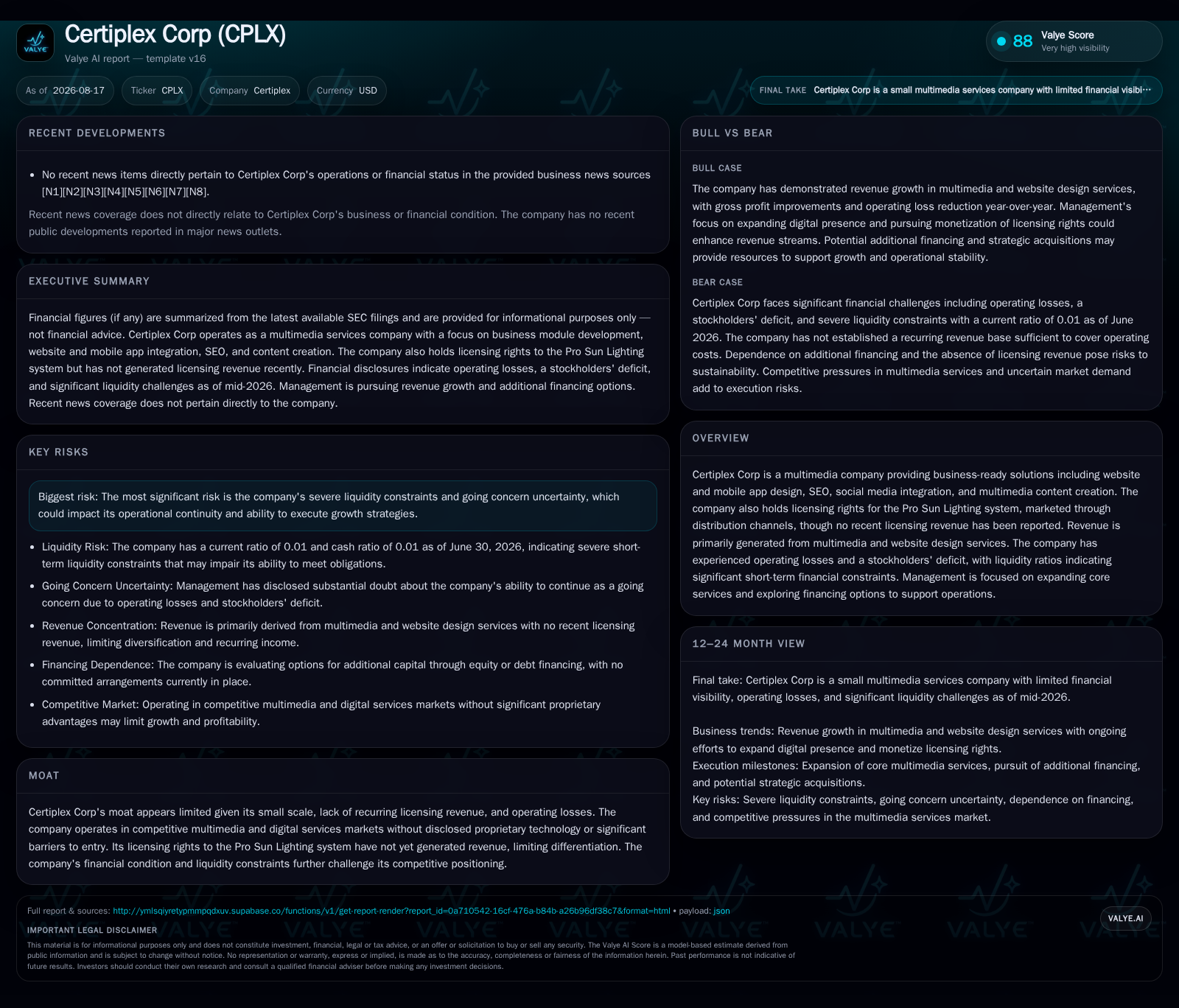
Certiplex Corporation remains reliant on revenue generated from project-based digital multimedia services such as website design, SEO, and mobile app integration, with no reported licensing income from its Pro Sun Lighting system. The company faces acute liquidity pressures, evidenced by an alarming current ratio near 0.01 as of June 2026 and a stockholders’ deficit sustained through ongoing operating losses. Operating expense escalation, especially in consulting and professional fees, offsets gross profit improvements from higher service revenues. Certiplex’s failure to establish recurring revenue streams amid a highly competitive digital services market challenges its ability to scale and raises substantial going concern risks. Management plans to pursue additional capital and strategic client growth but the lack of funding commitments and monetized licensing rights represent critical near-term hurdles.
With cash and equivalents at $1,621 against $194,234 in current liabilities at quarter-end, the company’s current ratio stands at approximately 0.01, indicating significant short-term liquidity constraints [F1]. Net debt is estimated near $48 million, based on total debt of about $49.7 million less cash reserves [F1]. This financial structure underscores the urgency for management to address liquidity and capital structure issues to sustain operations [F1].
Stalled Transition: The Reliance on Project-Based Digital Services
The core revenue engine powering Certiplex remains project-based fees tied to multimedia service offerings including website design, mobile app development integration, SEO consulting, social media content production, and business module development [S1][S8]. Revenues rose modestly to $143.8K for fiscal 2025 from $120.5K the prior year driven by incremental sales of these services [S8]. However, these revenues are predominantly one-off or short-duration project fees rather than stable recurring contracts or retainers that characterize more mature digital agencies providing ongoing SEO or marketing support services.
Licensing Rights Held but No Monetization Evident
Certiplex holds licensing rights for the Pro Sun Lighting system—a product focused on residential and commercial lighting solutions marketed through distribution channels [S1]. Despite owning these rights for several years, the company has not recognized any licensing revenue either in fiscal 2024 or 2025 [S1][S3]. This dormant status points to either ineffective commercialization efforts or structural barriers preventing monetization.
In digital multimedia or technology-focused peers possessing proprietary IP or licensed products, licensing income often supplements service revenues with higher-margin inflows enhancing profitability profiles. However, Certiplex’s inability to translate this license into tangible revenue underscores its limited strategic moat and heightens reliance on inherently volatile project-based services [S1][S3]. Absent clear pathways—such as partnering with established distributors or launching direct sales campaigns—the licensing asset currently represents unproductive capital consuming managerial focus without direct financial benefit.
Competitive Environment Undermining Pricing Power and Recurring Revenue
Operating in the broader Digital Multimedia and Web Services market places Certiplex amidst intense competition marked by minimal technological entry barriers and commoditized service components like website design and SEO optimization. Many small digital agencies struggle similarly to convert project work into steady retainer contracts while managing escalating operating costs.
Peers who successfully navigate these challenges often develop proprietary platforms or integrated service ecosystems that lock clients into multi-service retainers boosting both margins and cash flow stability—advantages currently out of reach for Certiplex given its present financial constraints.
Growth Drivers: Digital Content Demand Meets Financial Constraints
Fundamental tailwinds supporting the broader industry include rising importance of online presence for businesses driving demand for website development and SEO services; expanding mobile app adoption facilitating engagement channels; growth in e-commerce accelerating integrated marketing efforts; plus advances in richer multimedia content enabling differentiation online. Such trends theoretically position Certiplex’s service portfolio well for organic growth.
However, quandaries emerge as Certiplex’s resource scarcity—evidenced by dwindling liquidity—restricts ability to aggressively invest in client acquisition activities such as comprehensive SEO campaigns or outbound sales strategies mentioned by management plans [S3][S10]. Without adequate working capital or access to financing for scaling marketing expenditures or augmenting creative/technical staff utilization rates with training/capacity enhancement initiatives, capturing meaningful market share remains challenging.
Structural Risks: Operating Losses, Expense Trends, and Financing Uncertainty
Though operating losses narrowed slightly from $(56.2) million in 2024 to $(44.8) million in 2025 due to increased revenue-driven gross profits ($121.7K up from $98.4K), net losses remain substantial at $(47.3) million perpetuated by rising interest expenses linked principally to an SBA loan payable totaling nearly $2M interest annually [S1][F1]. The persistent gap between operating cash burn versus generated service fees creates mounting pressure on the capital structure.
Without success implementing cost controls—particularly reigning in consulting/professional fees—or materially expanding revenues via recurring streams or monetized licensing income the financial outlook deteriorates rapidly [S1][S2][S10]. Management acknowledges continuing evaluation of debt/equity financing avenues yet reports no firm commitments while stressing that failure to raise funds imminently threatens going concern status.
Upcoming Milestones: Financing Talks, Client Expansion, Licensing Potential
Key upcoming execution markers include efforts toward securing additional funding through equity offerings or debt extensions as vital lifelines enabling operation continuity beyond near-term horizons [S2][S3]. Monitoring management disclosures regarding firm financing commitments will be critical indicators regarding solvency improvements.
Concurrently growth prospects depend upon successful enlargement of client base through intensified digital marketing approaches—especially harnessing SEO optimizations paired with potential call center outreach cited within forward-looking statements [S3][S10]. Progress turning the Pro Sun Lighting licensing rights into active revenue streams would also represent materially positive developments but has yet to materialize despite long-held ownership [S3].
Failure across these vectors likely culminates in contractionary scenarios restricting Certiplex’s ability to escape its financially distressed state.
Financial Profile Discussion: Limited Cash Cushion Amid Heavy Liabilities
At June 30, 2026 balance sheet levels underscore the fragility of Certiplex’s financial position highlighted by cash reserves of only $1.6K dwarfed by nearly $195K current liabilities creating an urgent solvency imbalance reflected in the current ratio approximating a near-insolvency figure of ~0.01 [F1]
Total debt aggregated close to $49.7K further compounds leverage concerns relative to liquidity available resulting in roughly $48K net debt exposure absent significant asset liquidation options [F1]. Persistently negative operating cash flows reported historically amplify strain raising questions about execution feasibility for growth initiatives without swift recapitalization [S1][S2].
In sum, Certiplex must deliver on multiple fronts—including capital infusion, scaling recurring revenues beyond project dependency, cost containment especially among consulting/professional fees—and exploit its licensing asset if it is to traverse away from existential risk toward financial sustainability within a competitive multimedia service market landscape.
Disclaimer: This analysis is for informational purposes only based on publicly available SEC filings dated through August 17, 2026 and does not constitute investment advice.
Disclaimer: This is research-only, informational analysis and not investment advice. It may include AI-generated interpretation and general industry context. Always verify important details using primary sources.

Comments