
Dreamland Ltd’s Strategic Shift to Direct IP Licensing and Investment Intensifies Margin Pressure
Latest quarterly filings reveal CEO insider share transactions amid ongoing transition to IP-backed event investments.
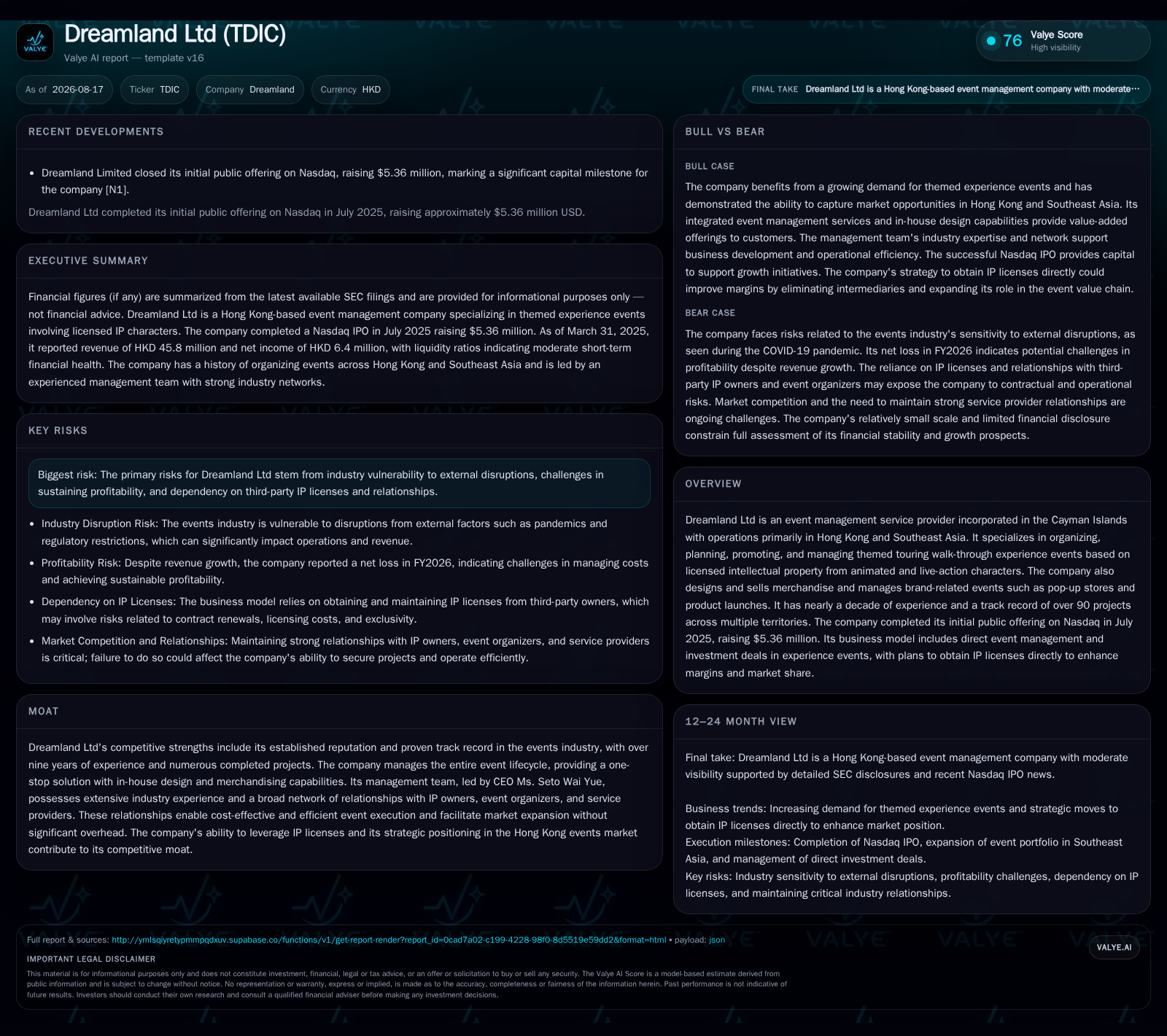
Dreamland Ltd, a Hong Kong-based event management company specializing in themed walk-through experience events, has recently intensified its strategic pivot towards acquiring direct intellectual property (IP) licenses and investing in event projects alongside partners. The CEO’s recent substantial purchase of shares underscores management's confidence despite deepening net losses driven by expanded investments and impairment charges. While revenue growth remains steady, margin pressure increased amid escalating professional fees and share-based compensation following its Nasdaq listing. The company’s ability to convert its nine-year track record into sustainable profitability hinges on securing proprietary IP rights and managing investment returns amid a competitive and economically sensitive regional events market.
Recent Operating Update: Insider Buying Amid Strategic Transitions
Dreamland Ltd’s latest interim disclosures reveal significant insider share transactions by CEO Ms. Seto Wai Yue during mid-2026. On August 6, she acquired 320,000 Class A ordinary shares from Imperial Vision Fund SPC Series 1 SP at US$3.75 per share for aggregate consideration of $1.2 million [S2]. This transaction lifted her beneficial ownership among Class A shares from approximately 22% to over 31%. Earlier, on July 7, the company completed a related-party private placement where Ms. Seto subscribed for a combined total of 652,000 ordinary shares raising $2.4 million in gross proceeds [S3]. These capital infusions underscore management’s conviction amidst ongoing monetary needs to fund the firm’s strategic pivot.
A series of reverse stock splits (1-for-5 in April; then 1-for-25 in June) were executed to cure Nasdaq listing bid-price deficiencies detected early in the year. Regulatory compliance was restored by May through the first split; the second aimed at sustaining investor confidence going forward [S7][S15]. This illustrates external market pressures unrelated directly to core operations but critical for public market access.
Business Model: Full Event Lifecycle Management With Emerging Direct IP Ownership
Dreamland operates predominantly as an experiential event management service provider focused on themed touring walk-through experiences licensed from well-known animated or live-action intellectual properties (IPs) [S1][S18]. Their core offering encompasses end-to-end event lifecycle oversight—concept planning, licensing negotiations with IP owners, venue coordination, on-site execution, promotion, ticketing facilitation, merchandising design/sales including food/beverage concessions—and brand activations like pop-up retail or product launch events.
Revenue generation is multifaceted: primary inflows come via service fees earned from contractually managing events for customers who are mainly event organizers or enterprises seeking brand engagement opportunities [S1]. Merchandise sales complement this by supplying custom-made IP goods created expressly for each event along with licensed merchandise sourced from third parties [S18]. Additionally, sponsorship commissions embedded within certain arrangements contribute further revenue streams.
Since fiscal year ended March 2025, Dreamland has transitioned into an investment role involving direct capital injection into select event projects alongside partners under binding profit-sharing agreements. These investments are accounted at cost less impairments due to limited market comparables and expected completion within one year classify them as current assets [S1]. This shift aims to enhance margin capture by participating more fully in event economics beyond service fees but simultaneously introduces volatility through share-of-loss risk exposure.
Industry Context and Competitive Positioning
Within the vibrant yet fragmented Asia-Pacific experiential events market—including Hong Kong where Dreamland is headquartered—the company occupies a niche specializing in licensed character-driven immersive experiences that have grown popular post-pandemic as consumers seek engaging leisure activities.
Peers include global entertainment conglomerates with thematic event divisions such as Live Nation Entertainment who operate multi-genre large-scale events but usually lack focused IP-invested touring attractions contextually analogous to Dreamland’s offerings. Regional competitors span other bespoke event management firms coupled with IP licensing entities targeting franchise activation campaigns.
Dreamland’s integrated model—managing both the complex logistics and creative merchandising under one roof—provides operational control advantages facilitating cost efficiencies and customer retention through quality consistency. Its networked relationships with prominent IP owners remain central facilitating access contingent on license renewal terms—a known vulnerability given industry dependence.
Growth Drivers: Immersive Event Demand and IP Licensing Expansion
Demand for immersive branded experiences continues expanding driven by rising consumer appetite for entertainment beyond traditional media consumption formats post-COVID normalization.
Growth factors include:
- Geographic expansion into Southeast Asian markets poised for experiential economic growth,
- Rising corporate marketing budgets increasingly allocated toward experiential brand activations,
- Advances in interactive technologies such as green-screen photo capture enhancing event appeal,
- Strategic push to obtain direct licenses mitigating margin leakage inherent in sub-license deals,
- Expansion into merchandising leveraging higher-margin merchandise with controlled design/manufacturing processes,
- Post-pandemic rebound facilitating higher footfall opportunities relative to pandemic-constrained years.
These drivers collectively support potential scaling while emphasizing sustained IP relations management effectiveness.
Risks and Constraints: Profitability Pressure Amid Capital Intensity and Concentration Risks
Profitability remains challenged by several structural pressures:
- Significant impairment charges recorded against investment stakes held in underperforming event projects contributed materially to net loss rising sharply to HK$74 million in FY2026 versus a modest profit previously [S1], highlighting financial risk embedded in this newer business line.
- Substantial legal/professional fees and share-based compensation related costs following Nasdaq IPO weigh heavily on operating expense ratios weakening margin profile.
- Concentration risk arises with three customers generating more than 10% of revenue each plus reliance on similarly concentrated vendors accounting for significant proportions of merchandise or facilitation expenses; disrupting any one relationship could trigger disproportionate operational impacts [S19][S21].
- External economic conditions within Hong Kong/Asia influence discretionary spending patterns affecting event attendance rates; downturns may sharply compress top-line volumes impacting variable margin flows.
- Dependence on timely renewal/continuity of third-party IP licenses limits long-term visibility as failure or delay could disrupt project pipelines affecting revenue predictability.
- Elevated staff costs must be managed carefully without corresponding revenue jumps else margin erosion will intensify further.[S1]
- Event cancellation/postponement risks persist given residual public health sensitivities or regulatory variables intrinsic to large gatherings.
What To Watch Next
Investors should focus on:
- Announcements regarding acquisition or renewal of direct IP licenses which would signal enhanced control and potential margin expansion opportunities;
- Quarterly disclosures detailing performance of invested event projects—realized gains/losses—to gauge financial discipline within new investment strategy;
- Management commentary about customer/vendor diversification efforts addressing concentration risks;
- Revenue growth trends post-pandemic recovery cycle indicating resiliency of experiential demand;
- Operating expense controls especially linked to professional fees and share-based compensation impacts;
- Cash flow dynamics reflecting working capital efficiency given sizable receivables balances noted;
- Any future equity or debt financing plans implied by increasing capital expenditure commitments or liquidity requirements;
- Progress updates on AI-powered technology collaboration aimed at enriching digital infrastructure supporting event operations announced during May 2026 [S7][S18];
- Market reception reflected by trading activity post-reverse splits impacting public float stability.
Financial Profile Discussion
Financing activities have included proceeds from multiple related-party private placements notably involving CEO participation that injected over $4 million during mid-2026 supported by previous shareholder/subscriber commitments ensuring runway extension amid heavy investment outflows evident from cash flow usage patterns[S2][S3][S13]. Despite these capital infusions, growing finance costs relating to borrowing activity have risen reflecting incremental leverage taken on potentially to fund expansion strategies [S10][S11].
Looking ahead profitability depends critically on containing impairments related to new ventures quickly turning investments profitable along with disciplined cost control measures balancing promotional efforts required for sustained market penetration against fixed overhead pushes.
This analysis synthesizes disclosed SEC filings focusing on latest quarterly developments augmented by annual filing context alongside sector knowledge frameworks tailored specifically for Dreamland Ltd’s business model nuances within the experiential themed event space.Exchange rates assumed stable as per IFRS reporting currency disclosures.Readers should consider operational cadence volatility inherent within the event services industry before extrapolation beyond stated facts.
Disclaimer: This is research-only, informational analysis and not investment advice. It may include AI-generated interpretation and general industry context. Always verify important details using primary sources.

Comments