
Reitar Logtech’s Strategic Spin-Off and Partnership Aim to Refine Focus Amid Financial Challenges
Recent filings highlight Reitar Logtech's restructuring via a spin-off and new collaborations in smart warehousing, while the company faces liquidity constraints and sustained losses.
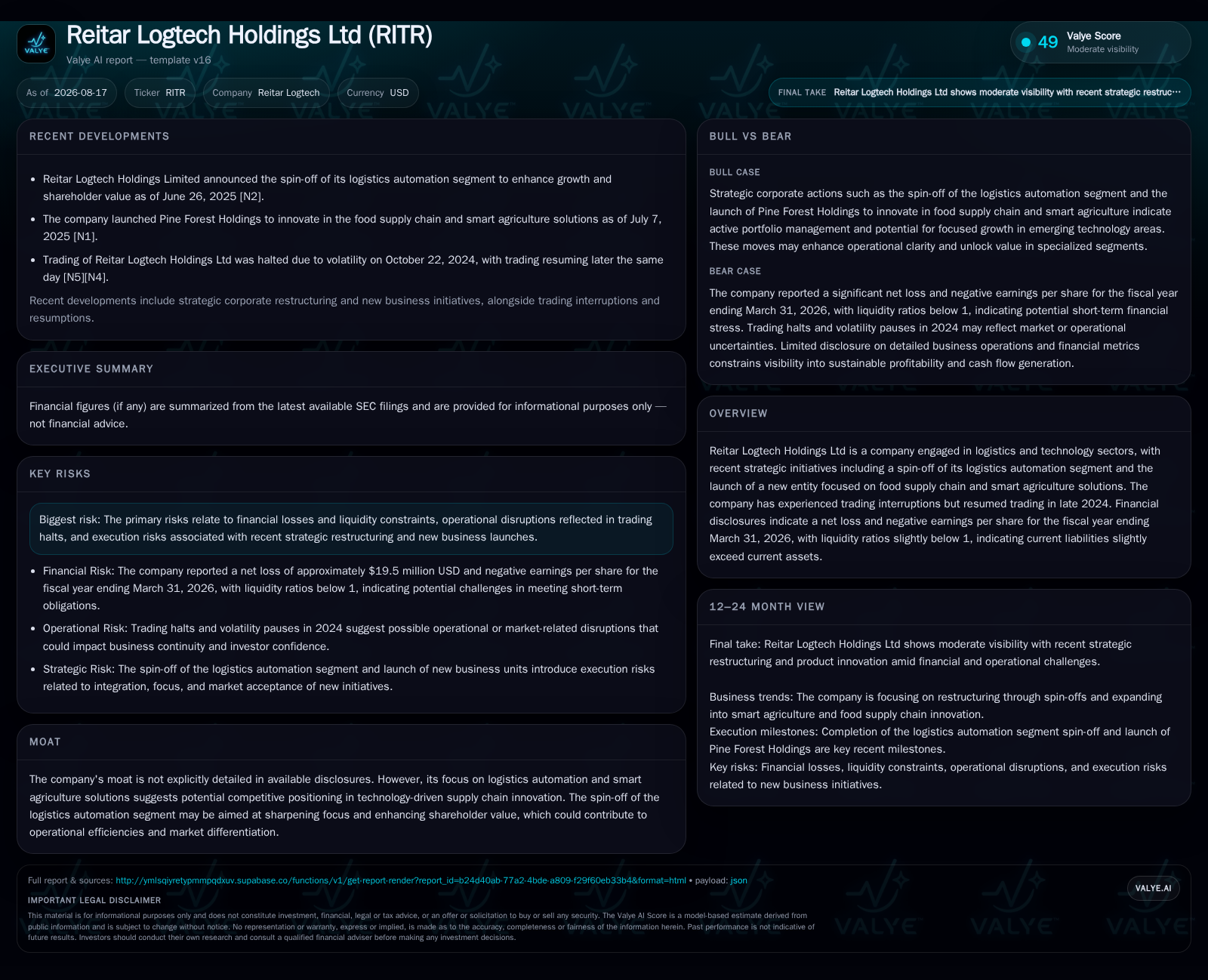
Reitar Logtech Holdings Ltd has embarked on a strategic restructuring by spinning off its logistics automation segment into an independent entity, signaling an effort to sharpen operational focus and enhance shareholder value. Concurrently, the company has initiated a strategic cooperation with Cainiao Group to scale its smart warehousing and automated logistics solutions globally. Despite these initiatives, Reitar reports ongoing financial pressures including net losses and a current ratio below unity, underscoring liquidity strains. The firm's future will hinge on successful execution of its strategic refocus, realization of recurring revenue streams from technology deployments, and managing risks inherent to complex logistics technology integration.
Recent Operating Update
In its most recent filings dated August 2026 ([S2], [S3], [S9]), Reitar Logtech Holdings Ltd disclosed pivotal developments that shape its near-term trajectory. Foremost is the decision to spin off its logistics automation segment into an independent business — a move designed to concentrate management focus and potentially unlock shareholder value by allowing each entity to pursue clearer strategic agendas. This restructuring aligns with industry trends where technology-driven logistics providers streamline operations to deepen innovation within specialized units.
Accompanying this spin-off is a strategic cooperation agreement signed with Cainiao Group aimed at expanding Reitar’s smart warehousing and automated logistics solutions internationally ([S3], [S9]). Cainiao’s scale as a logistics operator could accelerate deployment rates of Reitar’s technologies — from warehouse management systems (WMS) integrated with Internet of Things (IoT) sensors to robotic process automation (RPA) for order fulfillment — positioning the firm better during intensifying competition.
Business Model Overview
Reitar operates at the intersection of logistics technology and supply chain services, delivering integrated solutions that blend hardware automation installations with software platforms for supply chain visibility and efficiency optimization. Revenue streams derive primarily from project-based contracts — particularly construction management and engineering design services recognized via a percentage-of-completion accounting method — alongside service fees for technology consulting and anticipated recurring revenues from software-as-a-service (SaaS) subscriptions ([S1]).
The company’s portfolio encompasses smart warehousing systems that leverage data analytics coupled with digital twins for inventory optimization; transportation management systems (TMS); last-mile delivery enhancements; as well as emerging exposure to smart agriculture supply chain technologies responding to increasing demands for traceability and sustainability within food logistics ([S1], sector knowledge).
This multi-pronged offering targets customers ranging from e-commerce enterprises craving last-mile efficiencies to food supply chain operators requiring granular control over perishables. Monetization involves upfront capital expenditure contracts for hardware installation plus ongoing subscription or licensing fees for cloud-based management platforms — an archetypical hybrid model within logistics tech firms striving for improved revenue visibility.
Industry Structure and Competitive Position
Within the competitive landscape, Reitar situates itself against larger established players such as Zebra Technologies (specializing in asset tracking hardware), Manhattan Associates (enterprise supply chain software), and J.B. Hunt’s tech-enabled logistics services arm (). Unlike pure-play SaaS vendors like Blue Yonder that emphasize software subscriptions with high gross margins, Reitar balances capital-intensive automation hardware deployment with software offerings.
Capital intensity poses both opportunity and risk; upfront investments in R&D plus physical automation equipment require substantial cash outlays but can create switching costs once integrated into customer operations — imparting potential moat characteristics if execution is flawless. However, legacy system integration complexities and evolving technology standards present persistent hurdles. The firm's engagement in newly spun-off entities also signals attempts to sharpen focus but adds short-term uncertainty during transition phases.
Growth Drivers
Several structural factors underpin growth prospects:
- Supply Chain Digitization Demand: Increasing pressure across industries to enhance transparency, speed, and cost-efficiency fosters appetite for IoT-enabled warehouse management platforms.
- E-commerce Expansion: Rapid growth in omni-channel retailing amplifies volume complexity necessitating smarter order fulfillment technologies.
- Smart Agriculture Solutions: Emerging regulatory demands for food traceability drive adoption of specialized technology in agricultural supply chains.
- Strategic Partnerships: Collaborations like that with Cainiao Group provide distribution scale advantages critical in deploying automated logistics systems globally ([S3],[S9]).
- Technological Advancements: Progress in AI-driven analytics and robotic process automation fuels continuous product innovation capabilities.
KPIs such as contract backlog growth, system deployment rates, recurring revenue accumulation from platform users, customer retention rates, and realized client cost savings would serve as leading indicators confirming successful scaling.
Risks and Constraints
Reitar faces multiple risks symptomatic of its industry placement:
Monitoring progress on spin-off completion milestones, effectiveness of collaboration terms with partners like Cainiao Group, contract acquisition velocity, order fulfillment project completions, and improvements in internal audit processes will be critical watchpoints.
What to Watch Next
Key near-term indicators include:
- Formal completion and operational separation timeline for the logistics automation spin-off entity. - Expansion pace of contract backlog underpinned by strategic partner network deployments. - Shift towards higher software recurring revenue mix validating SaaS monetization strategy. - Enhancements in liquidity metrics or capital raising initiatives addressing working capital gaps. - Announcements regarding customer wins involving new smart agriculture or automated warehouse projects. - Updates on internal control remediation efforts addressing prior deficiencies noted by auditors [S1]
Disclaimer: This analysis is based solely on publicly available SEC filings and related documents as cited. It aims to provide an informed examination without making investment research views or forecasts.
Disclaimer: This is research-only, informational analysis and not investment advice. It may include AI-generated interpretation and general industry context. Always verify important details using primary sources.

Comments