
ITHAX Acquisition Corp III’s Capital Readiness Highlights SPAC Deal Timing Uncertainty
The latest quarterly filing reveals robust liquidity and full IPO proceeds held in trust, yet the absence of a business combination underscores execution risks inherent to SPACs.
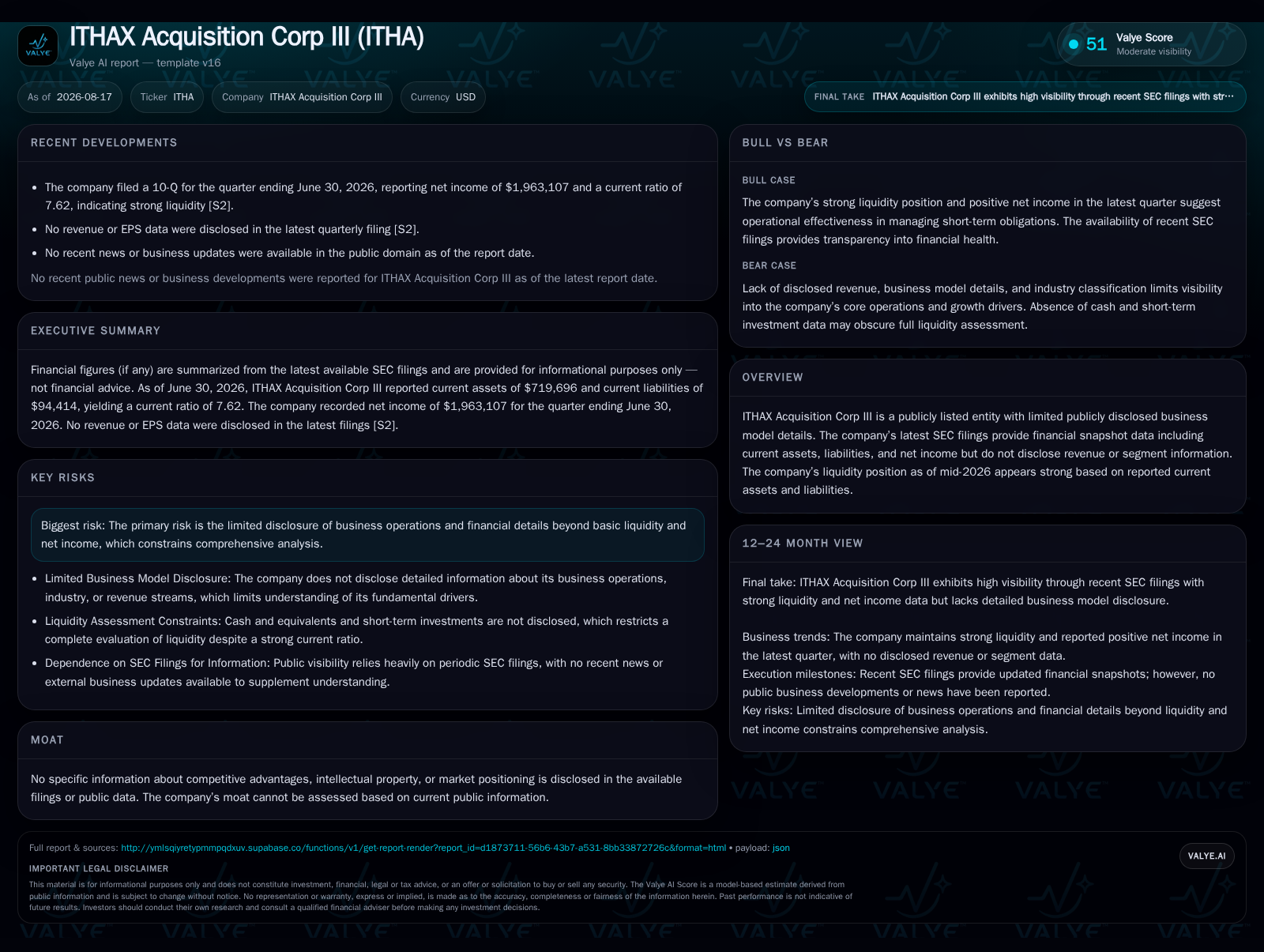
ITHAX Acquisition Corp III remains well-capitalized with a strong current ratio of 7.6 as of mid-2026, supported by $719.7 million in current assets predominantly held in trust accounts. Despite this financial strength, no update or announcement regarding a business combination—the critical path for value realization in a SPAC—has been disclosed, leaving shareholder returns contingent on uncertain deal timing and redemption behaviors. The company’s capital structure, featuring units composed of Class A shares and redeemable warrants, follows typical SPAC frameworks, while sponsor private placement warrants align incentives toward deal closure but may introduce dilution. Key industry benchmarks place ITHA's $230 million IPO proceeds at a moderate scale relative to peers, with standard underwriting terms. Investors must weigh the comfort of ample liquidity against common execution risks like delayed transactions, shareholder redemptions, and regulatory uncertainties.
Latest Quarterly Update Confirms Robust Capital Base but No Business Combination Yet
ITHAX Acquisition Corp III’s most recent quarterly filing dated August 13, 2026 reveals that the company maintains a substantial balance sheet characterized by approximately $719.7 million in current assets compared to $94.4 million in current liabilities, resulting in an exceptionally strong current ratio near 7.6 [F1], [S2]. This liquidity is primarily concentrated in the U.S.-based trust account established at JPMorgan Chase Bank per IPO agreements where gross proceeds from the December 2025 offering were deposited along with proceeds from private placement warrants totaling $230 million total capital raised before expenses [S16]. Critically, no operating revenues or segment breakdowns appear given the entity’s nature as a SPAC shell vehicle pre-business combination; accordingly, the latest data confirms operating income remains negative and minimal in magnitude consistent with administrative expense accruals typical of non-operating public shell companies [F1].
Absence of any disclosed business combination updates or target announcements through Q2 2026 emphasizes that value realization remains contingent on successful M&A execution events ahead—a not uncommon scenario given typical SPAC timelines allow up to two years post-IPO for consummation without triggering wind-down provisions [S2], [S1]. Confirmatory signals indicating de-SPAC progress would include public filings noting signed term sheets, shareholder vote schedules on proposed mergers, or engagement announcements with PIPE investors.
SPAC Business Model Foundations: Capital Structure and Shareholder Rights Define Value Pathway
As detailed in SEC exhibits filed shortly after its IPO closing in December 2025, ITHAX raised its capital through an initial public offering consisting of 23 million units sold at $10 per unit including full exercise of an over-allotment option—the IPO was underwritten by Cantor Fitzgerald & Co. with customary underwriting fees detailed in subsequent agreements [S6], [S11]. Each unit bundles one Class A ordinary share along with half a redeemable warrant exercisable at $11.50 per share subject to adjustment mechanisms outlined in warrant agreements; such structuring aligns investor incentives toward share price appreciation post-deal completion while providing potential dilution from warrant exercises as warrants become valuable only if equity value exceeds exercise cost after merger completion.
In alignment with SPAC norms, gross proceeds (net of underwriters’ deferred discount) plus additional funds raised from private placement warrants sold exclusively to sponsors and representatives ($5.5 million) are held in trust accounts pending transaction outcomes; these funds generally remain inaccessible for operational deployment except tax payments on earned interest before an acquisition closes or wind-down occurs if no deal is closed within mandated timeframes [S16], [S17]. The sponsor holds private placement warrants purchased at nominal prices entitling them to incentivized equity stakes commonly referred to as "sponsor promote," which serve both as motivation to identify attractive acquisition targets and a source of dilution risk for public shareholders upon exercise.
Public shareholders retain redemption rights typically allowing them to redeem their shares at IPO price plus interest before consummation of any business combination if they disfavor the proposed transaction terms—an important check that safeguards investors but simultaneously heightens execution risk when high redemption rates reduce cash available for acquisition financing substantially impacting deal viability and valuation negotiations [S13], [S2].
Industry-Wide Benchmarks Frame ITHA’s IPO Scale and Sponsor Incentives Within the SPAC Market Context
Comparative analysis versus peer SPACs highlights that ITHAX’s $230 million capital raise positions it within an intermediate tier among recent SPAC offerings—neither one of the largest megadeals nor a small-scale vehicle—in line with sponsors deploying focused capital pools aimed at specific growth verticals rather than broad large-cap buyouts [S11]. Underwriting fees paid to Cantor Fitzgerald comply with prevalent fee compressions observed industrywide following heightened regulatory scrutiny over fee structures leading many underwriters to lower upfront discounts while increasing performance-based compensation contingent on deal success.
The sponsor’s promote percentage embedded via private placement warrants falls within standard ranges observed across active SPAC sponsors reflecting balanced incentive alignment—enough upside participation compared to public shareholders’ full investment return if merger conditions prove favorable without overwhelming dilution pre-merger [S17]. SEC filings emphasize that failure to consummate qualifying mergers within two years triggers mandatory liquidation return policies potentially curtailing shareholder upside unless charter amendments extend timelines under extraordinary circumstances—moves that require shareholder consent and can introduce legal complexities [S13], [S10].
Moreover, voluntary redemptions exercised by shareholders ahead of mergers reduce available cash resources allocated for acquisitions thereby forcing renegotiations or dependence on external PIPE financings which may dilute existing holders further or delay closing timetables significantly impacting momentum around de-SPAC transitions. Market volatility also influences warrant intrinsic values creating an oscillating perception of future upside beyond current stock prices complicating investor appetite during vote cycles.
Regulatory environments remain fluid; ongoing SEC initiatives focus on enhancing disclosure standards around sponsor conflicts and valuation methodologies that could increase operational costs or slow approval processes thus amplifying inherent franchise risks associated with Special Purpose Acquisition Companies pre-combination phase dynamics.
Growth Opportunities: Market Appetite and Sponsor Track Record Hold Potential Without Disclosure Clarity
Growth catalysts primarily derive from continued investor demand for alternative mechanisms enabling private companies rigidly positioned outside traditional SME IPO pathways to achieve public trading status efficiently through de-SPAC transactions rather than longer roadshow-driven listings subject to equity market fluctuations [S1]. Retail investor interest buoyed by SPAC structures combining access to startup growth exposure alongside warrant leverage effects sustains unit offering liquidity though cyclicality persists based on broader macroeconomic backdrops.
Sponsor team credentials evidenced by governance disclosures imply experienced management potentially capable of executing appropriately vetted acquisitions though absence of publicly revealed pipeline details prevents assessment on quality dimensions limiting predictive visibility currently available outside standard sector optimism tied mostly to aggregate market flows around special purpose acquisition vehicles.
Risks Around Redemption Behavior and Delayed Deal Execution Could Dampen Future Returns
Extensive SEC risk factor disclosures highlight multiple pressure points: mandatory timeline constraints demanding initial combination completion within prescribed windows directly influence urgency; shareholder voting outcomes modulated by perceived fairness of transaction terms affecting redemption ballots; evolving litigation landscape introducing reputational and financial vulnerabilities linked historically with certain aggressive market practices among some SPACs impairing confidence levels negatively impacting stock performances post-announcement stages; finally dilution caused by warrant conversions can depress net earnings per share prospects post-merger especially if priced inaccurately relative to target underlying fundamentals adversely affecting long-term investor returns absent tightly managed expectations frameworks [S2], [S13], [S4].
Cumulatively these elements create nuanced considerations whereby financial health alone cannot substitute for demonstrated transactional skill sets paired with transparent corporate communications critical for managing stakeholder perceptions during inherently speculative pre-combination phases particular to this asset class.
What to Watch for Clarity on ITHA's Acquisition Timeline, Shareholder Decisions, and PIPE Interest
Investors and analysts should monitor several key development milestones: timely announcements regarding binding agreements or letters of intent related to target acquisitions will be pivotal signposts validating strategic direction; scheduled shareholder meeting notifications concerning proposal approvals or charter amendments influencing redemption policy modifications will reflect governance dynamics shaping final deal structures; likewise presence or absence of PIPE investment commitments supplying supplemental acquisition capital might indicate robustness or fragility respectively underpinning transaction feasibility.
These checkpoints offer measurable events against which market participants can recalibrate expectations moving beyond speculative waiting periods towards fact-based valuation paradigms reflecting concrete transactional progress.[S1], [S2]
Financial Profile Discussion
Strong working capital ratios buttress confidence that requisite funds remain securely segregated ready for deployment contingent upon successful transactions preserving capital integrity vital within sector standards.[F1]
Disclaimer: This analysis is based exclusively on publicly available SEC filings as cited and general industry frameworks associated with Special Purpose Acquisition Companies (SPACs). It does not constitute investment advice but aims to provide an informed perspective on ITHAX Acquisition Corp III’s structural and financial positioning prior to any announced business combinations.
Disclaimer: This is research-only, informational analysis and not investment advice. It may include AI-generated interpretation and general industry context. Always verify important details using primary sources.

Comments